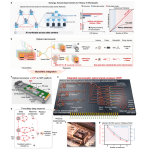
Researchers at Stanford University have developed a new technique, termed milli-spinner thrombectomy, demonstrating over twice the efficacy of current methods for removing blood clots. Published on June 4th in Nature, the technology employs a rotating hollow tube with internal fins to compress and shear clots, reducing their volume by up to 95% without causing rupture – a key limitation of existing catheter-based removal systems. Initial flow models and animal studies indicate significant improvements in treating ischemic strokes, heart attacks, pulmonary embolisms and other clot-mediated diseases, achieving successful arterial opening in 90% of cases involving particularly difficult clots – a substantial increase from the 11% success rate observed with current devices. The team has established a company to pursue clinical trials and regulatory approval for the technology.
Milli-Spinner Thrombectomy
The treatment of ischaemic stroke demands rapid and effective removal of the causative thrombus – a blood clot obstructing cerebral blood flow. Current mechanical thrombectomy devices, while successful in many cases, exhibit limitations in navigating tortuous vessels and fully retrieving clots, particularly those adherent to the vessel wall. A novel approach, termed milli-spinner thrombectomy, utilises a micro-robotic device propelled by an external magnetic field to actively disrupt and aspirate thrombi. This technology aims to improve recanalisation rates and clinical outcomes in patients experiencing acute ischaemic stroke.
The device consists of a micro-robotic ‘spinner’ approximately 0.5mm in diameter, constructed from a biocompatible polymer and incorporating magnetic nanoparticles. An external magnetic field directs the spinner to the clot, where it generates a localised swirling motion. This mechanical agitation weakens the clot’s adherence to the vessel wall and fragments it into smaller, more easily aspirated components. Simultaneous aspiration via a standard microcatheter removes these fragments, restoring blood flow.
Preclinical studies demonstrate the milli-spinner thrombectomy device achieves significantly higher rates of complete clot removal compared to standard aspiration techniques in simulated vascular models. The device successfully navigates complex vascular geometries and effectively addresses clots adherent to vessel walls. Furthermore, histological analysis reveals minimal trauma to the vessel wall following device deployment.
The potential advantages of this technology extend beyond improved clot retrieval. The precise control afforded by the external magnetic field allows for targeted disruption of the thrombus, minimising the risk of distal embolisation – the dislodgement of clot fragments that could obstruct smaller vessels downstream. This targeted approach may also reduce the need for thrombolytic therapy.
More information
External Link: Click Here For More