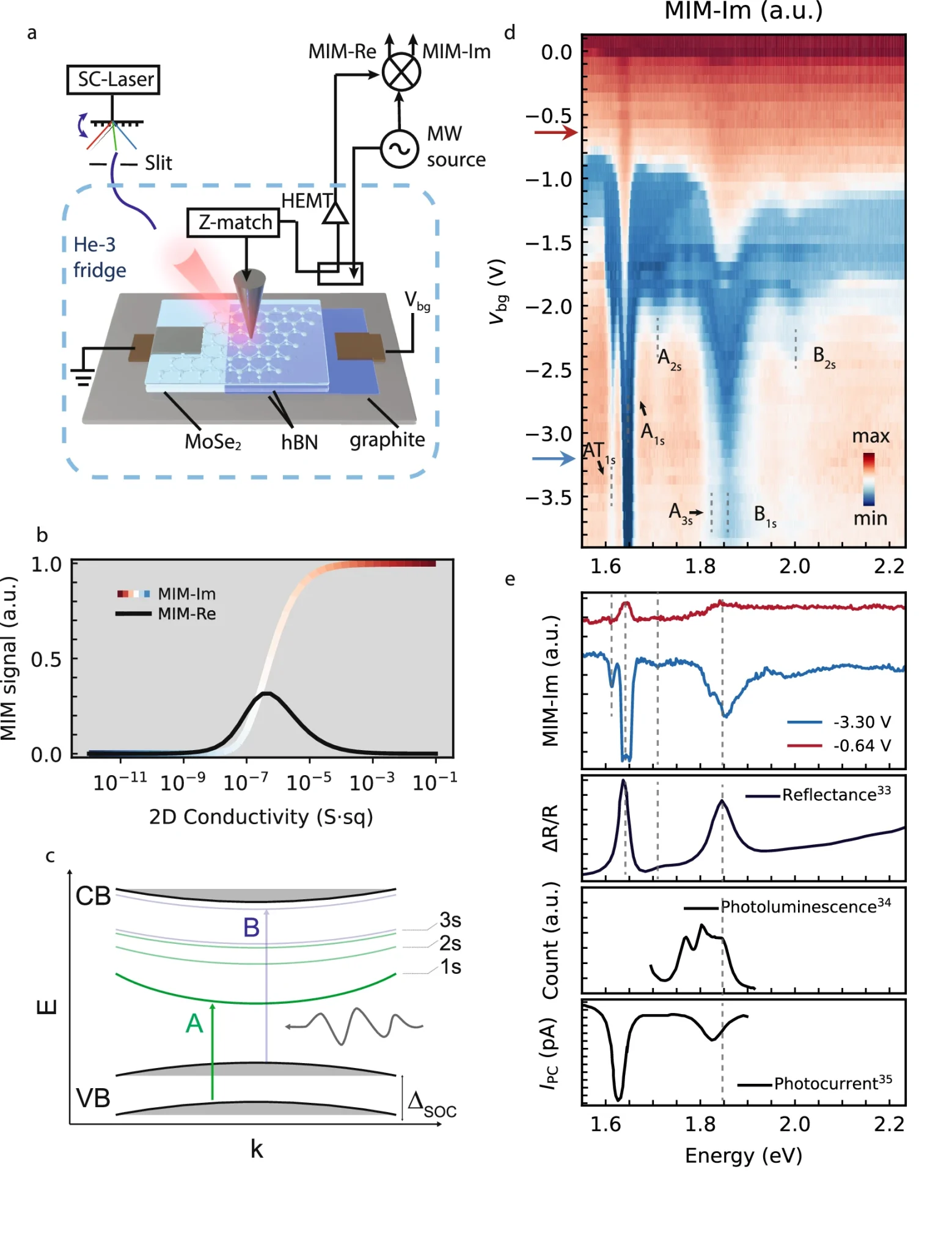
The Stanford University research team achieved a breakthrough in exciton mapping by successfully performing local exciton mapping at 1.5K temperatures using their novel cryogenic scanning probe technique. The team, led by Zhurun Ji and Zhixun Shen, developed exciton-resonant microwave impedance microscopy (ER-MIM), enabling precise measurement of excitonic responses in monolayer MoSe2 devices. This advancement reveals critical insights into exciton-environment interactions, paving the way for next-generation quantum technologies. Their work establishes ER-MIM as a powerful optoelectronic sensing platform, with applications ranging from quantum computing to nanoscale electrometry.
Exploring Exciton-Polaron Interactions at Cryogenic Temperatures
Researchers at Stanford University, led by Zhixun Shen, have developed a novel cryogenic scanning probe technique called exciton-resonant microwave impedance microscopy (ER-MIM) to measure excitonic responses in atomically thin materials locally. This technique allows for the observation of exciton polarons , and their Rydberg states , within a monolayer of MoSe2 at extremely low temperatures of 1.5K. By utilising microwave signals, the team successfully identified and characterised these quasiparticles, offering a new pathway for understanding their behaviour at the nanoscale.
Building on this initial observation, the Stanford group systematically investigated the impact of carrier density, inhomogeneous electric fields, and dielectric screening on these excitons. Their experiments reveal both local and nonlocal effects, going beyond the capabilities of conventional probing methods. The ER-MIM technique allows for precise extraction of electrical parameters surrounding excitons, effectively demonstrating exciton-assisted nanoscale electrometry. This detailed analysis provides valuable insight into the complex interactions between excitons and their surrounding environment.
These findings establish ER-MIM as a powerful optoelectronic sensing platform with significant implications for quantum technologies. According to Zhurun Ji and colleagues, the ability to precisely map and understand exciton-environment interactions opens avenues for exciton-based quantum control and the development of novel device technologies. Discrete energy levels within excitons, similar to those used in qubits, suggest potential applications in quantum computing and communication, furthering the pursuit of nanoscale quantum sensing mechanisms.
Advancing Nanoscale Electrometry with Exciton-Resonant Microwave Imaging
Building on these observations, researchers at Stanford, including Zhurun Ji and Benjamin E. Feldman, demonstrated the power of exciton-resonant microwave impedance microscopy (ER-MIM) for nanoscale electrometry. The technique allows for precise mapping of the electrical environment surrounding excitons within a monolayer MoSe2 device, revealing both local and nonlocal effects previously inaccessible with conventional probes. Specifically, the team identified how carrier density and inhomogeneous electric fields influence exciton behavior, providing a detailed picture of charge distribution at the nanoscale. This level of spatial resolution is crucial for understanding and controlling exciton-based devices.
The ER-MIM technique, operating at 1.5K, relies on measuring changes in microwave signals to characterize exciton responses. According to the research, integrating deep learning techniques enabled the precise extraction of electrical parameters surrounding these excitons. This data allows scientists to quantify the dielectric screening effects on excitons, revealing how the surrounding material influences their energy and behavior. Furthermore, the team successfully mapped Rydberg states of exciton polarons, offering insights into their extended electronic structure and interactions.
These advancements in nanoscale electrometry have significant implications for future quantum technologies. According to Thomas P. Devereaux, the ability to precisely map the electrical environment around excitons opens avenues for exciton-based quantum control and device fabrication. By understanding and manipulating these interactions, researchers can potentially develop novel quantum sensors and devices with enhanced performance. This work establishes ER-MIM as a powerful optoelectronic sensing platform, paving the way for exploring new functionalities in atomically thin materials and beyond.
This development could enable more precise characterization of nanoscale materials and devices, moving beyond the limitations of conventional probes. The Stanford team’s exciton-resonant microwave impedance microscopy (ER-MIM) offers a new pathway to understand exciton-environment interactions at cryogenic temperatures.
The implications extend beyond fundamental research to industries reliant on advanced material science and nanotechnology. By precisely extracting electrical parameters surrounding excitons, as demonstrated by Shen and colleagues, ER-MIM establishes a powerful optoelectronic technique. This quantified nanoscale electrometry could facilitate the design of next-generation devices with enhanced performance and functionality.