

Determining the most effective ways to measure quantum systems presents a significant challenge, particularly when experiments impose limitations on how those measurements can be made. Jia-Xuan Liu from the Hefei National Research Center for Physical Sciences at the Microscale, and colleagues, now demonstrate a new approach to achieving optimal precision in quantum estimation using only local measurements. The team establishes a clear criterion for schemes to reach the fundamental limit of measurement accuracy, and reveals that certain quantum states, known as graph states, naturally lend themselves to highly accurate local estimation determined by their underlying structure. Importantly, this research identifies families of states that not only maximise precision but also exhibit resilience to noise and even offer a degree of noise correction, outperforming commonly used states under realistic conditions, and thus represents a substantial advance in the development of robust and practical quantum technologies.
A central challenge in quantum metrology involves identifying optimal protocols under realistic measurement constraints, such as performing only local measurements on multipartite systems. This work presents a sufficient criterion for achieving the best possible estimation precision, known as saturating the quantum Cramér-Rao bound, using local measurements. In ideal scenarios, the research demonstrates that graph states consistently admit local estimation protocols with precision determined solely by the underlying graph structure.
Optimal Estimation with Local Measurements Only
Researchers developed a new methodology for optimizing quantum estimation protocols, particularly when experimental constraints limit measurement possibilities. The approach focuses on identifying protocols that achieve the best possible precision within these limitations, crucial because many quantum technologies are restricted by the ability to perform complex, multi-qubit operations. The core of the method leverages the mathematical framework of stabilizer formalism to establish sufficient conditions for optimal performance. This allows researchers to systematically identify probe states, the initial quantum states used for estimation, that can saturate the Cramér-Rao bound, a fundamental limit on estimation precision.
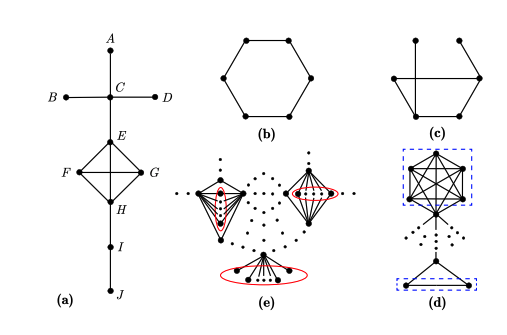
The team demonstrates that graph states, a specific type of multi-qubit entangled state, naturally lend themselves to these optimal local estimation protocols, with the precision directly determined by the underlying graph structure. A key innovation lies in identifying specific subspaces of graph states that not only achieve optimal precision but also exhibit resilience to noise and even the potential for noise correction before the parameter being estimated is encoded. This is achieved by carefully analyzing the relationships between vertices within the graph state, categorizing them based on their connections, and utilizing these relationships to construct robust measurement protocols. By starting with a stabilizer, a symmetry property of the quantum state, researchers can construct local Hamiltonians and measurements that guarantee optimal performance, simplifying experimental requirements. This offers a significant advancement, providing a robust trade-off between estimation precision and tolerance to noise, crucial for realizing practical quantum technologies.
Graph States Achieve Optimal Measurement Precision
Researchers have made significant advances in quantum metrology, developing new methods to achieve highly precise measurements of physical parameters. A central challenge is to design measurement protocols that perform optimally under realistic experimental constraints, particularly when only local measurements on individual components of a quantum system are possible. This work introduces a new criterion, based on the mathematical concept of stabilizers, to determine when local measurements can achieve the best possible precision, known as saturating the Cramér-Rao bound. The team demonstrates that graph states, a class of entangled quantum states, universally satisfy this criterion, meaning they can be used to achieve optimal precision simply by tailoring the structure of the graph, providing a powerful framework for designing high-precision sensors.
Importantly, the research extends beyond ideal conditions to address the impact of noise, a major obstacle in real-world quantum experiments. They identified specific subspaces of quantum states that not only maintain optimal precision despite noise but also exhibit enhanced robustness and even the potential for noise correction before the parameter being measured is encoded. These subspaces offer a significant improvement over existing approaches, such as using Greenberger-Horne-Zeilinger states, particularly when subjected to dephasing noise, a common type of quantum degradation. The core of this advancement lies in the efficient utilization of stabilizers, which connect precision, noise resilience, and optimal measurement strategies. This work lays the foundation for identifying the best quantum resources for local measurement-based metrology and provides a quantitative understanding of the relationship between precision and noise tolerance, paving the way for more robust and accurate quantum sensors.
Local Measurements Achieve Robust Precision Estimation
This work identifies a series of multi-qubit probe states that achieve high precision in parameter estimation through local measurements, while also demonstrating resilience to noise. Researchers established sufficient criteria for local measurements to satisfy the Cramér-Rao bound, a fundamental limit on estimation precision, and developed optimal schemes for both ideal and noisy environments. Stabilizer states are shown to be a versatile quantum resource within the framework of local measurement-based quantum metrology, offering both enhanced precision and reference templates for optimal measurements. The study demonstrates that these states maintain approximately invariant precision even in the presence of noise, and outperform other noise-resilient states, such as Greenberger-Horne-Zeilinger states, particularly for larger system sizes.
🗞 Optimal Quantum Estimation with Stabilizer-Based Local Measurements
🧠 ArXiv: https://arxiv.org/abs/2508.07150


