Scientists are pioneering a new approach to gravitational wave detection, aiming to explore the largely uncharted high-frequency range between 10kHz and 100MHz. M. Wenskat, B. Giaccone, and J. Branlard, alongside colleagues V. Chouhan, C. Dokuyucu, and L. Fischer, detail their work on utilising superconducting radiofrequency (SRF) cavities to identify minute harmonic distortions caused by gravitational waves , distortions that alter electromagnetic field behaviour within the cavity. This research, conducted collaboratively at DESY and the SQMS Center at Fermilab, is significant because current detectors like LIGO and Virgo cannot probe this higher frequency spectrum, potentially revealing new astrophysical sources and phenomena. The team’s successful warm and cold commissioning of a prototype cavity, originally built for the MAGO collaboration, represents a crucial step towards realising a novel gravitational wave observatory capable of pushing beyond existing technological boundaries.
High-frequency Gravitational waves with SRF cavities
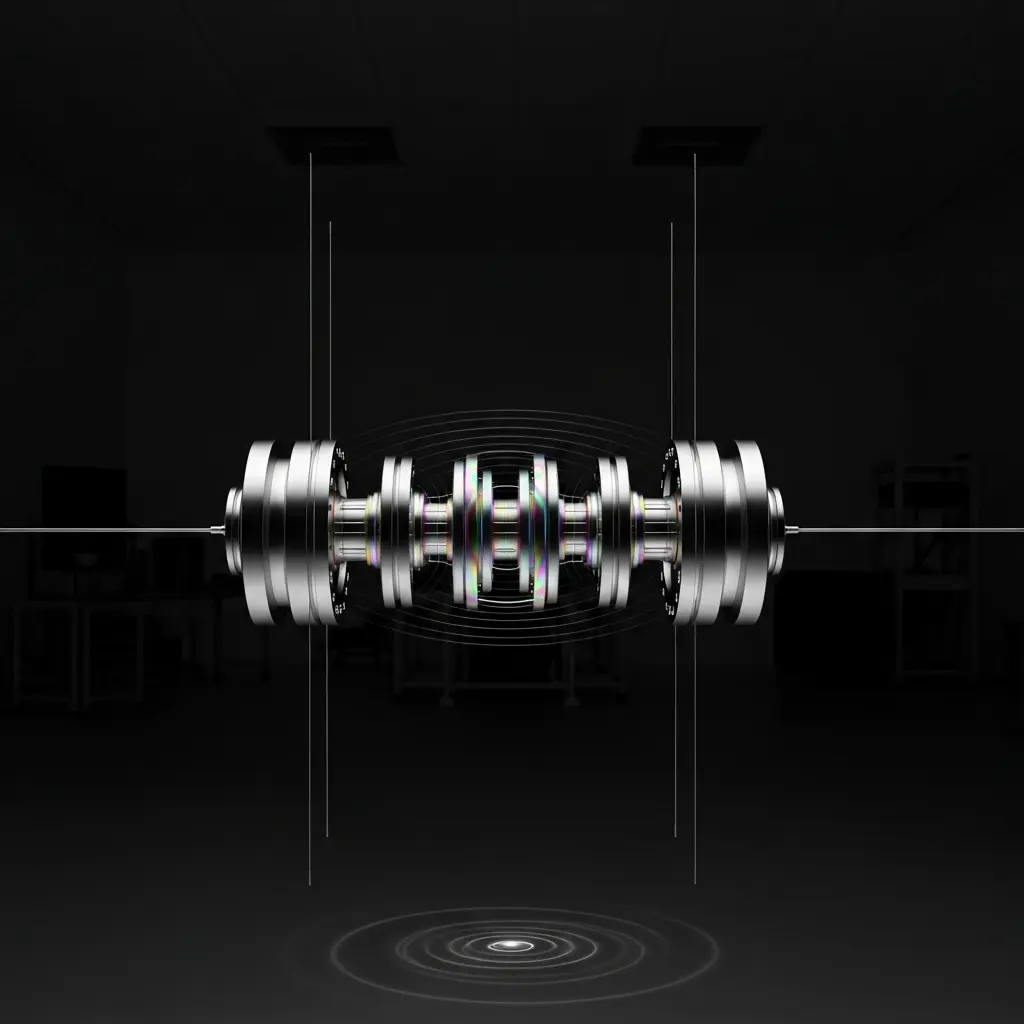
This work focuses on the challenging environmental requirements and the necessary research and development to operate the SRF cavity with unprecedented precision. The study unveils a novel detection concept where electromagnetic cavities act as resonant bars, employing electromagnetic eigenmodes as mechanical-to-EM transducers, analogous to traditional Weber bars but utilising an LC circuit for signal conversion. By configuring a resonator with two nearly degenerate modes and injecting RF power into only one, the researchers aim to detect power transfer to the quiet mode when a gravitational wave induces a deformation of the cavity walls, a process known as Heterodyne detection. Experiments show that this approach, initially proposed in the 1970s by Pegoraro et al and Caves, leverages the mechanical interaction between gravitational waves and the cavity walls.
The research establishes that even minuscule harmonic displacements, on the order of 10−17cm, are potentially detectable using a superconducting parametric converter. The current investigation builds upon the MAGO proposal, which aimed for a scaled-up experiment with 500MHz cavities, and utilises a spherical 2-cell cavity, designated PACO-2GHz-variable, with a tunable coupling cell to manipulate the frequency difference between the two modes. Detailed geometric surveys, employing a Hexagon MetrologyTM7-axis portable measuring arm and RS6-Laserscanner, revealed significant deviations from the nominal cavity geometry, including a toroidal dent and bending of the coupling cell. Furthermore, ultrasonic wall thickness measurements indicated non-uniformity, with average thicknesses of (1.84 ±0.05) mm for cell 1 and (1.89 ±0.05) mm for cell 2, and variations of up to 100μm. The work opens exciting possibilities for gravitational wave astronomy at higher frequencies, potentially revealing signals from previously inaccessible sources and complementing the discoveries made by LIGO and Virgo. This innovative technology could also find applications in other areas requiring high-precision measurements of mechanical deformation and electromagnetic fields.
Superconducting Cavities Detect High-Frequency Gravitational Waves with unprecedented
Scientists are pioneering a new approach to gravitational wave (GW) detection, focusing on the largely unexplored frequency range between 10kHz and 100MHz. Crucially, the cavity operates within a cryostat maintained at 1.8 K, a temperature achieved through advanced seismic noise mitigation techniques to isolate the sensitive instrument from external vibrations. The study harnessed this ultra-low temperature environment to enhance the cavity’s responsiveness to subtle gravitational wave signals. The warm and cold commissioning process involved rigorous electromagnetic characterisation of the SRF cavity, ensuring optimal performance and stability before initiating GW searches.
Scientists developed a precise measurement protocol to quantify the cavity’s response to simulated GW events, establishing a baseline for future data analysis. This innovative technique relies on detecting changes in the resonant frequency of the cavity, which are directly correlated to the strain induced by passing gravitational waves.
Revived SRF cavity detects gravitational wave shifts
Scientists have successfully revived a 20-year-old superconducting radiofrequency (SRF) cavity to search for high-frequency gravitational waves (GWs) in the 10kHz to 100MHz range. Experiments revealed a frequency shift of 200kHz achieved through the removal of 4-6μm of inner surface material, resulting in a sensitivity of 40kHz/μm, a value comparable to simulation predictions of 20kHz/μm. Subsequent tuning steps increased the eigenfrequency of cell 1 by +1.2MHz, followed by a +200kHz adjustment to cell 2. Stability assessments, conducted over 10 days with over 44 measurement steps, showed small frequency variations attributable to daily temperature fluctuations in the RF laboratory.
Measurements of the uncoupled system indicated a frequency difference between the cells of only 4-7kHz at room temperature. Following tuning, the cavity underwent RF cold tests at Fermilab, revealing a splitting of the broad TE011 peak into two distinct peaks separated by approximately 11kHz below the superconducting transition, aligning with the designed value. The cavity exhibited high Q factors for both symmetric and antisymmetric modes, mirroring the performance of a previous MAGO prototype. The symmetric mode quenched at 1.3 J, while the antisymmetric mode was limited by phase-locked loop (PLL) instability due to the proximity of the two modes within the PLL bandwidth.
Further tests at DESY demonstrated the LLRF system’s ability to track frequency changes caused by pressure variations, maintaining resonance despite a peak-to-peak pressure drift of nearly 18 mbar and a corresponding frequency shift of up to 700Hz for the 0-mode. This yielded a pressure sensitivity of 42.8Hz/mbar, confirming the successful implementation of the cavity control algorithm. Environmental conditions and operational challenges were carefully managed, including the development of a low-level RF system with unprecedented accuracy and resolutions, as well as a seismic noise mitigated cryostat at 1.8 K. The findings establish that achieving the desired sensitivity requires precise control over the manufacturing process, particularly in ensuring the similarity of eigenfrequencies between coupled cells. The significance of this work lies in its potential to fill a critical gap in GW detection by exploring frequencies above those currently accessible with LIGO/Virgo. This could lead to new insights into astrophysical phenomena and the nature of gravity itself. However, the authors acknowledge that further research is necessary to fully realize the cavity’s potential. Future directions include refining surface treatment methods for SRF cavities and developing more sophisticated tuning strategies. The project also underscores the need for specialized facilities capable of handling unique geometries and precise temperature control during heat treatments. Overall, this research represents a crucial step towards establishing a new generation of GW detectors that can explore previously uncharted frequency ranges.
👉 More information
🗞 Detection of high-frequency gravitational waves using SRF cavities
🧠 ArXiv: https://arxiv.org/abs/2601.18719