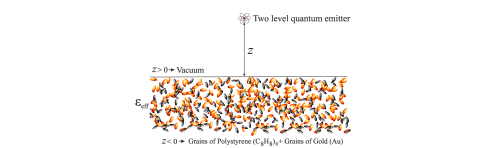
Research demonstrates manipulation of spontaneous emission, a process where excited atoms release photons, via engineered electromagnetic environments. Calculations utilising techniques like Green’s function formalism reveal how materials and boundaries alter local field modes and the density of states, impacting emission rates and enabling advances in nanophotonics and material science.
The behaviour of light emitted by atoms and molecules, specifically spontaneous emission and its modification via the Purcell effect, remains a central topic in modern physics with implications for nanoscale technologies and material science. These phenomena, rooted in the interaction between quantum emitters and their electromagnetic environment, dictate the efficiency and characteristics of light sources at the smallest scales. Researchers from Universidade Federal do Rio de Janeiro and Universidade Federal Fluminense, namely P. P. Abrantes, D. Szilard, and C. Farina, explore these interactions in detail within a chapter of the proceedings from the III International Workshop on Nonstationary Systems. Their work, entitled “Spontaneous emission and Purcell effect: some aspects”, provides a theoretical overview and analysis of spontaneous emission, the Purcell effect, and contemporary methods for manipulating these processes through engineered materials and environments.
Researchers investigate spontaneous emission (SE), a fundamental process where an excited atom or molecule emits a photon without external stimulation, and the Purcell effect, which describes the modification of this emission rate due to the surrounding electromagnetic environment. This exploration resides at the intersection of electrodynamics, the study of electromagnetism, and quantum electrodynamics (QED), the quantum theory of light and matter. Understanding these phenomena allows for precise control over radiative processes, with implications for diverse technologies.
The rate of spontaneous emission is not intrinsic to the emitter itself, but is profoundly influenced by the local electromagnetic environment. The Purcell effect quantifies this influence, stating that the emission rate is proportional to the local density of states (LDOS), a measure of the number of electromagnetic modes available for the photon to occupy. Canonical examples illustrate this principle; an emitter positioned near a perfectly conducting plate experiences an enhanced emission rate due to the increased LDOS created by the reflective surface. Conversely, placing an emitter within a resonant cavity, a structure designed to trap electromagnetic waves, can dramatically alter the LDOS and, consequently, the emission rate.
Modern strategies focus on engineering these electromagnetic environments at the nanoscale to tailor spontaneous emission. Plasmonic cloaks, utilising the collective oscillation of electrons in metals (plasmons), manipulate electromagnetic fields, offering a means to enhance or suppress emission. Composite metamaterials, artificially structured materials exhibiting properties not found in nature, provide further control over the LDOS. Researchers also investigate phase transitions in materials, such as metal-insulator transitions, which dynamically alter electromagnetic properties, and strain-induced modulation in two-dimensional materials like phosphorene, where mechanical stress modifies the electronic structure and optical response.
Analytical techniques, including mode summation and Green’s function formalism, are crucial for rigorously describing these complex scenarios. Mode summation decomposes the electromagnetic field into a superposition of individual modes, allowing detailed analysis of each mode’s contribution to the overall emission rate. The Green’s function formalism provides a powerful mathematical tool for solving electromagnetic problems in complex geometries, effectively calculating the electromagnetic field response to a given source. Through these methods, scientists demonstrate how surrounding materials and boundary conditions fundamentally affect local field modes and the LDOS, dictating the rate of spontaneous emission.
Phosphorene, a single-layer form of phosphorus, presents a particularly promising avenue for controlling spontaneous emission. Its electronic and optical properties are highly tunable through mechanical strain. Applying strain alters the material’s band structure, the range of energies electrons are allowed to occupy, and consequently modifies its interaction with light. This allows for precise tuning of the spontaneous emission rate of emitters embedded in or near phosphorene, offering a pathway to dynamically controllable optical devices.
Bridging the gap between theoretical modelling and experimental validation is paramount. Researchers meticulously compare theoretical predictions with experimental results, refining their models and deepening their understanding of the underlying physics. This iterative process ensures that theoretical insights are grounded in real-world observations and that experimental findings are accurately interpreted.
The ability to control spontaneous emission rates through material selection and environmental engineering holds significant potential for creating advanced optical devices and sensors. Applications range from highly sensitive biosensors, capable of detecting minute biological signals, to advanced imaging systems with improved resolution and contrast.
Ultimately, researchers envision a future where spontaneous emission can be precisely controlled and harnessed for a wide range of applications, including highly efficient lighting and displays, advanced sensors, and secure communication systems. Continued exploration of the fundamental principles governing light-matter interactions promises to unlock new possibilities and drive innovation across multiple scientific and technological fields.
👉 More information
🗞 Spontaneous emission and Purcell effect: some aspects
🧠 DOI: https://doi.org/10.48550/arXiv.2506.10210