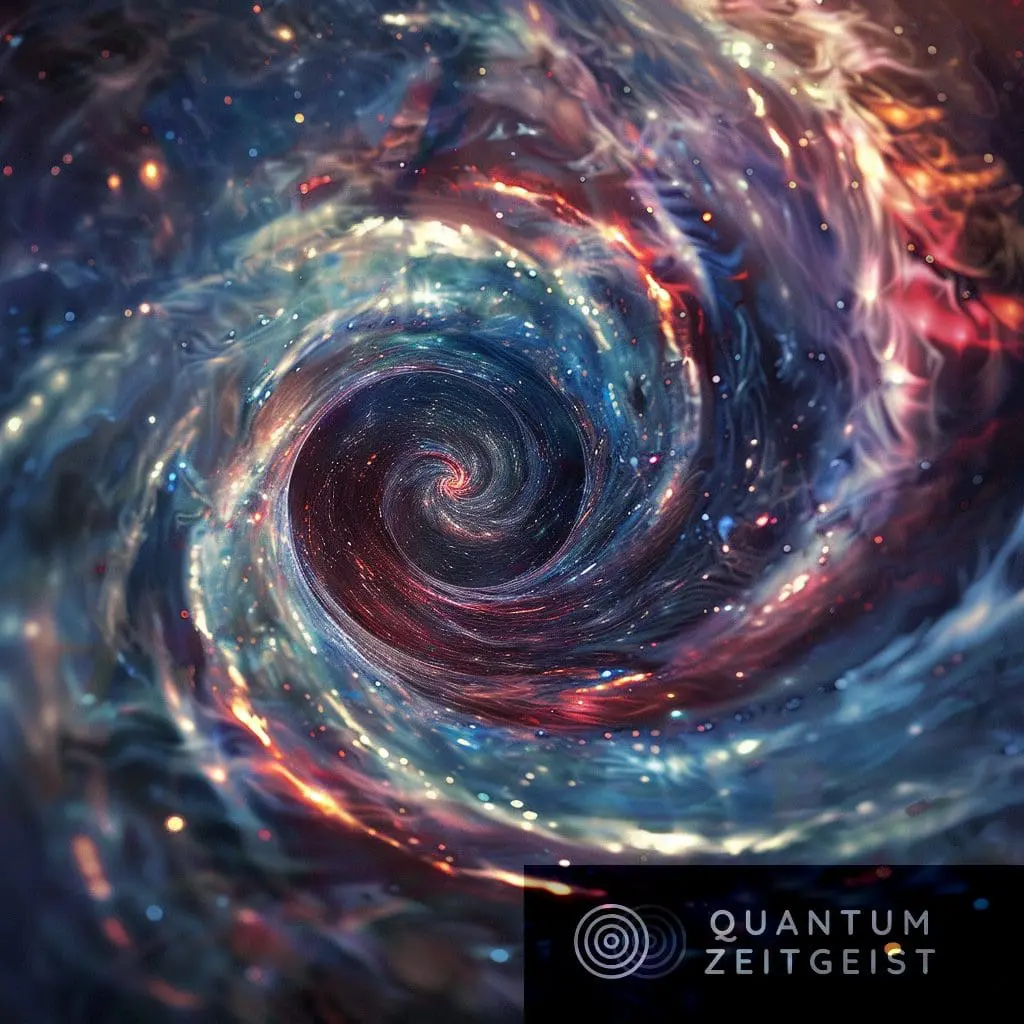
The Spiral Multiverse Theory, proposed by computer engineer Tejas Shinde, challenges the conventional Big Bang theory by suggesting a continuous spiral pattern universe originating from a single point, or singularity. This theory posits that each universe begins with its own bang, forming a network of interconnected universes expanding in a spiral shape. The theory introduces the concept of interdimensional quasars as portals for multiverse travel and suggests each universe undergoes its own inflation without observable changes in the cosmic microwave background. This new perspective on cosmic evolution could open up new avenues for scientific exploration and understanding.
What is the Spiral Multiverse Theory?
The Spiral Multiverse Theory, proposed by Tejas Shinde, a computer engineer, suggests a continuous spiral pattern universe originating from a single point, known as a singularity. This theory challenges the conventional Big Bang theory, which posits a singular explosive origin for the universe. Instead, the Spiral Multiverse Theory proposes that each universe begins with its own bang, forming a network of interconnected universes. This network, or multiverse, expands in a spiral shape, with the width and length of the arms expanding as the universe expands. The point where all universes connect is referred to as the Everyverse.
The Spiral Multiverse Theory offers a fresh perspective on cosmic evolution and presents a potential path for practical research. It introduces the concept of interdimensional quasars as portals for multiverse travel. The theory also suggests that each universe undergoes its own inflation without observable changes in the cosmic microwave background, a remnant radiation from the Big Bang.
How Does the Spiral Multiverse Theory Compare to Other Multiverse Theories?
Several existing theories aim to explain the existence of the multiverse. The Brane Multiverse theory, for instance, suggests that the universe is made up of multiple membranes stacked on top of one another to create a larger multiverse. The Quilted Universe theory posits that the universe is infinite, and everything that happens in such a vast area of space will inevitably happen an infinite number of times. The Simulation Universe theory claims that we live not in the real physical world, but in a simulation. The Ultimate Multiverse hypothesis suggests that every possible universe variation exists, each with its own unique set of the known laws of physics. Lastly, the Quantum Universe Hypothesis explains the existence of multiple universes as a result of an endless number of alternative outcomes.
The Spiral Multiverse Theory differs from these theories in its proposition of a continuous repeating pattern of spiral-shaped blasts from a singular point. Unlike the disconnected bubble universe proposed by other theories, the Spiral Multiverse Theory suggests a connection among all universes at the point of singularity blast, forming a network.
What is the Theoretical Framework of the Spiral Multiverse Theory?
The Spiral Multiverse Theory posits that before 13.8 billion years, there was nothing – no space and time, just a vacuum that was not truly empty. This vacuum experienced fluctuations, involving the temporary creation of virtual particles and antiparticles. These fluctuations reached a critical point in the vacuum, leading to an energetic surge. This surge resulted in an extremely dense and hot state with zero volume, known as a Singularity.
The Singularity did not explode or expand its complete dense state at first expansion. Instead, it underwent a continuous expansion, or multiple big bangs (multi-bang), forming space and time at the speed of light. This expansion was also spinning, forming a spiral pattern. Each expansion underwent its own inflation to form spiral-shaped universes, each resulting in the same or different set of physical laws or constants. The universe was full of unattached electric charges and glowed. During inflation, while spinning, survived matter and antimatter get randomly distributed.
How Does the Spiral Multiverse Theory Impact Our Understanding of the Universe?
The Spiral Multiverse Theory significantly impacts our understanding of the universe’s origin. It challenges the conventional Big Bang theory and the concept of cosmic nothingness. It suggests the existence of pre-existing space with distinct singularities for each universe. This theory also offers a fresh viewpoint on cosmic evolution and a possible path for practical research by presenting the idea of interdimensional quasars as portals for multiverse travel.
The Spiral Multiverse Theory also explores the unique characteristics of the multi-bang process. It suggests that each universe undergoes its own inflation without observable changes in the cosmic microwave background. This theory, therefore, provides a new perspective on the universe’s formation and evolution, potentially opening up new avenues for scientific exploration and understanding.
What are the Implications of the Spiral Multiverse Theory for Future Research?
The Spiral Multiverse Theory presents a potential path for practical research. It introduces the concept of interdimensional quasars as portals for multiverse travel. This could open up new avenues for exploration and understanding of the universe. The theory also suggests that each universe undergoes its own inflation without observable changes in the cosmic microwave background. This could have significant implications for our understanding of the universe’s formation and evolution.
Furthermore, the Spiral Multiverse Theory’s proposition of a continuous repeating pattern of spiral-shaped blasts from a singular point could provide a new framework for studying the universe. This could lead to new insights into the nature of the universe and potentially revolutionize our understanding of cosmology. The theory’s suggestion of a connection among all universes at the point of singularity blast could also provide a new perspective on the structure and interconnectedness of the multiverse.
Publication Date: 2024-03-31
Authors: Tejas Shinde
Source: International Journal for Research in Applied Science and Engineering Technology
DOI: https://doi.org/10.22214/ijraset.2024.58697