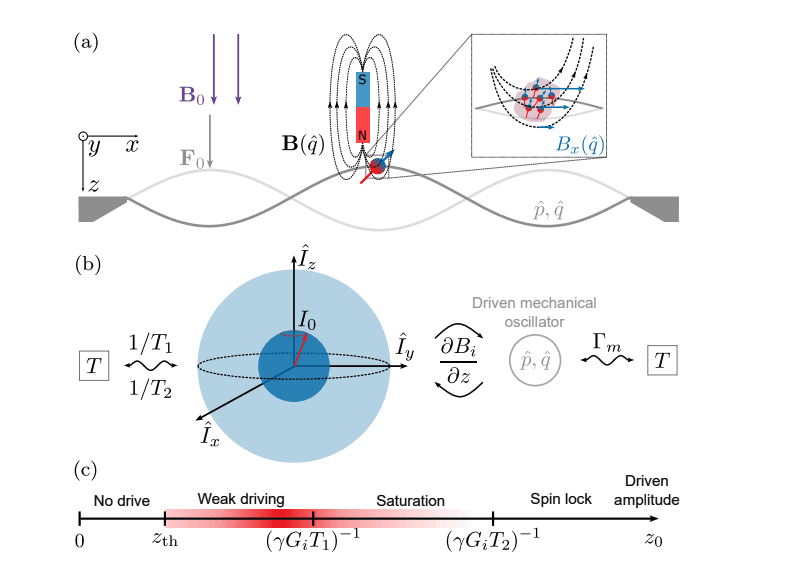
The detection and control of individual nuclear spins represents a significant challenge in fields ranging from materials science to biomedicine, and researchers are continually seeking more sensitive methods to achieve this. Diego A. Visani, Letizia Catalini, and Christian L. Degen, along with colleagues at ETH Z ̈urich and the Institute for Theoretical Physics, now demonstrate a novel approach utilising megahertz mechanical resonators to detect nuclear spins through subtle changes in the resonator’s frequency. The team reveals that, rather than attempting to measure the small average shift in frequency caused by nuclear spin polarisation, it is possible to detect the fluctuating polarisation of an ensemble of spins by measuring an increase in the resonator’s frequency variance. This innovative technique, supported by both analytical modelling and numerical simulations, predicts the potential for detecting single nuclear spins with currently available resonator technology, opening new avenues for nanoscale investigations.
Theoretical Condensed Matter Physics and the Condensed Matter Physics Center, Universidad Autónoma de Madrid, Spain, investigate how tiny mechanical resonators can be used to explore the quantum world. These resonators, vibrating at megahertz frequencies, possess properties that make them ideal for both fundamental research and sensitive force measurements. This work proposes a method for detecting, and ultimately controlling, individual nuclear spins by linking them to these resonators through a magnetic field gradient. The interaction between the sensor and a collection of nuclear spins creates a shift in the sensor’s behavior.
Nanomechanical Resonators and Ground State Cooling
Researchers are increasingly utilizing nanomechanical resonators as powerful tools for exploring the quantum realm. These tiny vibrating structures offer exceptional sensitivity and control, making them valuable for a wide range of experiments. Studies have focused on understanding the fundamental properties of these resonators, including their behavior at extremely low temperatures where quantum effects become dominant. Investigations into optomechanics, which combines mechanical and optical systems, have revealed new ways to manipulate and control these resonators, enhancing their capabilities for quantum sensing and information processing. Theoretical models and simulations play a crucial role in understanding the complex dynamics of these systems and predicting their behavior under various conditions.
Single Nuclear Spins Detected via Resonators
Researchers have developed a novel method for detecting and potentially controlling individual nuclear spins using tiny mechanical resonators. These resonators, operating at megahertz frequencies, interact with the magnetic moments of nearby atomic nuclei, offering a new pathway for nanoscale magnetic resonance imaging and future quantum technologies. The team demonstrates that by carefully tuning the resonator’s frequency and monitoring subtle changes in its oscillation, it is possible to detect the influence of even a single fluctuating nuclear spin. Unlike traditional methods that rely on detecting the average polarization of many spins, this technique focuses on the fluctuations in polarization, which manifest as changes in the resonator’s frequency variance.
This is particularly advantageous when working with extremely small sample volumes where the average signal is weak and difficult to measure. The researchers predict that this variance measurement offers a significant improvement in sensitivity, potentially enabling the detection of single nuclear spins with existing resonator technology. Importantly, this method operates efficiently when the resonator is slightly detuned from the spin’s natural resonance frequency, simplifying the experimental setup. By mechanically driving the resonator, researchers envision the possibility of manipulating the nuclear spins themselves, potentially paving the way for new spin-based quantum devices. This ability to both sense and control nuclear spins with a mechanical system represents a significant step forward in the field of spin mechanics and offers exciting possibilities for future advancements in nanoscale imaging and quantum information processing.
Resonator Variance Detects Nuclear Spin Fluctuations
This research demonstrates a method for detecting nuclear spins by coupling them to megahertz mechanical resonators via a magnetic field gradient. The key finding is that fluctuations in the polarization of the nuclear spin ensemble cause a measurable increase in the resonator’s frequency variance, offering a pathway to single-spin detection using existing resonator technology. By focusing on these statistical polarization fluctuations, the approach simplifies experimental requirements and avoids the need for complex spin control mechanisms typically found in other magnetic resonance force microscopy techniques. The authors acknowledge that the sensitivity of this method is limited by thermomechanical and technical noise sources, but recent advances in resonator stability and calibration suggest that achieving the necessary precision is feasible. Future research directions include exploring the potential for coherently manipulating nuclear spins through mechanical driving and investigating spin cooling via backaction, potentially opening new avenues for nanoscale magnetic resonance imaging and quantum sensing. This work establishes a foundation for studying local spin dissipation, decoherence, and dipole-dipole interactions at the atomic scale, ultimately paving the way for a versatile platform for nuclear spin quantum sensing and control.
👉 More information
🗞 Near-resonant nuclear spin detection with megahertz mechanical resonators
🧠 ArXiv: https://arxiv.org/abs/2508.14754