The pursuit of novel magnetic materials has focused increasing attention on two-dimensional crystals, offering potential for innovative device applications, and researchers are now exploring the unique properties of the van der Waals material chromium sulfide bromide. Sergio M. Rezende from Universidade Federal de Pernambuco, Byron Freelon from University of Houston, and Roberto L. Rodríguez-Suárez from Pontificia Universidad Católica de Chile, led an investigation into the magnetic behaviour of this antiferromagnetic material, developing a comprehensive spin-wave theory that accounts for complex interactions within the crystal structure. This detailed model incorporates both interactions between layers and within them, as well as triaxial magnetic anisotropy, and successfully reproduces experimental data from antiferromagnetic resonance and inelastic neutron scattering. The resulting accurate determination of key material parameters promises to unlock a deeper understanding of this intriguing material and facilitate the prediction of its behaviour in future technologies.
CrSBr, 2D Magnetism and Semiconductor Properties
This collection of research papers focuses on CrSBr, a fascinating two-dimensional material combining semiconducting and magnetic properties, a rare and highly sought-after combination. The studies explore fundamental aspects of magnetism, spin waves, and materials science, revealing the potential of CrSBr for future technologies. This research establishes a strong foundation for understanding this material and related compounds. Scientists meticulously investigate the magnetic order within CrSBr, which is primarily antiferromagnetic, and how easily the magnetization can be controlled through magnetic anisotropy.
They also study various types of excitations, including spin waves, lattice vibrations, and electron-hole pairs, alongside the electronic and optical properties crucial for device applications. Researchers explore how properties change with layer number, a key aspect of two-dimensional materials, and methods to control magnetism using external stimuli like electric fields, strain, and light. This research delves into magnonics, a field utilizing spin waves to carry and process information, and develops methods to control and manipulate these waves within CrSBr. Theoretical calculations and simulations underpin the experimental work, providing insights into the underlying physics and predicting material behavior. This work on CrSBr and other 2D magnetic materials is driven by the potential for revolutionary applications in spintronics, magnonics, quantum computing, sensors, data storage, and next-generation electronics.
CrSBr Antiferromagnetism via Spin-Wave Theory and AFMR
Scientists developed a comprehensive theoretical framework and conducted detailed experiments to understand the antiferromagnetic behavior of CrSBr. They pioneered a full spin-wave theory, accounting for multiple intralayer and interlayer magnetic interactions, alongside triaxial magnetic anisotropy, to model the complex magnetic ordering within the material. This theoretical model enabled precise calculations of various properties, laying the groundwork for interpreting experimental data and revealing subtle magnetic interactions. To validate the theoretical model, researchers performed detailed antiferromagnetic resonance measurements and inelastic neutron scattering experiments, probing the material’s response to magnetic fields and characterizing spin dynamics.
By fitting the theoretical predictions to both sets of data, scientists determined reliable values for all seven interaction parameters governing the magnetic behavior of CrSBr. The research team harnessed these precisely determined parameters to calculate other crucial properties, extending the understanding beyond the initial measurements and providing a comprehensive characterization of the material’s magnetic landscape. The combination of advanced theoretical modeling and precise experimental techniques represents a significant achievement in understanding two-dimensional magnetism and opens avenues for exploring novel spintronic devices.
CrSBr Exhibits Ferromagnetic and Antiferromagnetic Ordering
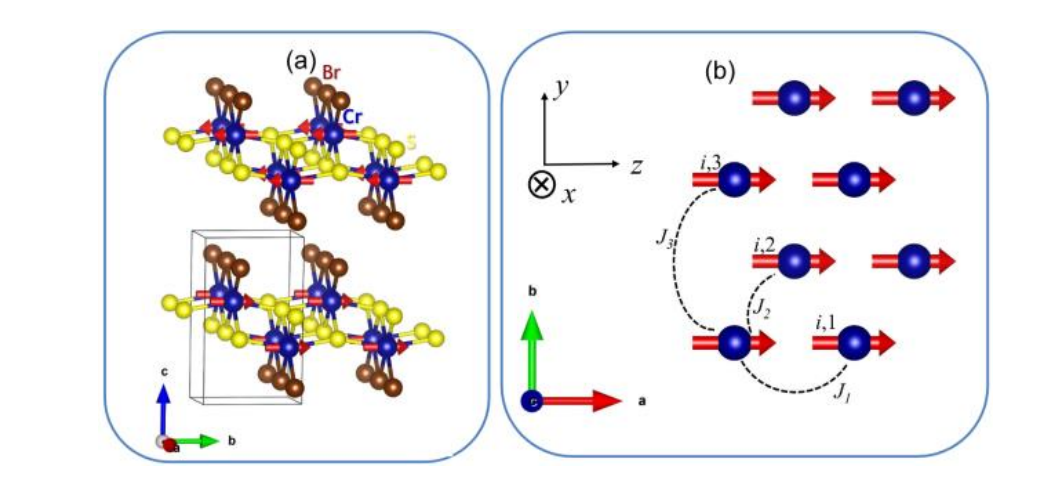
Scientists developed a comprehensive quantum spin-wave theory to understand the magnetic behavior of CrSBr, a magnetic semiconductor notable for its air stability and deformability. This work builds upon previous investigations using inelastic neutron scattering and antiferromagnetic resonance techniques, meticulously modeling the material’s structure and accounting for three ferromagnetic intralayer exchange interactions and one antiferromagnetic interlayer interaction, alongside triaxial magnetic anisotropy. The research establishes that CrSBr undergoes a ferromagnetic phase transition at 146 Kelvin, followed by antiferromagnetic ordering below 132 Kelvin, resulting in an A-type antiferromagnetic arrangement along the c-axis. The developed theory accurately describes the magnetic excitations within CrSBr, enabling the determination of seven key interaction parameters that govern its magnetic properties.
Measurements confirm the accuracy of the theoretical model through fitting to experimental data obtained from antiferromagnetic resonance and inelastic neutron scattering. The team successfully quantified the strength of the three intralayer ferromagnetic exchange interactions and the single interlayer antiferromagnetic interaction, providing a detailed understanding of the magnetic landscape within CrSBr. This detailed characterization is crucial for exploring potential applications in spintronic devices and for further investigation of the material’s unique magnetic properties. The findings deliver a robust framework for predicting and controlling the magnetic behavior of CrSBr, paving the way for the development of novel magnetic materials and devices.
Chromium Sulfide Bromide Magnetism Fully Characterized
This research presents a comprehensive spin-wave theory developed to model the magnetic behavior of the two-dimensional van der Waals crystal, chromium sulfide bromide. By considering both intralayer and interlayer magnetic interactions, alongside triaxial magnetic anisotropy, scientists accurately calculated magnon dispersion relations, essentially, how magnetic excitations propagate through the material. The team successfully fitted their theoretical results to experimental data obtained from antiferromagnetic resonance measurements and inelastic neutron scattering, yielding reliable values for seven key interaction parameters that govern the material’s magnetic properties. These findings represent a significant advance in understanding the fundamental magnetism of this interesting material and provide a foundation for further exploration of its potential applications. The accurately determined interaction parameters will be valuable for future investigations into related materials and the design of novel spintronic devices.
🗞 Spin wave theory for the triaxial magnetic anisotropy 2D van der Waals antiferromagnet CrSBr
🧠 ArXiv: https://arxiv.org/abs/2510.06006