

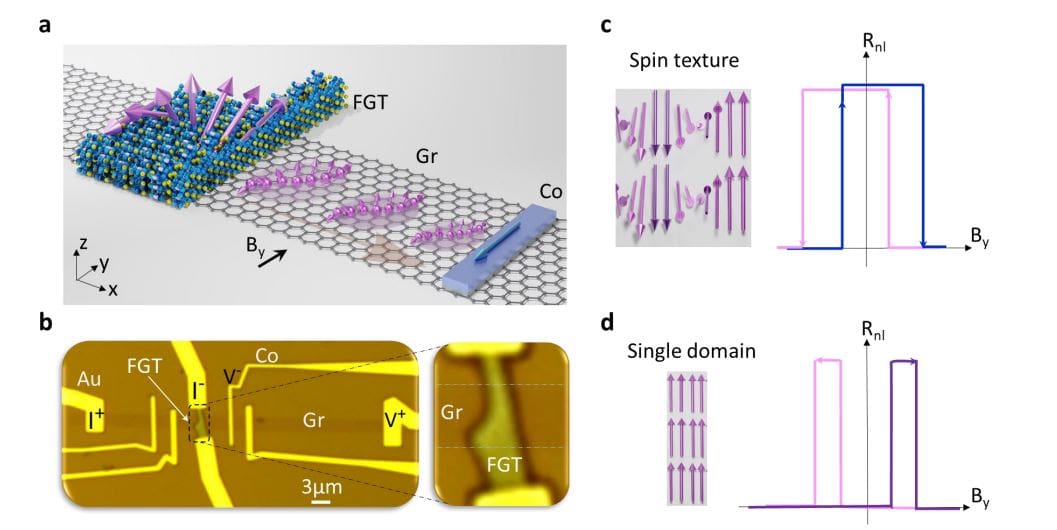
The pursuit of advanced spintronic devices hinges on reliably controlling nanoscale magnetic textures, and a team led by Bing Zhao, Roselle Ngaloy, and Lars Sjöström at Chalmers University of Technology, alongside Saroj P. Dash, now demonstrates a significant step forward in this field. Researchers successfully detects and characterises spin textures within a two-dimensional van der Waals magnet using a novel all-electrical method, bypassing the need for complex microscopic imaging. By fabricating nanoscale structures within the material, the team creates distinct magnetic configurations that influence the flow of spin within a graphene channel, enabling the observation of multi-level switching and spin precession signals at room temperature. This breakthrough offers a pathway towards integrated 2D spintronic circuits with direct access to magnetic textures, potentially revolutionising data storage and processing technologies.
Graphene, hBN and 2D Spintronic Devices
Research increasingly focuses on two-dimensional materials like graphene and hexagonal boron nitride, alongside their unique combinations in heterostructures. These materials are central to advancements in spintronics, a field that exploits the spin of electrons to store and process information. Studies investigate the electronic properties of graphene and its potential for creating novel devices, while other work explores the creation of heterostructures with tailored electronic characteristics. Diamond, containing nitrogen-vacancy centers, also receives attention for its potential in quantum sensing applications.
Electrical Detection of Skyrmions in Nanoscale Magnets
Scientists have developed a groundbreaking all-electrical method for detecting spin textures within the two-dimensional van der Waals magnet, Fe5GeTe2. This innovative approach utilizes a graphene spin-valve device at room temperature, bypassing the need for complex microscopic imaging techniques. By carefully fabricating nanoscale constrictions and notches within the Fe5GeTe2 material, the team created specific sites where unique spin textures can form, leveraging the material’s strong Dzyaloshinskii-Moriya interactions. This allows for the direct observation of multi-level switching and Hanle spin precession signals, demonstrating the potential for multi-state spintronic devices and advanced information storage technologies.
Electrical Detection of Skyrmions in van der Waals
Researchers have demonstrated all-electrical detection of spin textures within two-dimensional van der Waals magnets, specifically Fe5GeTe2, using a graphene-based lateral spin-valve device at room temperature. The team engineered nanoscale constrictions within the Fe5GeTe2 material, creating regions that host unique chiral spin textures, including skyrmions and stripe domains, and inject distinct spin polarizations into a graphene channel. Experiments reveal a multi-state switching behavior in the spin-valve device, drastically different from that observed in traditional ferromagnets, confirming the potential of van der Waals heterostructures for realizing novel spintronic applications.
Electrical Detection of Spin Textures in Fe5GeTe2
This research demonstrates a novel all-electrical method for detecting and characterizing spin textures within the two-dimensional van der Waals magnet, Fe5GeTe2. Scientists successfully employed a graphene-based lateral spin-valve device to observe these textures, achieving electrical detection without the need for conventional microscopy techniques. By engineering nanoscale constrictions and notches in the Fe5GeTe2 material, the team created robust spin textures that injected distinct spin polarizations into the graphene channel, enabling the observation of multi-level spin-valve switching and Hanle precession signals. This achievement marks a significant step forward in understanding magnetism in two-dimensional materials, revealing fundamental differences between Fe5GeTe2 and conventional ferromagnets and opening new avenues for designing programmable spin logic elements and neuromorphic architectures.
👉 More information
🗞 Spin-Texture Spin-valve with a van der Waals Magnet
🧠 ArXiv: https://arxiv.org/abs/2512.07559


