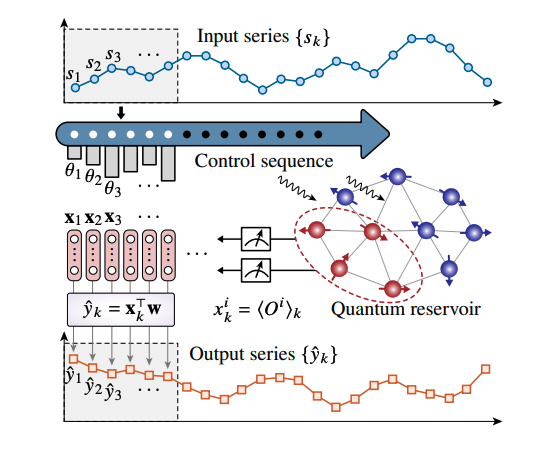
Predicting future events accurately remains a significant challenge across numerous fields, from finance to meteorology, and researchers are increasingly exploring unconventional computing methods to address this need. Yanjun, alongside colleagues at their institutions, now demonstrates a powerful new approach using quantum reservoir computing, a technique that harnesses the complex dynamics of physical systems for information processing. This work introduces a system built on correlated spin interactions, which generates the necessary complexity without requiring the extensive circuitry of previous designs. The results show a substantial leap in predictive accuracy, reducing errors by one to two orders of magnitude on standard benchmarks and, crucially, outperforming classical models with far greater computational resources in a long-term weather forecasting task, representing a key experimental milestone in the field.
Correlated Spins Enable Natural Reservoir Computing
Researchers have developed a new approach to reservoir computing by harnessing the natural dynamics of interacting spin systems, simplifying the construction of complex quantum circuits. This method leverages inherent many-body interactions to generate the complex dynamics needed for information processing, offering a potentially scalable alternative to traditional methods. Unlike approaches requiring intricate control over individual quantum bits, this technique relies on the system’s intrinsic properties, simplifying experimental implementation. A key innovation lies in incorporating natural relaxation processes as a computational resource.
Instead of actively resetting quantum bits, the team utilized the inevitable tendency of quantum systems to lose energy and coherence, specifically longitudinal and transverse relaxation. These processes, typically viewed as detrimental, were strategically employed to create “fading memory,” allowing the system to retain information about recent inputs while gradually forgetting older ones, crucial for processing time-series data. The system’s evolution is governed by a mathematical framework combining inherent dynamics with these relaxation effects, enabling prolonged processing. To overcome limitations in extracting information, researchers implemented time multiplexing.
Recognizing that accessing the full computational potential of a complex system requires measuring numerous parameters, they moved beyond static measurements. Instead, they repeatedly measured a single observable at different points during the reservoir’s evolution, effectively increasing the number of readouts and capturing a more complete picture of the system’s internal state. The experimental implementation utilized a nuclear magnetic resonance platform, allowing researchers to benchmark the system’s performance on the NARMA simulation, a standard test for temporal processing. They demonstrated significant improvements in prediction accuracy compared to existing methods, demonstrating the potential of harnessing natural quantum dynamics and innovative readout techniques.
Quantum Reservoir Computing Beats Classical Forecasts
Researchers have demonstrated a new approach to quantum reservoir computing, achieving significant performance gains over existing classical and quantum methods in complex time-series prediction tasks. This system leverages the natural dynamics of a correlated spin system, circumventing the challenges associated with building large, complex quantum circuits. The team’s quantum reservoir, comprising just nine quantum bits, outperformed classical reservoirs with thousands of nodes in long-term weather forecasting, representing a first-of-its-kind experimental demonstration of a quantum machine learning system surpassing large-scale classical networks on real-world data. A key innovation lies in integrating both coherent and incoherent spin dynamics to enhance the reservoir’s complexity.
By incorporating natural spin relaxation processes, the tendency of spins to return to equilibrium, the researchers created a system that retains memory of past inputs without requiring complex control mechanisms or quantum bit resets. This approach allows for prolonged temporal information processing and overcomes limitations imposed by quantum bit coherence times. The results confirm that inherent relaxation plays a crucial role in achieving high performance, aligning with recent theoretical studies. Furthermore, the team addressed the challenge of extracting information from the quantum reservoir’s vast state space.
Instead of attempting to measure all possible states, they employed time multiplexing, effectively increasing the number of readouts by performing repeated measurements during the reservoir’s evolution. This method allows the system to access a greater portion of the reservoir’s computational potential, significantly improving its ability to process and predict complex patterns. The combination of these innovations has resulted in a system that reduces prediction error by one to two orders of magnitude compared to previous quantum reservoir experiments, marking a substantial step forward in the field of quantum machine learning.
Quantum Advantage in Weather Forecasting Demonstrated
This research demonstrates a novel approach to reservoir computing, utilising the correlated dynamics of a small, nine-spin quantum system. The team successfully implemented a quantum reservoir computer that achieves significantly improved performance on standard time-series prediction benchmarks, reducing errors by one to two orders of magnitude compared to previous quantum implementations. Notably, this system outperformed classical reservoirs containing thousands of nodes in a long-term weather forecasting task, representing a first experimental demonstration of a practical quantum advantage in this domain. The findings highlight the potential of quantum systems to address complex dynamical prediction challenges, even with current, limited-scale hardware.
While acknowledging the inherent difficulty of predicting environmental variables, the quantum reservoir computer achieved comparable performance to much larger classical systems. Future research directions include increasing the complexity of the reservoir dynamics through refined control of internal interactions and scaling the system to larger quantum processors. Further exploration of integrating this approach with many-body phenomena, such as dynamical phase transitions and time crystals, could also systematically improve performance and uncover fundamental physical principles for enhanced quantum reservoir computing.
🗞 High-Accuracy Temporal Prediction via Experimental Quantum Reservoir Computing in Correlated Spins
🧠 ArXiv: https://arxiv.org/abs/2508.12383