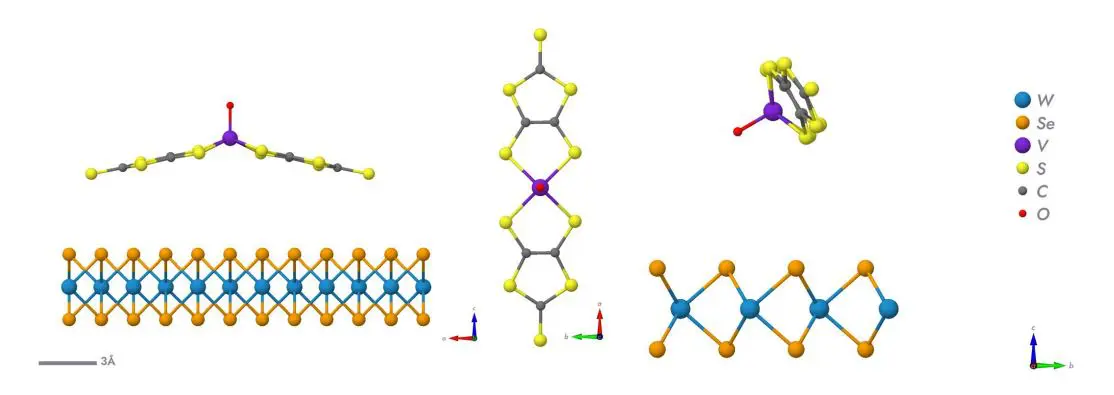
Heterostructures, crucial for advances in areas like photonics and spintronics, receive a significant boost from new research exploring the interface between molecules, transition metal dichalcogenides, and magnetic materials. Swagata Acharya from the National Renewable Energy Laboratory, Dimitar Pashov from King’s College London, Daphne Lubert-Perquel, and colleagues demonstrate a pathway to enhance functionality in these complex systems by leveraging an ‘inverse proximity effect’. Their work reveals that carefully controlling the orientation of molecules relative to a transition metal dichalcogenide allows researchers to tune and even quench the magnetic moment of nearby atoms, a phenomenon not observed in traditional two-dimensional magnet-TMD heterostructures. This precise control over spin states and exciton energies brightens and separates interlayer excitons, opening up exciting possibilities for developing new protocols to probe and manipulate magnetic properties for future technologies.
Excitons and Spin in 2D Heterostructures
This research details a comprehensive theoretical investigation of excitons, bound electron-hole pairs, and their behavior within van der Waals heterostructures, materials built from stacked two-dimensional layers. The study focuses on incorporating 2D magnetic semiconductors to understand and potentially engineer the interaction between excitons and spin, with implications for spintronics and optoelectronics. Scientists employed advanced computational methods, including sophisticated many-body perturbation theory calculations, to accurately model the electronic structure and optical properties of these materials, emphasizing the importance of accounting for strong electron correlations. The research centers on tailoring the properties of materials through layered heterostructures, offering unique opportunities to control electronic and optical characteristics.
Accurate modeling requires advanced computational techniques, particularly GW calculations with charge self-consistency, which accounts for changes in charge density due to electron interactions, essential for strongly correlated materials. The team also utilized a specific implementation called QSGW, incorporating ladder diagrams to improve accuracy. The findings demonstrate that accurate modeling of excitons in these heterostructures necessitates advanced computational techniques, and the interaction between excitons and magnetic order in 2D magnetic semiconductors presents a promising avenue for spintronic applications.
Quasiparticle Self-Consistency Improves TMD Heterostructure Functionality
This study pioneers a computational methodology, the Quasiparticle Self-Consistent GW approximation, to significantly enhance functionality in transition metal dichalcogenide (TMD) heterostructures, combining 2D magnets with nonmagnetic TMDs. This approach addresses a key challenge in these systems, where proximity-induced magnetic interlayer excitons are often dim and difficult to detect due to energy differences from intra layer excitons. The QSGW method, a self-consistent form of Hedin’s GW approximation, modifies the charge density using a variational principle, improving accuracy by accounting for electron-hole interactions often omitted in conventional calculations. Scientists implemented “ladder diagrams” to enhance screening and reduce the fundamental band gap and valence bandwidths, thereby improving the accuracy of the calculations.
Researchers meticulously tuned the degree of localization and magnetic moment by varying the molecular orientation relative to the TMD, altering proximity to the magnetic ion and influencing screening. The study demonstrates that this tuning can quench the ion’s spin moment and, critically, split the interlayer exciton from molecular excitons, making it easily resolvable in optical measurements. Furthermore, the team observed the excitonic spectrum smoothly redshift into the telecommunication window, potentially realizing quantum transduction within the molecular heterostructure. This innovative computational approach provides a pathway to brighter, more easily detectable excitons, paving the way for advanced protocols to probe and manipulate magnetic excitonic states in these novel materials.
Heterostructure Magnetism Enhanced by Molecular Control
This work details a breakthrough in designing heterostructures, combinations of different materials, for advanced applications in photonics and optoelectronics. Scientists investigated interfaces combining two-dimensional magnets with nonmagnetic transition metal dichalcogenides, focusing on controlling the resulting magnetic properties at the nanoscale. The core challenge addressed is the difficulty in detecting and utilizing the subtle magnetic interactions that emerge when these materials are combined, due to their inherently weak signal. Researchers employed a sophisticated theoretical approach, a high-fidelity ab initio diagrammatic method, to demonstrate that the functionality of these heterostructures can be significantly enhanced by carefully controlling the molecular orientation at the interface.
This method accurately models the behavior of electrons within the materials, revealing that molecular excitons exhibit charge transfer characteristics and are extended in space, unlike the localized excitons found in the 2D magnets alone. By varying the orientation of the molecules relative to the nonmagnetic layer, scientists discovered a pathway to tune the degree of localization and even quench the magnetic moment of the ions. Detailed calculations revealed precise control over electronic and excitonic properties. Results show that QSG ˆW accurately reproduces the experimentally reported bandgap of pristine WSe2, a significant improvement over simpler methods. Crucially, the QSG ˆW calculations reveal a substantial modification of the d-band splitting, providing a direct measure of effective Hubbard correlations. These findings pave the way for designing novel materials with tailored magnetic properties for advanced technological applications.
Tunable Excitons in Molecule-TMD Heterostructures
This research demonstrates a pathway to significantly enhance functionality in heterostructures, essential building blocks for advanced technologies including photonics and neuromorphic computing. Scientists have established that combining molecules with transition metal dichalcogenides creates unique excitonic properties not found in other heterostructure combinations. Specifically, the team discovered that excitons, bound electron-hole pairs, in these molecule/TMD structures are highly tunable, offering greater control over their energy, spin states, and brightness. The key to this enhanced tunability lies in the distinct character of electron and hole excitations on either side of the interface.
Unlike traditional two-dimensional magnet heterostructures where electronic wavefunctions are localized, the molecular component exhibits extended, charge-transfer characteristics. This allows for modification of the molecular environment via the TMD layers, an “inverse proximity effect” that alters both individual particle properties and excitonic features. Furthermore, the researchers found that replacing the magnetic ion within the molecule with one possessing different electronic configurations can further enhance functionality, potentially splitting excitonic states and increasing brightness for easier detection. This tunability even extends to shifting the excitonic spectrum into the telecommunication window, suggesting potential for quantum transduction within the heterostructure. This research provides a foundational understanding of exciton behavior in molecule/TMD heterostructures, paving the way for future exploration of different molecular compositions and orientations to optimize these effects.
🗞 Spin-quenching in molecule-transition-metal-dichalcogenide heterostructure through inverse proximity effect
🧠 ArXiv: https://arxiv.org/abs/2511.14968