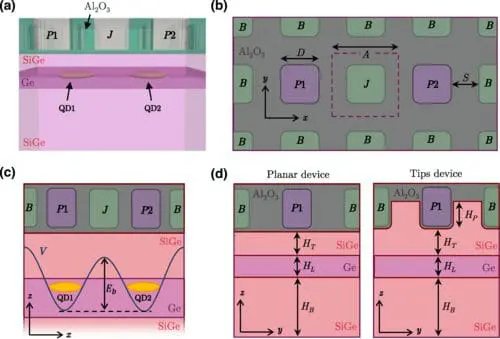
The quest for reliable spin qubit devices has taken a crucial step forward with new research from the University of Grenoble Alpes and CEA. By investigating the impact of charge traps at the semiconductor-oxide interface on spin qubits, scientists have discovered that metal gates can screen out these traps, reducing variability and improving device performance. The study proposes an innovative tip-shaped gate layout that maximizes coverage of the semiconductor-oxide interface, outperforming traditional planar layouts in some regimes. This breakthrough has significant implications for quantum computing and simulation, paving the way for widespread adoption of spin qubit devices.
Can Spin Qubit Devices Be Made More Reliable?
The scalability of spin qubit devices is crucial for their widespread adoption in quantum computing and simulation. However, variability in these devices can be a significant obstacle to overcome. In this article, researchers from the University of Grenoble Alpes and CEA have investigated the effects of charge traps at the semiconductor-oxide interface on the performance of spin qubits.
The team used numerical calculations to study the impact of multiple random distributions of interface traps on the chemical potentials, detuning, and tunnel coupling of two adjacent quantum dots in a SiGe heterostructure. Their results showed that the metal gates can have a beneficial screening effect, reducing the variability caused by charge disorder. This finding highlights the importance of designing the gate layout to minimize variability.
The researchers proposed an alternative tip-shaped gate layout that maximizes the coverage of the semiconductor-oxide interface and outperforms the traditional planar layout in some regimes. This design approach can help mitigate variability and improve the reliability of spin qubit devices.
How Do Charge Traps Affect Spin Qubits?
Charge traps at the semiconductor-oxide interface can have a significant impact on the performance of spin qubits. These traps can affect the wave functions of the confined carriers, leading to variations in their charge and spin properties. In particular, charge disorder in amorphous oxides can be detrimental due to its long-range influence.
The researchers used numerical calculations to study the effects of multiple random distributions of interface traps on the chemical potentials, detuning, and tunnel coupling of two adjacent quantum dots in a SiGe heterostructure. Their results showed that the metal gates can have a beneficial screening effect, reducing the variability caused by charge disorder.
What is the Role of Metal Gates in Spin Qubits?
The metal gates play a crucial role in spin qubits, as they can help screen out the effects of charge traps at the semiconductor-oxide interface. The researchers found that the tip-shaped gate layout proposed in this study can maximize the coverage of the semiconductor-oxide interface and reduce variability.
Can Tip-Shaped Gates Improve Spin Qubit Performance?
The researchers proposed an alternative tip-shaped gate layout that maximizes the coverage of the semiconductor-oxide interface and outperforms the traditional planar layout in some regimes. This design approach can help mitigate variability and improve the reliability of spin qubit devices.
How Do Different Gate Layouts Affect Spin Qubits?
Different gate layouts can have a significant impact on the performance of spin qubits. The researchers found that the tip-shaped gate layout proposed in this study can outperform the traditional planar layout in some regimes, highlighting the importance of design in managing device-to-device variability.
What are the Implications for Quantum Computing and Simulation?
The findings of this study have significant implications for quantum computing and simulation. By optimizing the gate layout to minimize variability, researchers can improve the reliability and scalability of spin qubit devices. This can help pave the way for the widespread adoption of these devices in quantum computing and simulation applications.
What are the Next Steps for Spin Qubit Research?
The next steps for spin qubit research will involve further optimization of the gate layout to minimize variability and improve device performance. The researchers propose that future studies should focus on experimentally verifying the theoretical predictions made in this study and exploring new design approaches to further reduce variability.
Conclusion
In conclusion, this study has demonstrated the importance of optimizing the gate layout to mitigate variability in spin qubit devices. By using numerical calculations to study the effects of charge traps at the semiconductor-oxide interface, researchers can improve the reliability and scalability of these devices. The proposed tip-shaped gate layout offers a promising approach for reducing variability and improving device performance.
Publication Date: 2024-08-09
Authors: Biel Martínez, M. Sanquer and Yann-Michel Niquet
Source: Physical Review Applied
DOI: https://doi.org/10.1103/physrevapplied.22.024030