

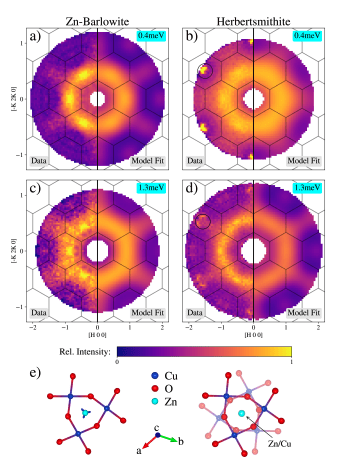
On April 8, 2025, researchers led by Aaron T. Breidenbach published Identifying Universal Spin Excitations in Spin-1/2 Kagome Quantum Spin Liquid Materials, reporting their discovery of universal spin excitations in Zn-barlowite through neutron scattering experiments.
High-resolution neutron scattering measurements on Zn-barlowite reveal spin excitations consistent with a quantum spin liquid (QSL) ground state. The observed continuum scattering above 1 meV mirrors that of herbertsmithite, suggesting universal spinon behavior in kagome QSLs. Spin-spin correlation analysis aligns with density matrix renormalization group calculations, confirming the QSL state for relevant Hamiltonian parameters. A gapped spectrum with a gap size of approximately 1 meV is measured, and intrinsic kagome correlations are distinguished from impurity-induced effects. These findings clarify universal behavior in this family of QSL candidates.
To tackle this complexity, scientists employ a dual strategy using inelastic neutron scattering and X-ray spectroscopy. Inelastic neutron scattering provides insights into the energy states of nuclei and electrons by observing how neutrons interact with the material. Meanwhile, X-ray spectroscopy probes the electronic structure through the absorption and emission of X-rays. This combination offers a comprehensive view of electron interactions within the material.
The experimental data is analyzed using weighted least squares (WLS) regression. This statistical method fits models to the data while accounting for varying measurement uncertainties, enhancing the accuracy of parameter determination that describes the material’s properties.
Research has revealed hidden electronic orders in quantum materials—subtle structures not immediately apparent but crucial for phenomena like superconductivity. Additionally, significant quantum fluctuations at low temperatures highlight how minor energy changes can profoundly influence material behavior, challenging traditional assumptions about stability.
Despite these advancements, challenges remain. Limited data coverage can lead to multicollinearity issues, affecting the reliability of parameter estimates. Addressing these requires more robust data collection methods or improved analytical techniques.
This integrated approach signifies a leap forward in understanding quantum materials, potentially unlocking new technologies. By combining advanced experimental methods with sophisticated analysis, researchers are paving the way for future discoveries that could redefine our technological landscape.
👉 More information
🗞 Identifying Universal Spin Excitations in Spin-1/2 Kagome Quantum Spin Liquid Materials
🧠 DOI: https://doi.org/10.48550/arXiv.2504.06491


