The unexpected observation of chiral phonon behaviour in certain materials has prompted a detailed investigation into the underlying mechanisms, led by Eduard Koller, Swetlana Swarup, and Johannes Knolle, with contributions from Natalia B. Perkins and their respective institutions. Recent experiments revealed a finite Raman circular dichroism, suggesting a breakdown of expected lattice symmetry and hinting at a more complex interplay between spin and lattice vibrations. This research team demonstrates that while bare phonons exhibit no such chirality, coupling them to chiral spin excitations under a magnetic field dramatically alters their properties, effectively mixing polarization and generating a measurable signal. The findings establish Raman circular dichroism as a powerful technique for detecting interaction-induced chirality in materials and provide a crucial link between magnetic fields, spin dynamics, and lattice vibrations.
Kitaev Material Excitations via Raman Scattering
This research details theoretical calculations exploring Raman scattering in the Kitaev material α-RuCl3, aiming to identify signatures of an exotic quantum state called a spin liquid. Raman scattering, a spectroscopic technique, reveals information about a material’s excitations, such as vibrations and magnetic waves. Researchers analyzed how different symmetry components contribute to the Raman signal, focusing on the interplay between phonons, quantized vibrations, and magnons, collective magnetic excitations. The team considered the impact of spin-lattice coupling and predicted the emergence of Fano resonances, indicating strong coupling between excitations. Calculations predict Fano-like lineshapes in the Raman spectra, suggesting this strong coupling, and demonstrate how the polarization of light influences observed excitations. This research provides theoretical predictions for the Raman spectra of α-RuCl3, which can be compared with experimental measurements to confirm the presence of a spin liquid state and understand the nature of its excitations.
Phonon Chirality Probed with Circularly Polarized Light
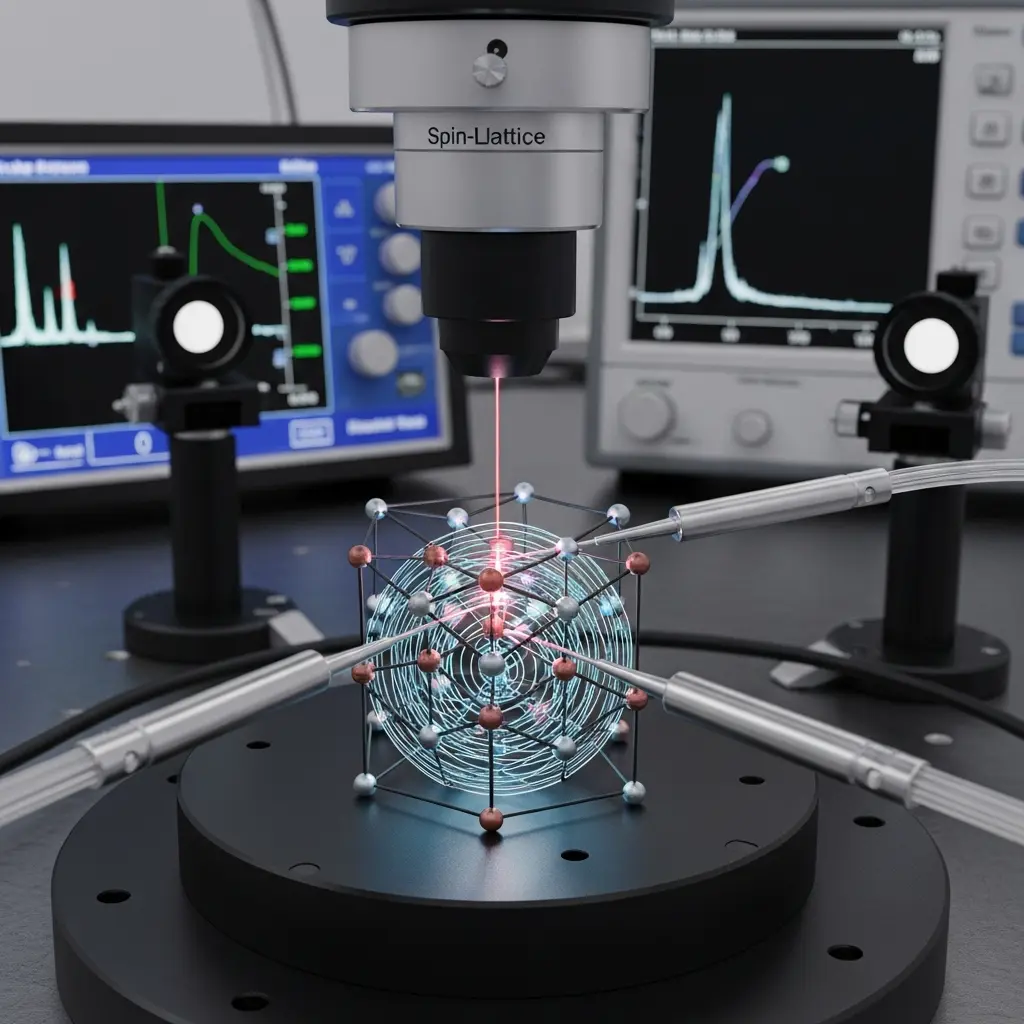
Scientists have developed a framework to investigate how phonons acquire chirality in correlated materials like α-RuCl3. The study employed Raman spectroscopy with circularly polarized light, a technique measuring Raman circular dichroism (RCD), a sensitive indicator of phonon chirality. Applying a magnetic field reduces the material’s symmetry. Researchers demonstrated that isolated phonons carry no angular momentum, but applying a magnetic field induces chirality in the spin sector, leading to hybridization between phonons and spin excitations. This hybridization alters vibrational modes, creating complex combinations with finite angular momentum and generating a measurable RCD signal, the magnitude of which correlates with the applied magnetic field. This methodology establishes RCD as a powerful probe of interaction-induced chiral phonons, extending beyond expectations of lattice symmetry alone, and demonstrating how magnetic interactions can influence vibrational properties.
Chiral Phonons Emerge in Magnetic Material
Recent research has revealed that phonons, traditionally considered neutral, can acquire chirality through interaction with chiral spin excitations. This challenges the conventional understanding that phonons carry no intrinsic quantum numbers like spin or angular momentum. Experiments conducted on α-RuCl3 revealed a finite Raman circular dichroism (RCD), indicating chiral phonon behaviour not expected based solely on the crystal’s symmetry. Researchers applied a magnetic field, reducing the crystal symmetry. While isolated phonons should carry zero angular momentum, the team measured a non-zero RCD, demonstrating that phonons gain chirality through coupling to the chiral Majorana continuum.
The research team developed a theoretical framework to explain this phenomenon, showing that isolated phonons do not contribute to RCD, but coupling to chiral spin excitations alters phonon properties, mixing polarization eigenvectors into complex combinations with finite angular momentum. This interaction generates a measurable RCD accompanied by characteristic Fano line shapes in the Raman response, reflecting interference between discrete phonons and the continuum. Measurements confirm that the observed RCD is consistent with experimental data, providing strong evidence for the proposed mechanism and establishing RCD as a powerful probe of interaction-induced chiral phonons in correlated quantum materials.
Chiral Spin Interactions Induce Phonon Chirality
This research establishes a clear connection between magnetic order and vibrational modes, demonstrating how chirality in the spin sector of a material can induce chirality in its phonons. Their calculations show that while isolated phonons exhibit no circular dichroism, coupling to chiral spin excitations, driven by an applied magnetic field, alters the phonons, creating complex vibrational modes with net angular momentum and a measurable circular dichroism signal. This interaction-induced modification explains the observed Fano line shapes in Raman spectra and confirms that the signal strength directly correlates with the magnetic field strength and the degree of chirality in the spin sector. The findings demonstrate that Raman circular dichroism can serve as a powerful probe of interaction-induced chiral phonons in correlated materials, extending beyond the expectations of lattice symmetry alone. Future research could explore the implications of these findings for other correlated materials and investigate the potential for controlling phonon chirality through manipulation of magnetic order, offering new avenues for understanding and manipulating quantum materials.
🗞 Spin-lattice coupling induced chiral phonons and their signature in Raman Circular Dichroism
🧠 ArXiv: https://arxiv.org/abs/2511.14902