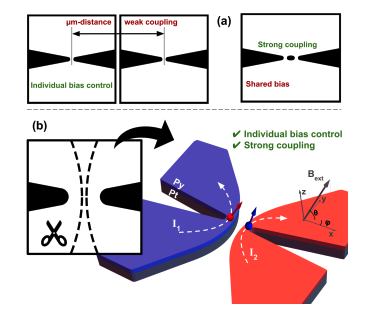
Spin-based technologies promise energy-efficient computing, and researchers continually seek ways to control and synchronise nanoscale magnetic oscillators, essential components for such devices. Roman V. Ovcharov, Roman S. Khymyn, Akash Kumar, and Johan Åkerman, all from the Department of Physics at the University of Gothenburg, now demonstrate a significant advance in this field by achieving mutual synchronisation between two nanoscale spin-Hall nano-oscillators featuring an innovative asymmetric-nanoconstriction design. This work establishes a method for oscillators to communicate and lock their behaviour solely through magnetic fields, eliminating the need for electrical connections or spin-wave pathways, and opens up possibilities for creating large, precisely controlled arrays of oscillators for future spintronic applications. The team’s platform allows for independent control of each oscillator’s frequency and strength, enabling robust in-phase or out-of-phase synchronisation and offering a pathway to explore complex, non-Hermitian spintronic dynamics.
Synchronizing Nano-Oscillators for Neuromorphic Computing
This research investigates mutually synchronized spin-Hall nano-oscillators, tiny devices with the potential to revolutionize neuromorphic computing and spin-based logic. Scientists are tackling key challenges including achieving robust synchronization, miniaturizing these oscillators down to incredibly small sizes, reducing their power consumption, and precisely controlling the phase of their oscillations. The team successfully fabricated functional nano-oscillators as small as 10 nanometers, a significant step in miniaturization, and demonstrated robust synchronization even in large networks. Researchers achieved precise control over the phase relationship between oscillators, essential for implementing complex computational functions, through adjustments to current and magnetic fields.
These oscillators operate with remarkably low power consumption, making them energy-efficient, and the study explored non-Hermitian physics and its role in controlling the oscillators. Furthermore, they demonstrated memristive control, potentially enabling more complex neural network designs, and successfully implemented injection locking to enhance synchronization. This work showcases potential applications in neuromorphic computing, building artificial neural networks, and spin-based logic circuits, opening avenues for a novel computing paradigm based on spin-wave Ising machines. The research utilizes advanced nanofabrication techniques, microwave measurements, magnetic force microscopy, and micromagnetic simulations to characterize and model the oscillators. This advances the field of spintronics, provides a pathway towards energy-efficient computing and artificial neural networks, sheds light on fundamental physics, and demonstrates a potentially scalable platform for future technologies.
Asymmetric Nano-Constrictions Enable Strong Dipolar Coupling
Scientists engineered a novel asymmetric-nano-constriction design for spin-Hall nano-oscillators to investigate mutual synchronization. This design enables strong dipolar coupling at separations below 50 nanometers while maintaining independent current control for each oscillator. The team pioneered a fabrication method, gently bending a conventional constriction to create a unique oscillator configuration, allowing two oscillators to be positioned closely for robust synchronization. Researchers characterized the auto-oscillation of a single oscillator, revealing a broad frequency tuning range and field-controlled nonlinear behaviors.
Micromagnetic simulations demonstrated that two such oscillators can mutually synchronize solely via dipolar stray fields, without electrical or spin-wave coupling. Experiments employing independent current biasing revealed that the coupled pair exhibits robust in-phase or out-of-phase locking depending on the bias conditions. The study investigated the relationship between bias conditions and amplitude correlation, finding that comparable amplitudes allow both in-phase and out-of-phase synchronization, while an imbalance drives the system into an out-of-phase state accompanied by suppression of the weaker oscillator. By combining strong conservative coupling with independent frequency and gain control, this platform provides a scalable route toward phased oscillator arrays and architectures, opening avenues for exploring non-Hermitian spintronic dynamics.
Dipolar Synchronization in Nano-Oscillator Pairs
Scientists have achieved mutual synchronization between two spin-Hall nano-oscillators using a novel asymmetric-nanoconstriction design. This system locks their oscillations solely through dipolar stray fields, without electrical or spin-wave coupling. Micromagnetic simulations reveal that the oscillators can stabilize in either in-phase or out-of-phase states, depending on the applied bias conditions. The transition between these states is governed by the relative amplitudes and frequency detuning of the individual oscillators. Experiments demonstrate that when the oscillators sustain comparable amplitudes, both in-phase and out-of-phase synchronization are accessible, whereas an imbalance in amplitude drives the system into an out-of-phase state accompanied by suppression of the weaker oscillator’s signal.
Specifically, with a control current applied, noticeable power appears once the current in the second oscillator reaches a specific level, and both oscillators exhibit weak auto-oscillations. Crucially, scientists found it possible to realize both in-phase and anti-phase states at essentially the same frequency, with non-zero net output, an attribute attractive for phase-binarized arrays and Ising-type computing. These results demonstrate a new platform for reconfigurable oscillator clusters, offering a testbed for exploring non-Hermitian spintronic phenomena and supporting potential applications in neuromorphic computing.
Dipolar Synchronization in Spin-Hall Nano-Oscillators
Researchers have demonstrated a new design for spin-Hall nano-oscillators, incorporating an asymmetric nanoconstriction, and successfully simulated the mutual synchronization of two such devices. The simulations reveal that these oscillators can synchronize solely through dipolar stray fields, without requiring electrical or spin-wave coupling, offering a simplified approach to oscillator interaction. Depending on the applied current, the coupled oscillators exhibit either in-phase or out-of-phase locking, with the transition governed by the relative amplitudes and frequency detuning of the individual oscillators. Notably, an imbalance in oscillator amplitudes promotes out-of-phase synchronization accompanied by suppression of the weaker oscillator, while balanced operation allows for stable switching between both 0° and 180° phase locking. This work represents the first theoretical demonstration of this synchronization method.
🗞 Mutual synchronization of two asymmetric-nano-constriction-based spin-Hall nano-oscillators
🧠 ArXiv: https://arxiv.org/abs/2509.12113