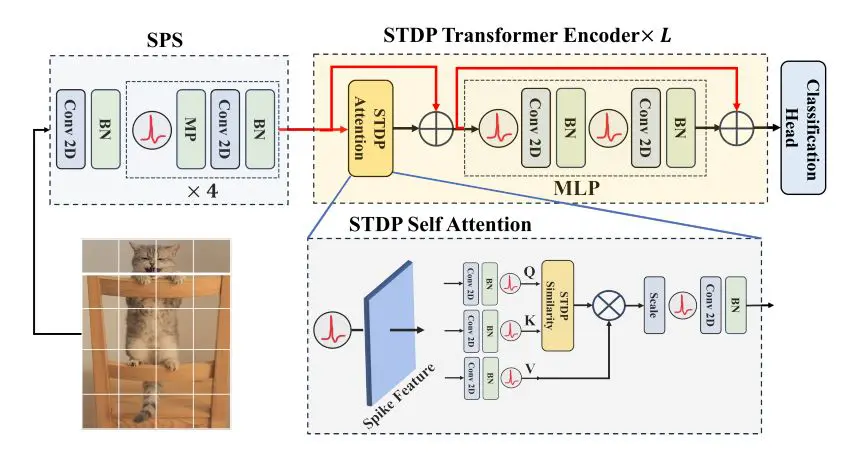
The brain excels at selectively focusing on relevant information while filtering out distractions, a process now mirrored in the attention mechanisms powering modern artificial intelligence. Kallol Mondal from National Institute of Technology Allahabad and Ankush Kumar from Indian Institute of Technology Roorkee, along with their colleagues, investigate how to replicate this efficiency using principles of biological learning. Their work addresses the significant energy demands of current large language models, which rely on computationally intensive processes. The team presents a novel spiking neural network Transformer that implements attention through spike-timing-dependent plasticity, a core mechanism of learning in the brain, embedding information directly into the connections between artificial neurons. This biologically inspired approach achieves high accuracy on image recognition tasks with a substantial reduction in energy consumption, paving the way for more sustainable and hardware-friendly artificial intelligence systems.
Spiking Transformers for Efficient Sequence Processing
Researchers have developed a novel Spiking Transformer (ST) architecture, a type of neural network designed to overcome limitations of traditional Transformers in terms of memory usage and energy efficiency. This system leverages spiking neural network principles, sparse, event-driven computation, and in-memory computing to improve scalability and efficiency, making it suitable for resource-constrained devices and long-sequence processing. This work represents a move towards more biologically plausible and energy-efficient artificial intelligence. Spiking Neural Networks (SNNs) differ from traditional artificial neural networks by using discrete spikes, or events, to communicate, leading to sparse, event-driven computation and reduced energy consumption.
The ST aims to perform computations within the memory itself, using devices like memristors, rather than constantly moving data between memory and processing units, drastically reducing energy consumption and latency. Spike-Timing-Dependent Plasticity (STDP), a learning rule where synaptic strength adjusts based on the timing of pre- and post-synaptic spikes, plays a crucial role in this process. Traditional Transformers face a critical limitation: the quadratic memory complexity of the attention mechanism. The ST addresses this by eliminating the explicit attention matrix and encoding attention weights directly within synaptic connections using STDP.
Using binary spike signals significantly reduces the memory footprint of the query, key, and value vectors, and removes the need for computationally expensive softmax normalization. The ST operates by first encoding input data into spike trains. Query, key, and value vectors are then represented as sparse spike trains. The similarity between these spike trains is encoded into synaptic weights using STDP, strengthening synapses that receive spikes close in time and weakening those with large time differences. These synaptic weights are stored in memristors, allowing computation to occur directly within the memory.
The output is generated based on the weighted sum of the value vectors, computed using these synaptic connections, and dimensionality is reduced using techniques like Global Temporal Mean Pooling and Global Average Pooling. This approach offers several benefits, including a reduced memory footprint, lower energy consumption, improved scalability, and increased biological plausibility. The in-memory computing architecture is well-suited for hardware acceleration using memristors or other emerging memory technologies. The final stages of processing involve converting the dynamic spatio-temporal representation from the encoder into a fixed-length vector for classification, using pooling techniques to average membrane potential across time and spatial patches.
Quantitative results demonstrate a 20-30% reduction in memory bandwidth requirements compared to traditional transformers, with significant memory savings for long sequences. For example, a sequence of length 512 requires 1MB of memory in a traditional transformer, while the ST requires significantly less. This establishes the Spiking Transformer as a promising architecture for resource-constrained devices and long-sequence processing.
Spike Timing Defines Transformer Attention Relevance
Researchers have pioneered a Spiking Transformer that reimagines attention mechanisms by drawing inspiration from biological neural circuits and spike-timing-dependent plasticity (STDP). They moved beyond conventional attention calculations, formulating self-attention as a process where relevance emerges directly from the precise timing of spikes, mirroring how brains compute synaptic importance. This approach replaces traditional attention weight calculations with an attention score computed via STDP, encoding information salience in precise spike timing and enabling efficient, event-driven processing. To achieve this, the team developed a method for translating firing rates into a temporal representation suitable for STDP, employing a First-Spike Coding scheme.
This scheme maps higher firing rates to earlier spike times, effectively encoding rate information in spike latency relative to a reference point. Input tokens are represented as binary vectors, where the number of ‘ones’ corresponds to the total spike count, and this count determines spike timing. This allows the model to compute relevance based on the timing of spikes, rather than their magnitude, aligning more closely with biological neural computation. A key innovation lies in eliminating the need for explicit attention score matrices, a limitation of previous spiking Transformers. By embedding the attention computation within synaptic plasticity dynamics, the model circumvents the von Neumann memory bottleneck, substantially reducing memory bandwidth requirements.
The team achieves this by leveraging the spiking nature of the Value matrix to perform inherently addition-only operations, avoiding computationally expensive global operations like softmax. This simplification enables efficient deployment on neuromorphic hardware with limited memory hierarchy. Researchers further introduce a spatial relevance computation based on spike distribution, representing input tokens as binary vectors and calculating total spike counts using the l1 norm. This allows them to translate rate information into a temporal representation suitable for STDP and compute relevance based on the timing of spikes, rather than their magnitude. By grounding the attention mechanism in spike timing, the team moves beyond existing spiking Transformers and aligns more closely with the computational principles observed in real neural circuits.
Spiking Transformer Achieves High Accuracy, Low Energy
The Spiking STDP Transformer (S2TDPT) represents a significant advancement in energy-efficient artificial intelligence, achieving high accuracy on image classification tasks while dramatically reducing power consumption. Experiments on the CIFAR-10 and CIFAR-100 datasets demonstrate the model’s capabilities, with S2TDPT achieving a top-1 accuracy of 94. 35% on CIFAR-10 and 78. 08% on the more challenging CIFAR-100 dataset, both using only four timesteps. These results surpass multiple state-of-the-art methods, including a 3.
88% improvement over Dspike, a 2. 73% improvement over ANN-ResNet19, and a 0. 22% improvement over Spikformer-4-384 on CIFAR-100. Crucially, S2TDPT achieves these results with remarkably low energy consumption, measured at 0. 49 mJ on CIFAR-100.
This represents an 88. 47% reduction in energy usage compared to a standard ANN Transformer, and significant improvements over other spiking neural networks, including a 15. 5% reduction compared to SAFormer, a 20. 67% reduction compared to S-Transformer, and a 37. 97% reduction compared to Spikformer.
The model’s efficiency is further demonstrated by detailed per-class performance analysis on CIFAR-10, which confirms robust classification across all categories. Interpretability analysis using Spiking Grad-CAM and Spike Firing Rate (SFR) maps reveals that S2TDPT focuses on semantically relevant regions within images, extracting localized, object-centered features. The SFR maps demonstrate high spiking activity corresponding to object regions, aligning with the Grad-CAM saliency and confirming the model’s ability to extract compact features.
🗞 Attention via Synaptic Plasticity is All You Need: A Biologically Inspired Spiking Neuromorphic Transformer
🧠 ArXiv: https://arxiv.org/abs/2511.14691