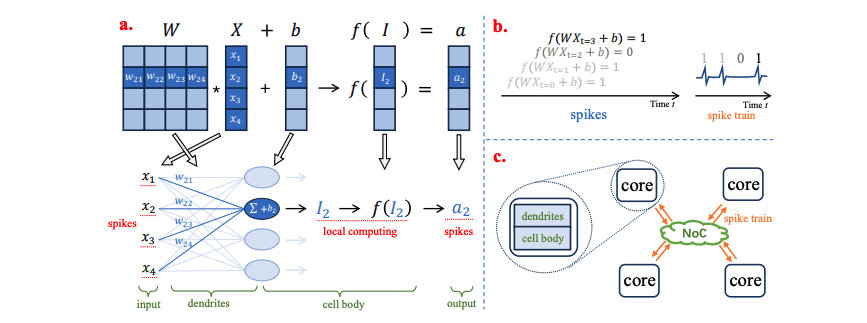
Researchers directly implemented quantized artificial neural networks (ANNs) on neuromorphic hardware, termed SDANN, bypassing the typical conversion to spiking neural networks and associated performance losses. This approach establishes a functional lower bound for the hardware and incorporates scaling and sparsity techniques for enhanced energy efficiency, validated through successful hardware deployment.
The pursuit of energy-efficient artificial intelligence is driving research into neuromorphic computing, a paradigm inspired by the biological nervous system. These systems utilise spiking neural networks (SNNs) – circuits that communicate using discrete signals, or ‘spikes’ – to minimise power consumption. However, translating the performance of conventional, continuous-valued artificial neural networks (ANNs) to these spiking architectures has proven challenging. Researchers at Zhejiang University – Zhenhui Chen, Haoran Xu, and De Ma – address this issue in their paper, ‘Bridging Quantized Artificial Neural Networks and Neuromorphic Hardware’. They present a framework, termed SDANN, which directly implements highly compressed (quantized) ANNs onto neuromorphic hardware, bypassing the need for complex retraining and demonstrating functionality on physical circuits.
Spiking Neural Networks: Towards Efficient and Deployable Artificial Intelligence
Spiking neural networks (SNNs) represent a departure from conventional artificial intelligence, drawing inspiration from the computational principles of biological nervous systems. While artificial neural networks (ANNs) process information via continuous values, SNNs utilise discrete, single-bit signals – termed ‘spikes’ – for inter-neuronal communication. This fundamental difference promises substantial reductions in energy consumption, a critical limitation of current AI deployments.
The conventional approach to constructing SNNs often involves replacing the activation functions of ANNs with spiking neuron models. However, a performance gap persists, largely due to the complexities of converting trained ANNs into equivalent SNNs without significant loss of accuracy. Researchers are therefore exploring alternative pathways to bridge this gap.
A recent development, termed SDANN (Spiking-quantized ANNs), proposes a direct implementation of quantized ANNs onto dedicated hardware. Quantization involves reducing the precision of numerical representations within the network – for example, using 8-bit integers instead of 32-bit floating-point numbers. This reduces computational demands and memory requirements, facilitating deployment on resource-constrained platforms. SDANN circumvents the need for complex parameter tuning typically required during ANN-to-SNN conversion, potentially mitigating associated performance losses.
The framework establishes a lower bound on hardware functionality by leveraging the efficiency of quantized ANNs, providing a benchmark for evaluating different hardware architectures. Scaling methods address limitations in hardware bit-width – the number of bits used to represent data – ensuring accurate representation of quantized weights and activations. Furthermore, spike sparsity techniques minimise energy consumption by reducing the frequency of spikes, thereby reducing computational load.
Experimental validation extends beyond simulations. Researchers have successfully deployed the SDANN framework on real hardware platforms, including Brainscales-2 and Spinnaker 2. These results confirm the feasibility of the approach and demonstrate the potential for realising low-power, efficient AI systems. The framework has been tested on tasks ranging from simple benchmarks to complex image recognition and object detection problems.
Beyond hardware implementation, research continues into biologically plausible learning rules. Spike-timing-dependent plasticity (STDP), a learning rule based on the precise timing of neuronal spikes, is being investigated as a means of training SNNs without reliance on large, labelled datasets. Furthermore, emerging memory technologies, such as memristors – devices that exhibit resistance dependent on past electrical activity – are being explored for building energy-efficient neuromorphic chips that mimic the structure and function of the brain.
These developments represent a significant step towards scalable and sustainable AI, with potential applications in edge computing, robotics, and broader neuromorphic computing architectures.
👉 More information
🗞 Bridging Quantized Artificial Neural Networks and Neuromorphic Hardware
🧠 DOI: https://doi.org/10.48550/arXiv.2505.12221