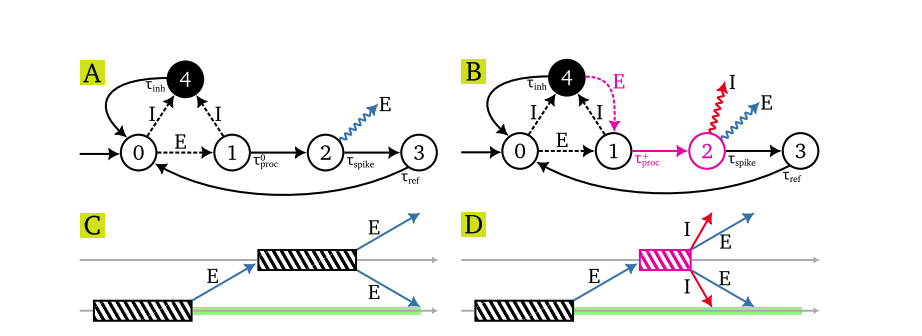
Finding the most efficient route between two points is fundamental to intelligent behaviour, yet conventional methods struggle to replicate the speed and efficiency of biological systems. Simen Storesund, Kristian Valset Aars, and Robin Dietrich, alongside Nicolai Waniek, from the Norwegian University of Science and Technology and Technical University Munich, present a new approach to this challenge, demonstrating how spiking neural networks can compute shortest paths using only the timing of signals. Their research reveals an algorithm where neurons predict incoming spike times and, by reducing response delays to early, accurate predictions, effectively compress information backwards from destination to origin. This biologically plausible mechanism, validated through both analytical proof and network simulations, demonstrates that complex pathfinding can occur through purely local, timing-based interactions, offering new insights into distributed computation in both natural and artificial intelligence systems.
Excitation and Inhibition Guide Pathfinding Simulations
This study details simulations testing a pathfinding algorithm designed to find the shortest path between a starting point and a target within a grid-like environment. The algorithm functions by iteratively tagging neurons based on proximity to the target and refining the path using excitation and inhibition. The research explores how different inhibition strategies impact performance, revealing that global inhibition proves more effective at quickly eliminating suboptimal routes and converging on the shortest path, while local inhibition requires more processing steps and can lead to multiple active paths. The algorithm successfully identifies the shortest path in a simple environment and extends to scenarios with multiple targets, where global inhibition helps prioritize a single path. The algorithm converges by iteratively tagging neurons and suppressing activity along less efficient routes, effectively refining the path towards optimality.
Spike-Timing Coincidence for Shortest-Path Computation
This study pioneers a biologically plausible algorithm for shortest-path computation, addressing limitations of existing approaches in artificial intelligence and reinforcement learning. Researchers developed a system that moves away from requiring global state information and backtracing, and avoids slow gradient-based updates, instead utilizing local spike-based message-passing mimicking neuronal communication with realistic processing delays. This approach utilizes spike-timing coincidences to identify nodes along optimal paths, effectively compressing temporal information as it propagates backward from the target to the source. The core of the method involves neurons reducing their response delays when receiving specific inhibitory-excitatory message pairs earlier than anticipated, signaling pathway optimality. Scientists constructed random spatial networks and simulated neuronal communication, demonstrating that the algorithm converges on shortest paths using only timing-based mechanisms. This work provides new insights into how biological networks might solve complex problems through purely local computation and relative spike-time prediction, opening new directions for understanding distributed computation in both biological and artificial systems.
Spike-Timing Algorithm Finds Shortest Paths Rapidly
Scientists developed a novel algorithm for shortest-path computation inspired by biological neural networks, demonstrating a breakthrough in biologically plausible artificial intelligence. The work centers on a spike-timing mechanism that operates through local message-passing, achieving pathfinding without relying on back-tracing or gradient-based updates. The core of the algorithm involves neurons becoming “tagged” when receiving inhibitory-excitatory message pairs earlier than predicted, creating a temporal compression that propagates backwards from the target to the source. Experiments demonstrate that the algorithm converges and successfully discovers all shortest paths using purely timing-based mechanisms, a significant achievement in unsupervised learning. The research establishes a formal convergence proof, confirming the algorithm’s reliability and predictability, and demonstrates that the network efficiently compresses temporal information and identifies optimal paths without requiring global state information or complex computations.
Spike-Timing Solves Shortest Path Problems
This research demonstrates that efficient shortest-path computation can arise from purely local spike-timing dynamics, offering a new understanding of how biological networks might solve complex problems. The team developed an algorithm that utilizes predictive spike-time coding, where neurons signal earlier than anticipated, creating a temporal compression that propagates backwards from the target to the source, effectively transforming graph search into a problem of local temporal prediction. This approach relies on established neural mechanisms, including spike-timing prediction, threshold adaptation, and competitive inhibition, making it biologically plausible and potentially implementable in neuromorphic hardware. The algorithm’s formal convergence guarantees establish a principled solution, and suggest that this paradigm could extend to other algorithms, potentially transforming classical approaches into biologically plausible, locally distributed variants.
🗞 Predictive Spike Timing Enables Distributed Shortest Path Computation in Spiking Neural Networks
🧠 ArXiv: https://arxiv.org/abs/2509.10077