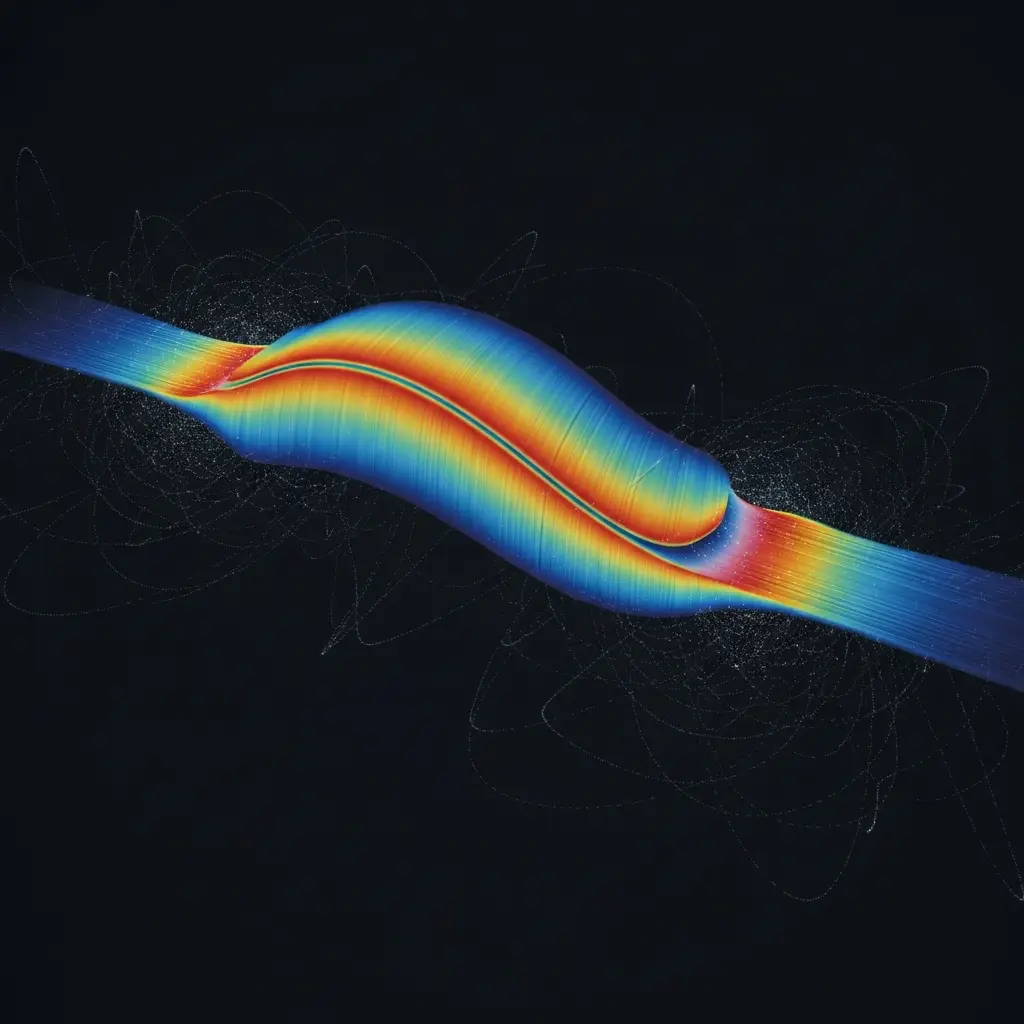
Researchers have demonstrated that domain wall motion, crucial for next-generation spintronic devices and terahertz logic, can be dramatically enhanced in specifically engineered magnetic materials. P. Diona, S. Artyukhin and L. Maranzana, from their respective institutions, detail how gradients within ferrimagnets not only propel these walls but also alter their effective mass. This previously unobserved phenomenon allows walls to shed or gain mass as they move through regions of differing magnetic properties, creating a ‘rocket-like’ acceleration effect. The team’s findings, published today, establish variable-mass domain walls as a promising new approach to achieving the ultrafast speeds required for advanced spintronics and high-frequency magnetic technologies.
Maranzana, from their respective institutions, detail how gradients within ferrimagnets not only propel these walls but also alter their effective mass. This previously unobserved phenomenon allows walls to shed or gain mass as they move through regions of differing magnetic properties, creating a ‘rocket-like’ acceleration effect.
Domain walls as variable mass systems offer unique
The research, published recently, reveals that spatially varying magnetic exchange and anisotropy not only exert a force on these walls but also dynamically modify their effective mass. This groundbreaking discovery establishes that domain walls can effectively act as variable-mass systems, shedding or gaining mass as they traverse regions with differing magnetic properties, akin to the propulsion of a rocket. Researchers achieved this by developing a theoretical framework and corroborating it with micro-magnetic simulations, showing how gradients in exchange or anisotropy induce a “rocket effect” that significantly enhances domain wall velocity. The study focuses on ferrimagnets, materials where Walker breakdown, a limitation on domain wall speed in conventional ferromagnets, is suppressed, allowing walls to approach the magnon speed.
As the wall moves through these gradients, its mass changes, resulting in an additional acceleration term proportional to the square of its velocity. Experiments were conducted using a ferromagnetic toy model, where the free energy density incorporates exchange interaction, anisotropy, and a Zeeman term. This equation reveals that a decreasing mass contributes to an accelerating force, mirroring the principle behind rocket propulsion. To extend this concept to more realistic scenarios, the research explored spatially non-uniform systems with varying exchange interaction, anisotropy, saturation magnetisation, and transverse shape anisotropy. Further extending their work to ferrimagnets, the team developed a Lagrangian and Rayleigh density incorporating antiferromagnetic order parameters and exchange interactions. This innovative approach promises to overcome existing limitations and unlock the full potential of domain wall-based devices.
Variable Mass Equations for Domain Wall Dynamics
The study pioneered a methodology employing equations of motion extended to account for variable domain wall mass, revealing a “rocket effect” analogous to thrust generation in variable-mass systems. Researchers engineered a system with space-dependent ferromagnetic exchange interaction Aex(x), easy-axis anisotropy K(x), saturation magnetization Ms(x), and transverse shape anisotropy Ky(x), varying these parameters smoothly over length scales exceeding the domain wall width to maintain shape integrity. This approach allowed the team to replace explicit spatial dependence with a dependence on the collective coordinate q, representing the domain wall position, simplifying the equation of motion. Experiments utilized a Lagrangian and Rayleigh density framework to describe the ferrimagnetic system, incorporating antiferromagnetic order parameter dynamics and defining parameters such as antiferromagnetic inertia ρ(x) = s2 T(x)d2/(4A(x)).
The team derived an equation of motion describing the total domain wall mass, mtot(q), as the sum of ferromagnetic mass mf(q) and antiferromagnetic mass maf(q) = ρ(q)/∆0(q), where ∆0(q) = p A(q)/K(q) represents the non-contracted domain wall width. Crucially, the relativistic contraction of the domain wall width was accounted for using the Lorentz factor γ(q) = 1/ q 1 −( q/vg(q))2, with vg(q) = p 2A(q)/(ρf(q) + ρ(q)) defining the magnon speed and ρf(q) = δ2s(q)/Kd representing the ferromagnetic inertia. The resulting equation of motion, mtot(q) q = − αsT ∆0(q)γ2(q) q−m′ tot(q) γ2(q) q2−mtot(q)v′ g(q) vg(q) 1 −2 q2 v2g(q) q2−Heff z (q)Ms(q) γ3(q), incorporates a term representing the rocket effect originating from the gradient of the total domain wall mass. This force, alongside a force induced by variations in the magnon velocity, becomes significant at high velocities, potentially enabling domain walls to approach the magnon velocity.
Rocket effect accelerates domain walls significantly
Experiments revealed that as a domain wall traverses regions with varying exchange or anisotropy, it experiences a change in effective mass, shedding or gaining mass akin to variable-mass systems. The team measured that a relative change in the exchange interaction yields a more significant rocket effect, with 2δmaf/maf = (δK/K −3δA/A), compared to the same relative change in anisotropy. Simulations employed realistic material parameters, including anisotropy values of approximately 104 J/m3, consistent with experimental results, and spatial variations of up to ±20, 40%. Agreement between theory and simulations, as shown in figures within the work, confirms the validity of the rocket effect in these systems.
Data shows that the rocket effect is more pronounced when the antiferromagnetic exchange interaction varies from 1 pJ/m to 4 pJ/m over a distance of 200nm, compared to a similar variation in anisotropy. Numerical simulations demonstrated domain wall velocities exceeding 1000m/s, and in certain configurations, approaching the magnon velocity, with the reduction of antiferromagnetic mass providing an additional boost. Specifically, the domain wall velocity was plotted as a function of position along a racetrack, showing acceleration facilitated by the mass loss. The study highlights amorphous rare-earth, transition metal ferrimagnets, like GdFeCo, as promising platforms for observing this effect, due to their tunable anisotropy, net magnetization, and spin angular momentum. Parameters used in simulations included A values of 2 pJ/m [1, 4] pJ/m, MA and MB of 5·105A/m and 4.5·105A/m respectively, α of 0.004, and K values ranging from [14, 5]·103 J/m3 to 10·103 J/m3, detailed in Table 1. Researchers suggest that voltage-controlled magnetic anisotropy or optical patterning could engineer the necessary spatial inhomogeneity for experimental observation, potentially leading to advancements in high-velocity racetrack memories and THz-frequency magnetic technologies.
Rocket Effect Drives Variable-Mass Domain Walls in astrophysical
This phenomenon arises from spatial variations in magnetic exchange and anisotropy, causing domain walls to shed or gain effective mass as they propagate. Quantitative agreement between analytical predictions and numerical simulations confirms the robustness of this effect. The authors acknowledge that the magnitude of antiferromagnetic exchange can vary, and realistic engineering of materials with tailored exchange stiffness, ranging from approximately 1 pJ/m to 4 pJ/m, is crucial for observing this effect. Future research could focus on exploring amorphous ferrimagnets, such as GdFeCo, which naturally exhibit the necessary tunability in exchange and anisotropy through external stimuli like voltage control or optical patterning. This work expands the possibilities for designing ultrafast spin textures and high-velocity racetrack memories.
👉 More information
🗞 Rocket-like dynamics of ferrimagnetic domain walls in graded materials
🧠 ArXiv: https://arxiv.org/abs/2601.21068