Understanding the properties of baryons, composite particles made of quarks, presents a fundamental challenge in modern physics, and recent research focuses on those containing multiple heavy quarks. Chaitanya Anil Bokade and Bhagyesh, both from the Manipal Institute of Technology, have undertaken a detailed investigation into the spectra and radiative decays of triply heavy baryons, specifically the and varieties. Their work employs a novel quark-diquark model, treating these baryons as combinations of a diquark cluster and a single quark, and calculates how these particles transition between energy levels through the emission of photons. This comprehensive analysis provides crucial theoretical predictions for these exotic states, offering valuable insights for ongoing and future experiments searching for these elusive particles and helping to refine our understanding of the strong force that governs their behaviour.
Triply and Doubly Heavy Baryon Spectroscopy
This research encompasses a broad investigation of heavy baryons, particles containing heavy quarks like charm and bottom. The primary focus lies on triply and doubly heavy baryons, such as Ωccc, Ωbbb, and Ξcc, offering insights into the strong force that governs their behaviour. Researchers explore both theoretical predictions and, increasingly, experimental verification of these particles’ properties. A central theme is determining the masses and characteristics of baryons containing heavy quarks. Studies employ a variety of theoretical approaches, including quark models and calculations rooted in Quantum Chromodynamics (QCD).
Effective theories simplify complex QCD calculations, while methods like the Faddeev equations solve the three-body problem inherent in baryon structure. Understanding how these baryons decay is crucial for both experimental identification and testing theoretical predictions. Investigations focus on decay constants, branching ratios, and the mechanisms driving these decays. Studying electromagnetic transitions provides insights into their internal structure and quantum numbers, while analyses of strong decays reveal how they break down via the strong force. This research highlights the importance of precision calculations to match experimental data and the crucial role of experiments at facilities like LHCb in confirming theoretical predictions and discovering new baryons.
Relativistic Quark-Diquark Model for Heavy Baryons
This study investigates triply heavy baryons, specifically Ωccc and Ωbbb, employing a quark-diquark model within a relativistic framework. Researchers first determined the mass of the diquark, a bound pair of identical-flavor quarks, before modelling the baryon as a two-body system consisting of this diquark and a third quark. To account for relativistic effects, the team developed a relativistic extension of the standard Hamiltonian, incorporating terms for kinetic energy and a potential interaction between the constituents. This Hamiltonian forms the basis for calculating the energy levels of the baryons.
To solve for the mass spectrum, the team addressed the relativistic Schrodinger equation as an eigenvalue problem, utilizing a numerical procedure established in their prior work. This involved expanding the wave function in terms of spectral integration and rewriting the Schrodinger equation to facilitate numerical computation. This approach enabled the researchers to systematically determine the energy levels, and thus the masses, of the triply heavy baryons under investigation.
Triply Heavy Baryon Spectra and Radiative Decays
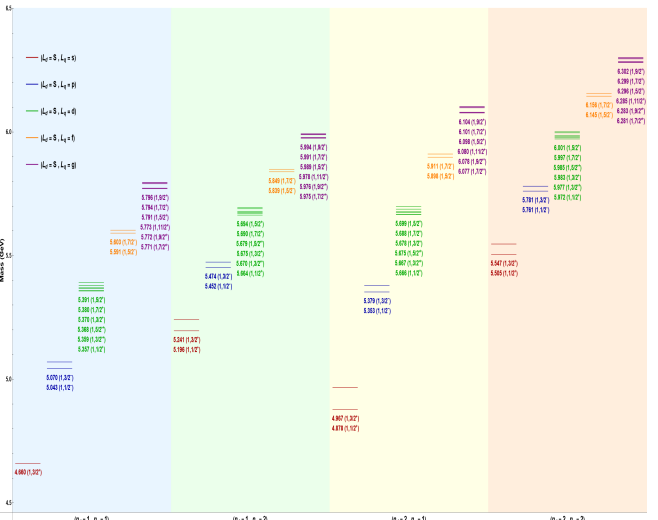
This work presents a comprehensive analysis of triply heavy baryons, investigating their spectra and radiative decays within a quark-diquark framework using a relativistic screened potential model. Researchers solved a relativized Hamiltonian to model these baryons as a combination of a diquark and a third quark, first determining the diquark masses before analysing the composite baryon structure. This approach allows for a systematic investigation of the internal dynamics of these complex particles, offering insights into the strong force interactions governing their behaviour. The study calculates electromagnetic transitions using E1 and M1 operators, providing a detailed spectral analysis alongside predictions for E1/M1 decay widths for both radially and orbitally excited states.
These calculations deliver a complete picture of the energy levels and decay pathways of triply heavy baryons, enabling direct comparison with other theoretical approaches and, crucially, future experimental observations. The team’s detailed spectral predictions are essential for guiding searches for these elusive particles at high-energy colliders. Recognizing the challenges in observing triply heavy baryons, the research acknowledges their low production rates in electron-positron collisions. However, the team’s calculations reaffirm the potential for detection at hadronic colliders like the LHC, estimating that with sufficient data, approximately 104 to 105 events containing triply heavy baryons with ccc and ccb content could be produced. To simplify the complex many-body problem, the team modelled baryons as a quark-diquark system, leveraging the similarities between meson and baryon structures.
Diquark Dynamics in Triply Heavy Baryons
This work presents a detailed analysis of triply heavy baryons, specifically those containing three heavy quarks, using a theoretical framework that combines relativistic effects with a description of the strong force. Researchers calculated the predicted masses of these baryons, finding results consistent with other theoretical estimates, and explored their radiative decays. A key finding is the importance of considering the internal dynamics of the diquarks, composite particles within the baryons, as these dynamics significantly influence the observed energy levels. The team demonstrated that states arising from diquark excitations have lower masses compared to those dominated by orbital motion between the quarks and diquark. Furthermore, the study revealed specific patterns in the radiative decay process, identifying the most prominent decay channels and predicting the relative decay rates. These comprehensive calculations provide a valuable theoretical reference for experimental searches of these elusive particles, guiding future investigations into the strong force and the structure of matter at extreme densities.
🗞 Spectroscopy and Radiative Decays of and Baryons in a Quark-Diquark Model
🧠 ArXiv: https://arxiv.org/abs/2510.03703