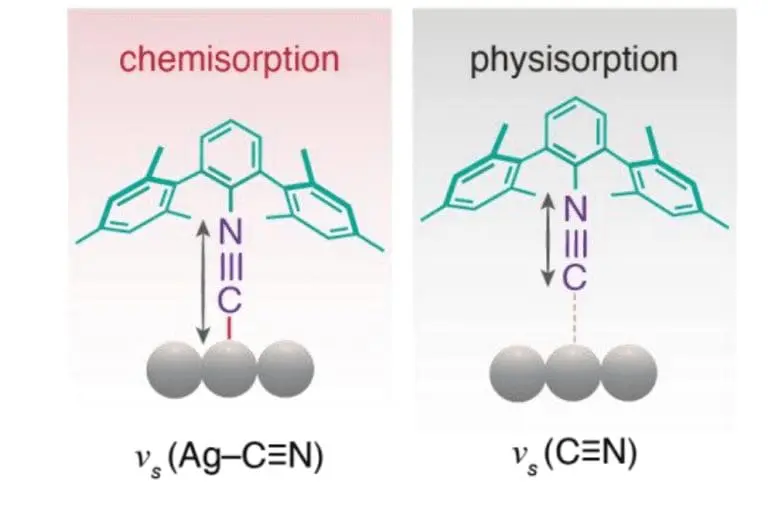
Understanding how molecules attach to the surface of nanocrystals is crucial for developing advanced materials with tailored properties for applications ranging from catalysis to optoelectronics. Dong Le, Wade Shipley from the University of California, San Diego, Alexandria Do, and colleagues now demonstrate a method for mapping exactly where these molecules bind, revealing a surprising degree of control over the process. The team employed a combination of advanced spectroscopic techniques and computer simulations to show that bulky organic ligands preferentially attach to areas of high curvature on silver nanocrystals, specifically targeting silver atoms with fewer neighbours. This site-selective binding, unlike that of less bulky ligands, highlights the potential to engineer nanocrystal surfaces with precise control over their chemical composition and ultimately, their function. The research establishes a powerful approach for designing bespoke ligands and fine-tuning the properties of nanocrystal-based materials at the nanoscale.
Surface Chemistry, Organometallics and Computation
This collection of research materials details a study of surface chemistry, organometallic chemistry, computational chemistry, spectroscopy, microscopy, and materials science. The work focuses on understanding how molecules interact with surfaces, particularly those of nanocrystals, and how these interactions can be controlled and predicted. The research employs a combination of theoretical modeling and experimental techniques to investigate these complex systems.
Organic Molecule Binding to Silver Nanocrystals
Scientists have pioneered a combined computational and experimental approach to understand how organic molecules bind to nanocrystal surfaces, a crucial step in tailoring nanomaterial properties. They employed density functional theory (DFT) calculations to predict the binding energies of two isocyanide ligands on both flat and stepped silver surfaces, revealing that one ligand binds significantly more strongly to step-edge sites, while the other maintained similar binding energies across different surface types. To further investigate these interactions, the team performed atomistic molecular dynamics (MD) simulations of a silver nanocube with the first ligand, revealing that the ligand preferentially bound to the corners and edges of the nanocube, accommodating its bulky structure. Experimental validation involved synchrotron infrared nanospectroscopy to probe ligand binding on individual silver nanocubes, confirming the predictions from both DFT and MD simulations. This work establishes a framework for fine-tuning nanomaterial properties by harnessing steric effects in ligand design.
Steric Control of Ligand Binding on Nanocubes
Scientists have achieved precise control over the binding of organic molecules to nanocrystal surfaces, demonstrating a breakthrough in the design of advanced nanomaterials. The research team utilized synchrotron infrared nanospectroscopy, atomic force microscopy, and scanning tunneling microscopy alongside first-principles computer simulations to validate site-selective adsorption of organic ligands on silver nanocubes. Specifically, the study reveals that sterically encumbered ligands, possessing bulky molecular structures, preferentially bind to the high-curvature features of the nanocubes. Experiments demonstrate that these ligands selectively locate to areas of high curvature on the nanocube surfaces, while ligands lacking these bulky groups show no preference for specific surface locations. This research demonstrates that by carefully designing organic ligands with specific steric properties, scientists can fine-tune nanocrystal surface chemistry and control the properties of the resulting ligand shell, paving the way for applications in catalysis, optoelectronics, and sensing technologies.
Ligand Structure Dictates Nanocrystal Binding Sites
This research demonstrates a clear link between the structure of organic ligands and their preferred binding sites on nanocrystal surfaces, establishing design rules for nanoscale surface functionalization. By combining computational modeling with advanced spectroscopic techniques, scientists elucidated how sterically encumbered isocyanide ligands selectively bind to high-curvature regions of silver nanocubes. Specifically, the study revealed that these ligands preferentially adsorb at corners of the nanocubes, while less bulky ligands exhibit more uniform surface coverage. The team validated these predictions through synchrotron infrared nanospectroscopy, alongside complementary morphological and vibrational evidence from atomic force microscopy and scanning tunneling microscopy. This research establishes that ligand structure can be harnessed to precisely control surface functionalization at the nanoscale, opening avenues for engineering the tail groups of these ligands to further dictate their placement and direct the self-assembly of site-selective ligands on nanocrystal surfaces.
🗞 Spectroscopic Determination of Site-Selective Ligand Binding on Single Anisotropic Nanocrystals
🧠 ArXiv: https://arxiv.org/abs/2510.12199