Photonic lanterns represent a powerful tool for efficiently converting between multiple optical fibres and a single fibre, yet imperfections in their manufacture mean their precise behaviour remains largely unknown. Adam K. Taras, Barnaby R. M. Norris, Christopher Betters, and colleagues at the Sydney Institute for Astronomy now present a detailed characterisation of these devices, revealing how they manipulate light. The team developed a system that directly measures the electric field emerging from a photonic lantern across a range of wavelengths and polarisations, providing the first comprehensive multi-wavelength, polarisation-resolved analysis of its internal workings. This achievement not only uncovers the subtle changes in light behaviour within the lantern, but also provides crucial data for improving future designs, optimising astrophotonic instruments, and refining device fabrication processes.
Photonic lanterns efficiently map between multimode and single-mode optical signals, but manufacturing imperfections make predicting their optical properties challenging. Accurate knowledge of this mapping is crucial for complex sensing and beam control applications. Scientists have now developed a characterisation system to directly measure the electric field emerging from a photonic lantern using digital off-axis holography, tracking its evolution over a 73 nanometer range near 1550 nanometers and in two orthogonal, linear polarisations. This work provides the first multi-wavelength, polarisation-decomposed characterisation of a photonic lantern’s mode transfer matrix.
Photonic Lantern Field Mapping via Digital Holography
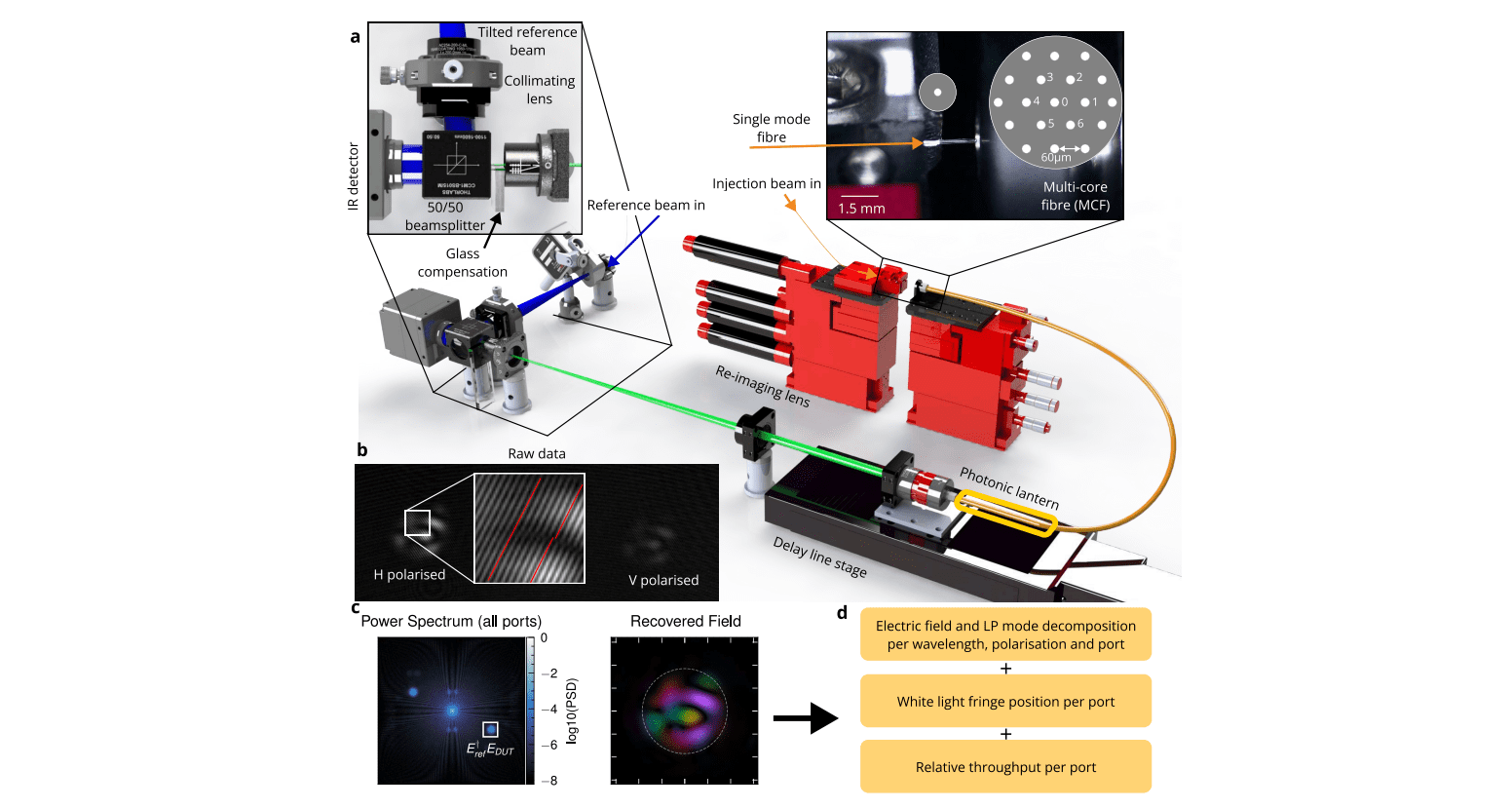
Scientists engineered a characterisation system to directly measure the electric field emerging from a photonic lantern using digital off-axis holography, meticulously tracking its evolution across a 73 nanometer bandwidth near 1550 nanometers and in two orthogonal linear polarisations. The study pioneered a multi-wavelength, polarisation-decomposed characterisation of the principal modes within a photonic lantern, achieving a level of detail previously unattainable. The experimental setup utilizes a broadband or wavelength-sweeping light source, splitting the light into reference and injection beams, and aligning the injection beam to a single core of a multi-core fibre feeding the photonic lantern. A re-imaging lens then projects the resulting mode onto a detector, passing through a polarisation beam displacer to capture both orthogonal polarisations simultaneously.
To facilitate holographic measurement, the reference beam is collimated, tilted, and projected onto the same detector, creating interference fringes essential for digital off-axis holography. A delay line stage precisely controls the path length for each port, ensuring accurate measurements across the broadband spectrum, while data acquisition occurs using the wavelength-sweeping source, both with and without the reference beam present. The system employs a 50/50 beamsplitter and an infrared detector to capture the interference patterns, and a glass compensation element maintains optical path length consistency. Following data acquisition, scientists recover the coherent component in Fourier space, enabling detailed analysis of the electric field and decomposition into linear polarisation modes for each wavelength, polarisation, and port.
This post-processing reveals relative throughput per port and precisely determines the white light fringe position, providing crucial insights into the device’s performance. The team characterised a 19-port photonic lantern, computing its mode transfer matrix and identifying trends in modal coherence, including a direct measurement of differential modal dispersion, offering initial insights into the behaviour of these complex devices. The resulting empirical mode transfer matrices are publicly available, benefiting future work in astrophotonic design, computational imaging, device fabrication and beam shaping.
Photonic Lanterns Measure Wavefront Aberrations
This research focuses on developing and characterising photonic lanterns for wavefront sensing, particularly for astronomical applications. The core research involves creating an all-photonic wavefront sensor that utilizes a photonic lantern to inject light into a single-mode fibre. The quality of the injected light, measured by the power coupled into the single-mode fibre, serves as a metric for incoming wavefront distortion. The photonic lantern efficiently couples multi-mode light into a single-mode fibre, a process highly sensitive to wavefront aberrations, allowing for in-situ measurement of the wavefront directly at the focal plane, avoiding moving parts or complex mechanical adjustments.
The primary target application is adaptive optics for astronomy, enabling correction of atmospheric turbulence and improving image quality. The research demonstrates the high sensitivity of the photonic lantern coupling efficiency to wavefront aberrations, forming the foundation of the wavefront sensing capability. Fabricating high-quality photonic lanterns presents a significant challenge, requiring precise fabrication techniques and reproducible results. Variations in lantern geometry can significantly impact performance. The coupling efficiency is mode-dependent, meaning different spatial modes of light are coupled with different efficiencies, necessitating an understanding and accounting for this mode dependence for accurate wavefront reconstruction.
The system can also be sensitive to the polarization of incoming light and performance can vary with wavelength, requiring broadband designs or wavelength-specific calibration. Reconstructing the wavefront from the measured power requires sophisticated data processing algorithms. Digital holography is used for characterizing the photonic lantern and measuring the coupled light field, leveraging computational imaging techniques to reconstruct the wavefront from the measured data. Future research will focus on improving lantern fabrication, developing robust calibration procedures, improving the speed and efficiency of data processing algorithms, demonstrating performance in a real-world astronomical setting, extending the operating wavelength range, and developing more compact and integrated sensor designs. This research represents a significant step towards developing a robust and efficient all-photonic wavefront sensor for astronomical applications.
Photonic Lantern Modal Characterisation via Holography
This work details the development of a characterisation system capable of directly measuring the complex mode transfer matrix of photonic lanterns. By employing digital off-axis holography, researchers successfully reconstructed the electric field of output modes across a 73 nanometer range near 1550 nanometers, achieving the first multi-wavelength, polarisation-decomposed characterisation of these converters. Analysis of the measured transfer function revealed the typical wavelength scale at which principal modes evolve, aligning with previous inferences, and provided a direct measurement of modal dispersion within the device. The findings demonstrate measurable differences in dispersion and symmetries when comparing experimental results to idealised simulations, highlighting the importance of empirical characterisation for all manufactured devices.
👉 More information
🗞 Illuminating the lantern: coherent, spectro-polarimetric characterisation of a multimode converter
🧠 ArXiv: https://arxiv.org/abs/2510.25330