

The relentless presence of noise poses a fundamental challenge to building reliable quantum computers, and understanding how this noise impacts entanglement is crucial for overcoming it. Kengo Anzai from Akita University, Hiroaki Matsueda from Tohoku University, and Yoshihito Kuno from Akita University, along with their colleagues, investigate how spatially varying noise affects a process called purification, which aims to extract clean entanglement from noisy quantum states. Their work reveals that introducing non-uniform noise fundamentally alters the point at which purification fails, shifting the critical behaviour of the system and leading to a new state where short-range entanglement persists. This discovery is significant because it demonstrates that carefully controlling the spatial distribution of noise, rather than simply reducing it overall, could offer a novel pathway towards stabilising fragile quantum information and improving the resilience of future quantum technologies.
Measurements Improve Quantum State Quality
Quantum computers promise revolutionary computational power, but maintaining the delicate quantum states within these machines presents a significant challenge. Noise and imperfections are inevitable, and can destroy quantum information through a process called decoherence. Researchers are investigating how variations in noise across a quantum circuit affect ‘purification’, a process where measurements can surprisingly improve the quality of a quantum state, counteracting the effects of noise. Current research often focuses on pure quantum states, but real devices operate with mixed states, which are inherently disordered.
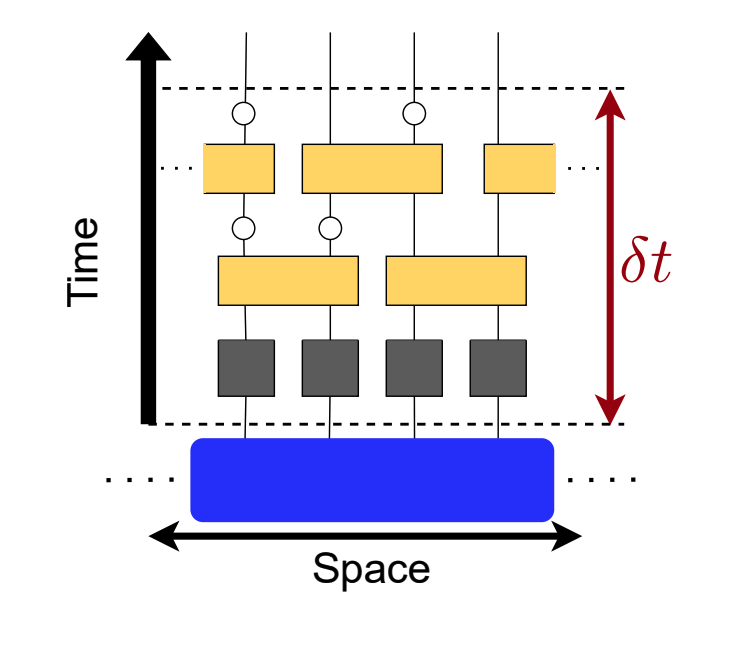
Understanding purification phase transitions in these mixed states is crucial for building robust quantum computers. This research explores how spatial variations in measurement probability impact this purification process, potentially altering the transition between ordered and disordered states. The team’s work centers on hybrid random quantum circuits, complex arrangements of quantum gates and measurements. They discovered that when the probability of measurement varies spatially, the purification phase transition behaves differently than in a uniform system. Using a measure to quantify entanglement, they found that the critical point of the transition shifts, consistent with principles from statistical physics that predict how disorder affects phase transitions.
Specifically, the researchers observed a change in the critical exponent governing the correlation length, indicating a fundamental shift in the type of transition occurring. Furthermore, the team investigated spatially varying the application of quantum gates. This modulation can lead to the emergence of a new phase, characterized by short-range entanglement, a localized connection between qubits. This contrasts with the long-range entanglement typically found in uniform systems, suggesting that spatial modulation can be used to engineer specific entanglement structures. These findings demonstrate that spatial variations in noise and control parameters can dramatically alter quantum purification, offering new avenues for designing more resilient and controllable quantum computers.
Random Circuit Entanglement and Phase Transitions
This research builds upon a strong foundation in quantum phase transitions and entanglement theory, drawing from early works by Sachdev and Harris on critical phenomena and the effects of disorder. Papers by Peres, Horodecki, and Vidal establish the importance of entanglement as a key resource and indicator of phases in these systems. A central theme is the study of random quantum circuits and measurement-induced transitions, with Bao and colleagues publishing core papers establishing the theory and exploring related phenomena. Gullans and Huse contributed important work on dynamical purification, while Li and Fisher investigated the statistical mechanics of quantum error correcting codes.
Other researchers, including Block, Zabalo, and Weinstein, have focused on specific aspects of these transitions, such as long-range interactions. The research relies heavily on computational and numerical methods, utilizing textbooks by Nielsen and Chuang as a foundation. Efficient simulation techniques, such as those developed by Koenig and Smolin, are employed, and tools like autoscale.py are used for finite-size scaling analysis. This emphasis on numerical data analysis demonstrates a commitment to rigorous testing of theoretical predictions. The research extends beyond the core topic, exploring related phenomena such as localization in disordered systems and quasiparticle dynamics. Connections to quantum error correction and the robustness of quantum information are also investigated. Entanglement negativity is a recurring theme, suggesting it’s a key observable used to characterize the phase transition and detect critical behavior.
Spatial Modulation Drives Purification Phase Transition
Results show that spatial modulation significantly affects the purification phase transition. The research begins with a random quantum circuit incorporating measurements and a spatial modulation of measurement probability, then explains the physical quantities of interest, specifically logarithmic purity and a measure of noise. Numerical results are presented to characterise the transition properties and their quantum criticality.
Purification and Entanglement in Random Quantum Circuits
The research investigates systems of qubits subjected to hybrid random quantum circuits, combining random unitary layers with measurement layers. Each qubit is measured with a probability that can be uniform or spatially modulated to control the average probability. The circuits consist of alternating unitary and measurement layers, and the analysis focuses on late-time behavior. The study finds that a measure of entanglement requires longer time steps to saturate than logarithmic purity. The researchers numerically investigate purification phase transitions using an efficient algorithm for the stabilizer formalism.
They establish a connection between the random quantum circuit and an effective spin Hamiltonian, revealing that the spatially modulated measurement probability corresponds to a disordered spin model with a random transverse field. This connection allows for qualitative predictions about the late-time state of the circuit. Two key physical quantities are examined: logarithmic purity and many-body negativity. Logarithmic purity efficiently calculates the entanglement in the system, while many-body negativity quantifies quantum entanglement in mixed states and reveals transitions between states. The researchers calculate both quantities using the stabilizer formalism and Gaussian elimination.
Numerical results for uniform measurement probability demonstrate two distinct phases: a mixed phase and a pure phase, separated by a purification phase transition. The logarithmic purity scales with the difference between the measurement probability and a critical probability of 0.159. Analysis of many-body negativity reveals similar behavior. Finite-size scaling analysis yields a critical probability of 0.167 and a correlation length critical exponent of 1.56. These values differ from those observed in standard measurement-induced phase transitions, suggesting that the spatially modulated measurement probability influences the criticality of the system. The research provides insights into the relationship between circuit complexity, entanglement, and phase transitions in disordered quantum systems.
🗞 Disordered purification phase transition in hybrid random circuits
🧠 DOI: https://doi.org/10.48550/arXiv.2507.12886


