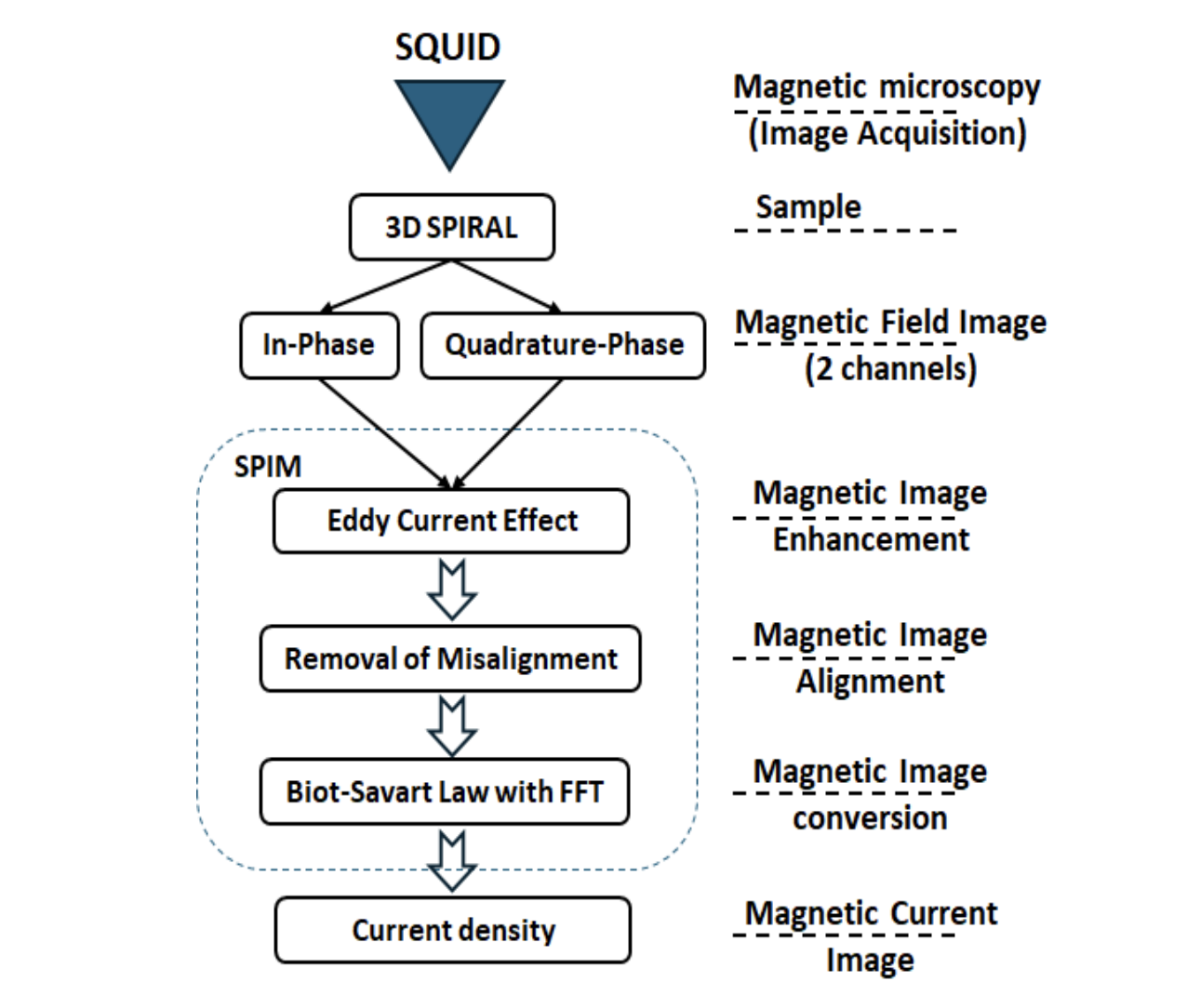
Non-destructive testing of increasingly complex semiconductor packaging presents a significant challenge for modern manufacturing, demanding innovative imaging techniques. Researchers led by J. Senthilnath and Jayasanker Jayabalan, from the Institute for Infocomm Research (I2R) and the National University of Singapore respectively, alongside colleagues including Zhuoyi Lin and et al., have developed a new approach to magnetic field imaging that addresses limitations in current methods. Their work centres on a spatial-physics informed model (SPIM) designed for use with SQUID microscopy, a technique sensitive to the tiny magnetic fields generated by electrical currents. This model improves image clarity and accuracy by accounting for distortions caused by eddy currents and potential misalignment during scanning, ultimately enabling more reliable detection of defects within complex semiconductor structures and highlighting the benefits of combining spatial analysis with physics-based modelling.
Physics-informed imaging reveals buried semiconductor connections
The semiconductor industry increasingly relies on advanced packaging to create complex integrated circuits. Ensuring the reliability of these packages demands rigorous testing, but inspecting deeply buried connections presents a significant challenge. Magnetic field imaging (MFI) offers a promising solution by visualizing the magnetic fields generated by these currents, but accurately interpreting these signals requires overcoming several hurdles. MFI utilizes highly sensitive sensors, such as Superconducting Quantum Interference Devices (SQUIDs), to detect extremely weak magnetic fields. However, several factors can distort the measured magnetic fields, complicating the process of converting them into a clear image of current flow.
To address these challenges, researchers have developed a spatial-physics informed model (SPIM) designed for use with SQUID microscopy. This innovative approach combines spatial analysis with established physics principles to enhance image quality and improve the accuracy of current density reconstruction. The SPIM method operates in three key stages, beginning with the enhancement of the magnetic image by aligning signals from both the in-phase and quadrature-phase channels to minimize the impact of eddy currents. Next, the model applies an affine transformation to correct for any rotational or skewing effects caused by misalignment during the scanning process.
Finally, the SPIM integrates the Biot-Savart Law with a Fast Fourier Transform to convert the processed magnetic field data into a detailed map of current density. By combining these techniques, the SPIM method demonstrably improves both the sharpness and accuracy of magnetic images obtained with SQUID microscopy. The researchers successfully demonstrated the model’s ability to remove rotational and skew misalignments, and enhance the clarity of current density reconstruction. This advancement holds significant potential for improving semiconductor failure analysis, enabling the early detection of defects and enhancing the reliability of advanced packaging technologies.
Magnetic Currents from Fields via Fast Fourier Transform
This method converts magnetic fields to magnetic currents by integrating the Biot-Savart Law with the Fast Fourier Transform. The methodology defines the magnetic field distribution in a three-dimensional space, then transforms it from the spatial domain to the frequency domain. This transformation facilitates the calculation of the magnetic potential, which is then differentiated to obtain the magnetic current density. The calculated magnetic current density is transformed back to the spatial domain, providing a spatial map of the magnetic currents derived from the initial magnetic field distribution.
SPIM Corrects Image Distortion and Sharpness
Results demonstrate that the proposed Spatial Phase Interpolation Method (SPIM) improves in-phase channel sharpness by 0.3% and reduces quadrature-phase channel sharpness by 25%. Furthermore, the method successfully removes rotational and skew misalignments measuring 0.30 in a real image. These findings suggest a promising avenue for improving the performance of imaging systems and image processing algorithms.
Spiral Sample Imaging with Physics-Informed Models
This study experimentally demonstrates magnetic field imaging using a SQUID microscopy scanner on a three-dimensional spiral sample. The SPIM method demonstrates several improvements, including a 0.3% improvement in the sharpness of the processed in-phase channel and a 25% reduction in the quadrature-phase channel. Image alignment through affine transformation visually outperforms adjustment for rotation, effectively addressing the skew effect of 0.30. Applying a Fast Fourier Transform with a cut-off value of 25 mm−1 provides a feasible current density and direction. While this study primarily focuses on improving lateral resolution, there is potential for future extensions of the model to incorporate both lateral and vertical resolutions, as well as to investigate samples with defects for fault isolation. ACKNOWLEDGMENT This study is supported by the Machine Learning Guided Failure Analysis & Diagnostic Capability Development for Next Generation 3D-IC Packaging at A*STAR via the IAF-PP by the Agency for Science, Technology and Research under Grant No. M23K8a0050.
🗞 A Spatial-Physics Informed Model for 3D Spiral Sample Scanned by SQUID Microscopy
🧠 DOI: https://doi.org/10.48550/arXiv.2507.11853