


As Europe asserts its technological sovereignty, a milestone has been reached in Spain with the unveiling of the country’s first quantum computer developed entirely with European technology, marking a significant stride in the region’s pursuit of computational autonomy.
This breakthrough, spearheaded by the Barcelona Supercomputing Center, consolidates Spain’s position at the forefront of supercomputing and paves the way for a new era of hybrid computing, combining traditional and quantum capabilities.
The Quantum Spain initiative, backed by the Ministry for Digital Transformation and Civil Service, aims to bolster technological and industrial development nationwide, with far-reaching implications for fields such as chemistry, logistics, finance, and security.
By harnessing the power of quantum computing, which enables the study of phenomena at the atomic level, Spain seeks to accelerate innovation, foster industrial progress, and create highly skilled jobs, while also reducing dependence on foreign technologies and aligning with the European Commission’s strategy for technological autonomy.
Key themes emerging from this development include the integration of quantum and classical technologies, the potential for transformative applications, and the importance of European collaboration in shaping the future of computing.
Quantum Leap: Spain’s First Homegrown Quantum Computer Revolutionizes Computing Landscape
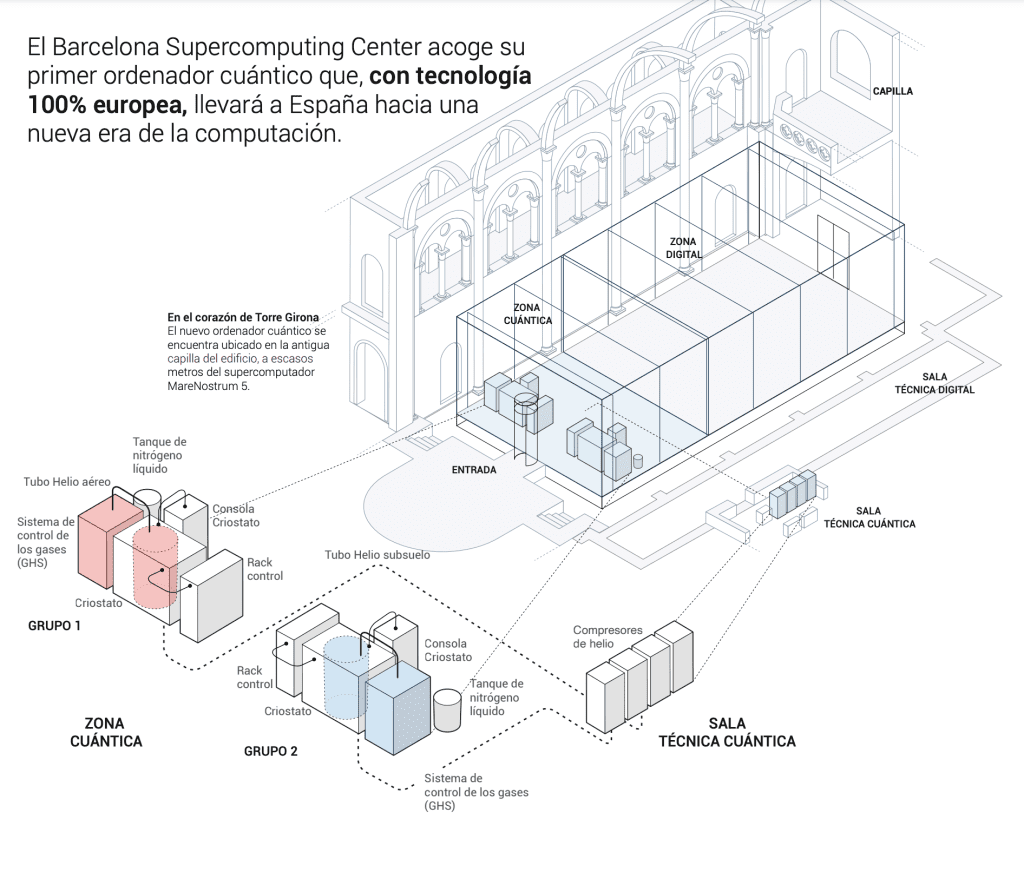
In a groundbreaking achievement, the Barcelona Supercomputing Center (BSC) has unveiled Spain’s first quantum computer, developed entirely with European technology. This milestone marks a significant step forward for the country’s technological and industrial development, cementing its position as a leader in quantum research and supercomputing. The new system, part of the Quantum Spain initiative, will be available to the research community, companies, and public organizations, fostering innovation and progress across various sectors.
Introduction to Quantum Computing
Quantum computing has the potential to transform diverse fields by enabling the study of phenomena at the atomic level. Its applications range from chemistry, where it could accelerate the development of new materials and medicines, to the resolution of complex problems in sectors such as logistics and finance. The technology’s ability to optimize processes makes it a key tool for these areas, especially when combined with artificial intelligence to develop more efficient machine learning algorithms. In the field of security, quantum computing could transform cryptography, presenting new challenges but also offering more robust solutions.
The Quantum Spain Initiative
The Quantum Spain initiative, promoted by the Ministry for Digital Transformation and Civil Service through SEDIA, aims to strengthen technological and industrial development throughout the country. The initiative is part of the Digital Spain 2026 program and the National Artificial Intelligence Strategy (ENIA). Funded by the Recovery, Transformation and Resilience Plan, Quantum Spain is a collaborative effort involving 27 leading research and supercomputing institutions in Spain, including the 14 nodes of the Spanish Supercomputing Network (RES) and other institutions such as CSIC, ICFO, and universities.
The New Quantum Computer
The new quantum computer, developed by the joint venture formed by Spanish companies Qilimanjaro and GMV, is based on superconducting qubits, the fundamental units of quantum computing. Unlike traditional bits, these qubits can represent multiple states simultaneously, allowing them to perform much more complex calculations. The system, built with 100% European technology, represents a decisive step in Spain’s strategy in quantum computing and reinforces European technological autonomy, aligning with the European Commission’s strategy to reduce dependence on key infrastructures from third countries.
Integration with MareNostrum 5
The new quantum computer will be integrated into MareNostrum 5, the most powerful supercomputer in Spain and one of the most advanced in the world. This integration represents a significant advance in the country’s computational capacity, offering complementary technologies that make up the BSC’s quantum infrastructure. The combination of quantum and classical technologies will boost research and innovation, fostering industrial and technological progress in Spain and contributing to the creation of highly qualified jobs.
Access and Applications
The new system will be available to the scientific community, companies, and public organizations through the access mechanisms of the Spanish Supercomputing Network (RES). Quantum computing has the potential to transform various fields, including chemistry, logistics, finance, and security. Its applications range from accelerating the development of new materials and medicines to optimizing complex processes and transforming cryptography.
Conclusion: A New Era for Computing
The introduction of Spain’s first homegrown quantum computer marks a significant milestone in the country’s technological development. The Quantum Spain initiative and the integration of the new quantum computer with MareNostrum 5 demonstrate the country’s commitment to innovation and progress. As quantum computing continues to evolve, it is likely to have a profound impact on various sectors, from research and development to industry and security. With its strong foundation in European technology, Spain is well-positioned to play a leading role in shaping the future of quantum computing.
The development of this new quantum computer has been financially supported by the Ministry for Digital Transformation and the Civil Service of the Spanish Government through the QUANTUM ENIA project call – Quantum Spain project and by the European Union through the Recovery, Transformation and Resilience Plan – NextGenerationEU within the framework of the Digital Spain 2026 Agenda. As the computing landscape continues to evolve, one thing is certain: quantum computing is here to stay, and its potential to transform our world is vast and exciting.
Key Takeaways:
- Spain’s first homegrown quantum computer has been developed with 100% European technology.
- The Quantum Spain initiative aims to strengthen technological and industrial development throughout the country.
- The new quantum computer will be integrated into MareNostrum 5, offering complementary technologies that make up the BSC’s quantum infrastructure.
- Quantum computing can potentially transform various fields, including chemistry, logistics, finance, and security.
- Combining quantum and classical technologies will boost research and innovation, fostering industrial and technological progress in Spain.
External Link: Click Here For More


