

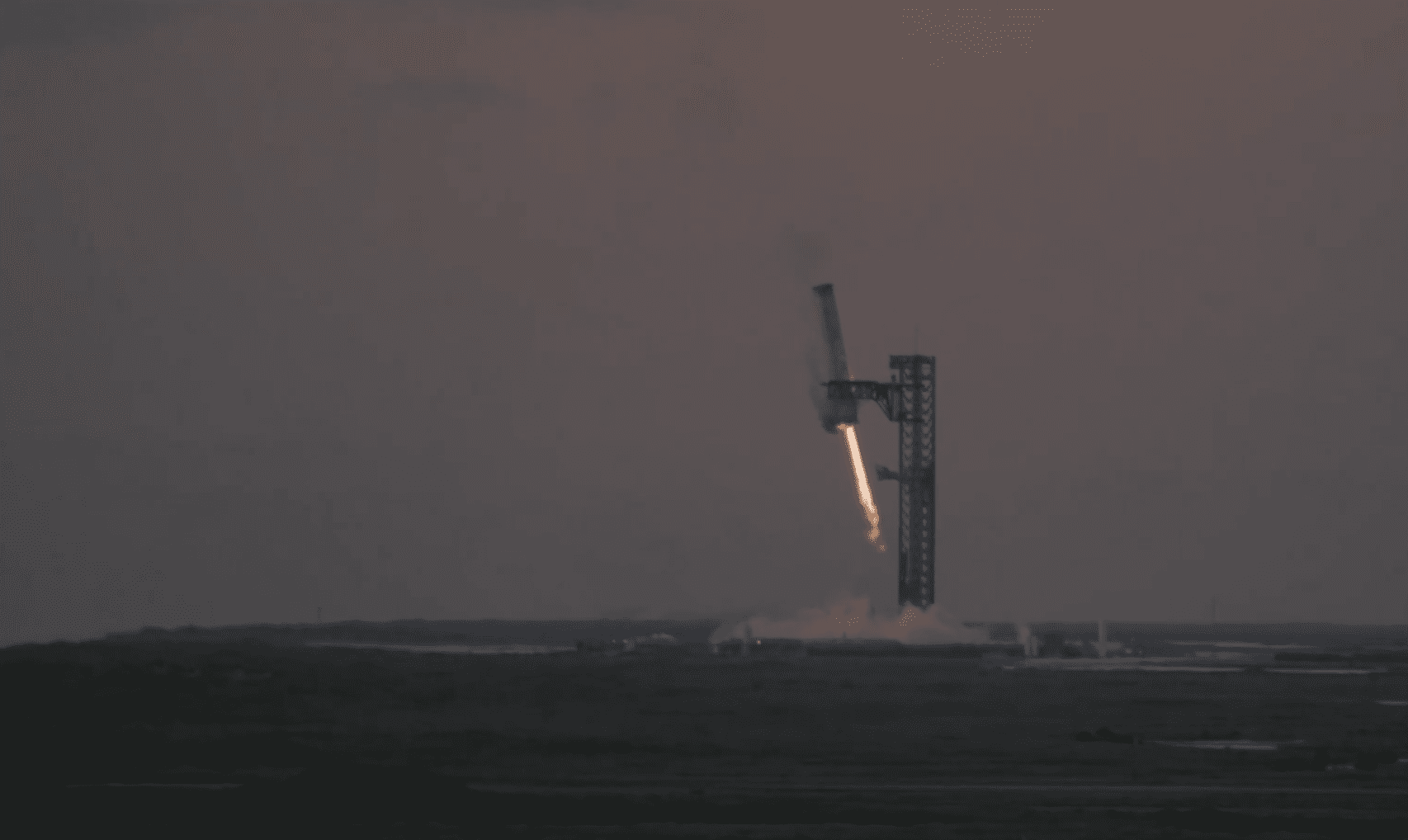
In a groundbreaking achievement, SpaceX’s Starship successfully completed its fifth flight test on October 13, 2024, demonstrating crucial techniques for its fully and rapidly reusable design. The Super Heavy booster was caught by the Mechazilla launch and catch tower at Starbase, marking a significant milestone in the development of this revolutionary spacecraft.
Following a successful liftoff, ascent, and stage separation, the booster performed a precise landing burn before being caught by the tower’s chopstick arms. This impressive feat was made possible by the tireless efforts of SpaceX engineers.
The Starship executed a flawless hot-staging separation, igniting its six Raptor engines and completing its ascent into outer space. It then coasted to the other side of the planet, reentered the atmosphere, and splashed down in the Indian Ocean, concluding the flight test just over an hour after launch. This remarkable achievement brings humanity one step closer to making life multiplanetary, a vision championed by SpaceX CEO Elon Musk.
Starship’s Fifth Flight Test: A Major Milestone Towards Reusability
The fifth flight test of SpaceX’s Starship on October 13, 2024, marked a significant achievement in developing this next-generation spacecraft. The test demonstrated several critical techniques essential for Starship and Super Heavy’s fully and rapidly reusable design. This milestone was reached after months of tireless work by SpaceX engineers, who successfully met thousands of distinct vehicle and pad criteria before the catch attempt.
The flight test began with a successful liftoff, followed by ascent, stage separation, boostback burn, and coast. The Super Heavy booster then performed its landing burn and was caught by the chopstick arms of the launch and catch tower at Starbase. This feat is a testament to the engineering prowess of SpaceX, as it showcases the company’s ability to design and execute complex systems.
The Starship itself executed another successful hot-staging separation, igniting its six Raptor engines and completing ascent into outer space. It then coasted along its planned trajectory to the other side of the planet before executing a controlled reentry, passing through the phases of peak heating and maximum aerodynamic pressure. The spacecraft finally executed a flip, landing burn, and splashdown at its target area in the Indian Ocean. The entire flight test concluded at splashdown, 1 hour, 5 minutes, and 40 seconds after launch.
Reusability: The Key to Making Life Multiplanetary
The successful catch of the Super Heavy booster by Mechazilla marks a significant step towards reusability, a critical component of SpaceX’s vision for making life multiplanetary. By demonstrating the ability to recover and reuse boosters, SpaceX is paving the way for more efficient and cost-effective space travel. This technology will enable the company to launch payloads and crew to destinations on Earth, the Moon, Mars, and beyond.
Reusability is a crucial aspect of SpaceX’s Starship program, as it allows for the reduction of production costs and the increase of launch frequencies. By reusing boosters, SpaceX can significantly decrease the cost per launch, making space travel more accessible and affordable. This, in turn, will enable the company to launch more missions, furthering humanity’s presence in space.
The Future of Space Travel: Crewed Missions and Beyond
The successful fifth flight test of Starship brings SpaceX one step closer to its goal of carrying crew and cargo to destinations on Earth, the Moon, Mars, and beyond. With reusability now a proven technology, the company can focus on developing the necessary systems for crewed missions.
SpaceX’s vision for the future of space travel is ambitious, with plans to establish a permanent human presence on the Moon and Mars. The Starship program is critical to achieving this goal, as it will provide the necessary transportation infrastructure for both crew and cargo. By making life multiplanetary, SpaceX aims to ensure the survival of humanity, even in the event of a global catastrophe.
The Role of Mechazilla in Reusability
Mechazilla, the launch and catch tower at Starbase, played a critical role in the successful catch of the Super Heavy booster during the fifth flight test. This system is designed to recover boosters after launch, allowing for their reuse in future missions.
The development of Mechazilla is a testament to SpaceX’s commitment to reusability. By designing and building this complex system, the company has demonstrated its ability to innovate and push the boundaries of what is thought possible. The successful catch of the Super Heavy booster marks a significant milestone in the development of Mechazilla, paving the way for future reuse of boosters.
Conclusion: A Leap towards Making Life multiplanetary
The fifth flight test of Starship marks a significant leap towards making life multiplanetary. With reusability now a proven technology, SpaceX can focus on developing the necessary systems for crewed missions and establishing a permanent human presence on the Moon and Mars. The successful catch of the Super Heavy booster by Mechazilla is a testament to the engineering prowess of SpaceX, showcasing the company’s ability to design and execute complex systems.
As SpaceX continues to push the boundaries of what is thought possible, it is clear that the future of space travel is bright. With reusability now a reality, the possibilities for humanity’s presence in space are endless.
External Link: Click Here For More


