

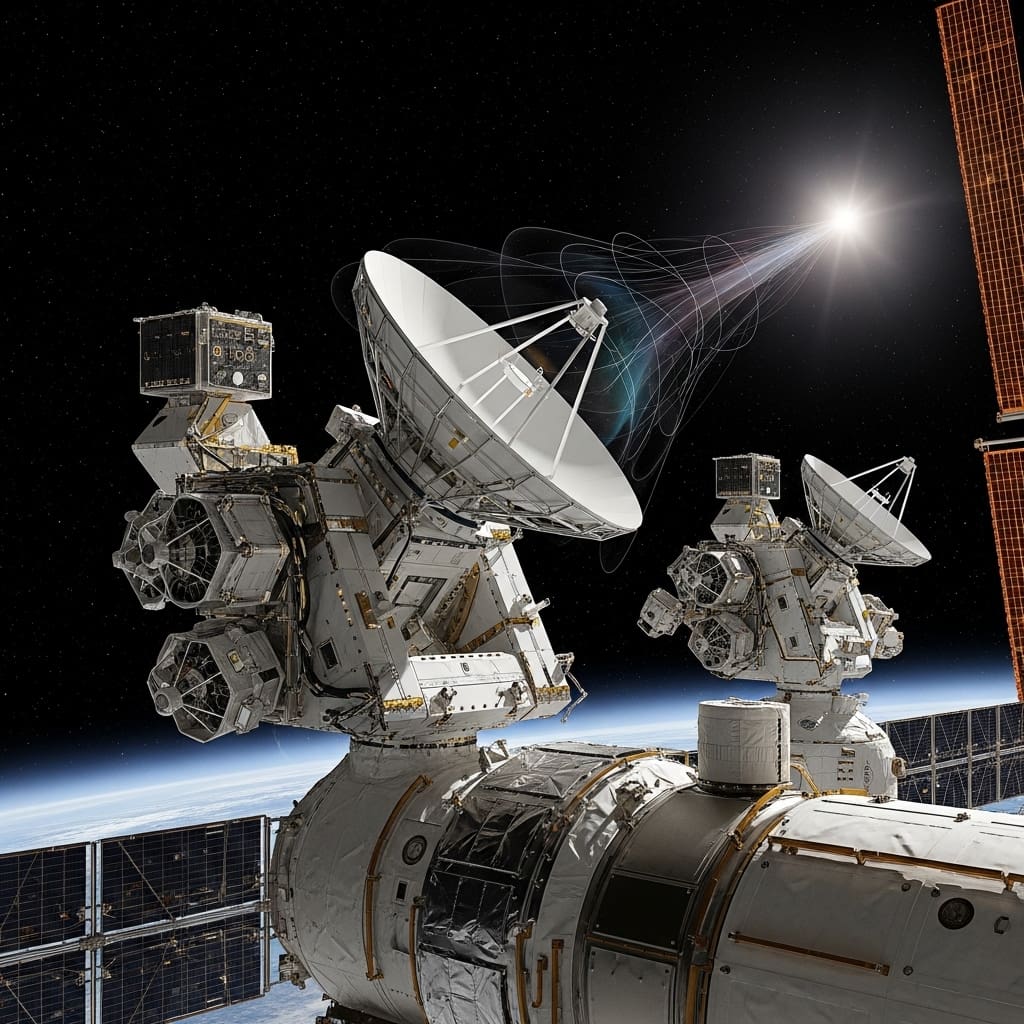
Scientists are increasingly focused on understanding the dynamic behaviour of the ionosphere, particularly during periods of heightened solar activity. Rachel Ulrich, Kelly R. Moran, and Ky Potter, from Los Alamos National Laboratory, alongside Lauren A. Castro, Gabriel R. Wilson et al., detail a novel statistical processing pipeline for data acquired by the Electric Propulsion Electrostatic Analyzer Experiment (ÈPÈE) aboard the International Space Station. Deployed during the peak of Solar Cycle 25, ÈPÈE captured crucial in situ measurements of the topside ionosphere, but extracting meaningful signals proved challenging due to inherent instrument noise. This research significantly advances the field by recovering data previously discarded as noisy, utilising a Vecchia Gaussian process approximation to model and subtract the noise floor, thereby increasing data coverage and improving our ability to monitor ionospheric variability and its impact on technologies like radio communication and navigation.
This innovative approach recovers values that would typically be rejected by conventional thresholding techniques, substantially increasing data coverage and enabling more robust monitoring of ionospheric variability.
The resulting products offer enhanced insights into the complex dynamics of the ionosphere, a low-density plasma region critical for understanding space-weather impacts on satellite navigation and radio communication. ÈPÈE operates by measuring ion energy and current, providing data at a rate of 0.5Hz, or one data point every two seconds, across 100 discrete energy bins ranging from approximately 0.8 to 185 electron Volts. Interpretation of these measurements relies on principles of plasma physics, specifically the use of a drifted Maxwellian distribution to approximate the ion velocity distribution, accounting for the non-equilibrium conditions around the ISS.
By analyzing the current peak and corresponding energy value at each timestamp, researchers can solve for the spacecraft potential, a key parameter for understanding the interaction between the spacecraft and the surrounding plasma. The statistical pipeline presented in this work leverages the relationship between ion current and velocity distribution, utilizing a Gaussian process to model the underlying signal and separate it from noise.
This allows for a more accurate estimation of plasma parameters, such as density and temperature, which are essential for anticipating space-weather effects on low Earth orbit satellites supporting vital infrastructure. The instrument operates by combining sensor geometry with an applied electric field, functioning as an energy bandpass filter with a measurement rate of 0.5Hz, yielding a data point every two seconds.
At each timestamp, ÈPÈE records current (I) and energy (E) in electron Volts (eV) across 100 discrete energy bins, spanning a total range of approximately 0.8 to 185 eV. This results in a distribution of current values characterizing the local space plasma at each moment in time. This innovative approach leverages principles of plasma physics, specifically the one-dimensional Maxwellian distribution, to interpret the measured ion current. ÈPÈE’s measurements of current are directly proportional to the integral of the velocity distribution weighted by particle speed within the analyzer’s energy window.
The resulting statistical products increase data coverage and facilitate noise-assisted monitoring of ionospheric variability, providing critical insights into space-weather impacts on satellite navigation and radio communication. The new methodology classified only 38 data points as “true noise” within a seven-hour period, a marked improvement compared to the original thresholding method which discarded 2,144 points during the same timeframe.
This represents a significant increase in usable data for characterizing plasma behavior in the topside ionosphere during the Solar Cycle 25 maximum. The processing pipeline estimates instrument noise, accounts for irregular sampling, and extracts ionospheric signals by learning a baseline noise model and employing a scaled Vecchia Gaussian process approximation.
This approach recovers values typically rejected by standard thresholding techniques, increasing data coverage and enabling improved monitoring of ionospheric variability. Candidate noise profiles are selected based on minimizing the integral over energy bins 2 through 20, a stable region identified for noise profile selection.
Analysis of data spanning Julian days 271-272 revealed that the revised approach not only reduced noise classification but also concentrated identified “true noise” within a limited window of time, latitude, and longitude. This concentration suggests a potential starting point for identifying the location of the Equatorial Ionization Anomaly, opening avenues for future research.
Furthermore, the smoothed current values derived from the new methodology provide more continuous spacecraft potential estimations, filling gaps in data previously available only from the FPMU instrument’s FPP and WLP sensors. This methodology offers a general framework applicable to other sensor interpretation tasks, extending beyond the specific data and scenario of this study.
The resulting smoothed energy and current data are valuable for estimating plasma density, exploring the Equatoral Ionisation Anomaly, and analysing fluctuations in relation to the ISS orbit. Future work will focus on longer-term data analysis to confirm this observation and account for additional influencing factors.
👉 More information
🗞 Ionospheric Observations from the ISS: Overcoming Noise Challenges in Signal Extraction
🧠 ArXiv: https://arxiv.org/abs/2602.02706


