

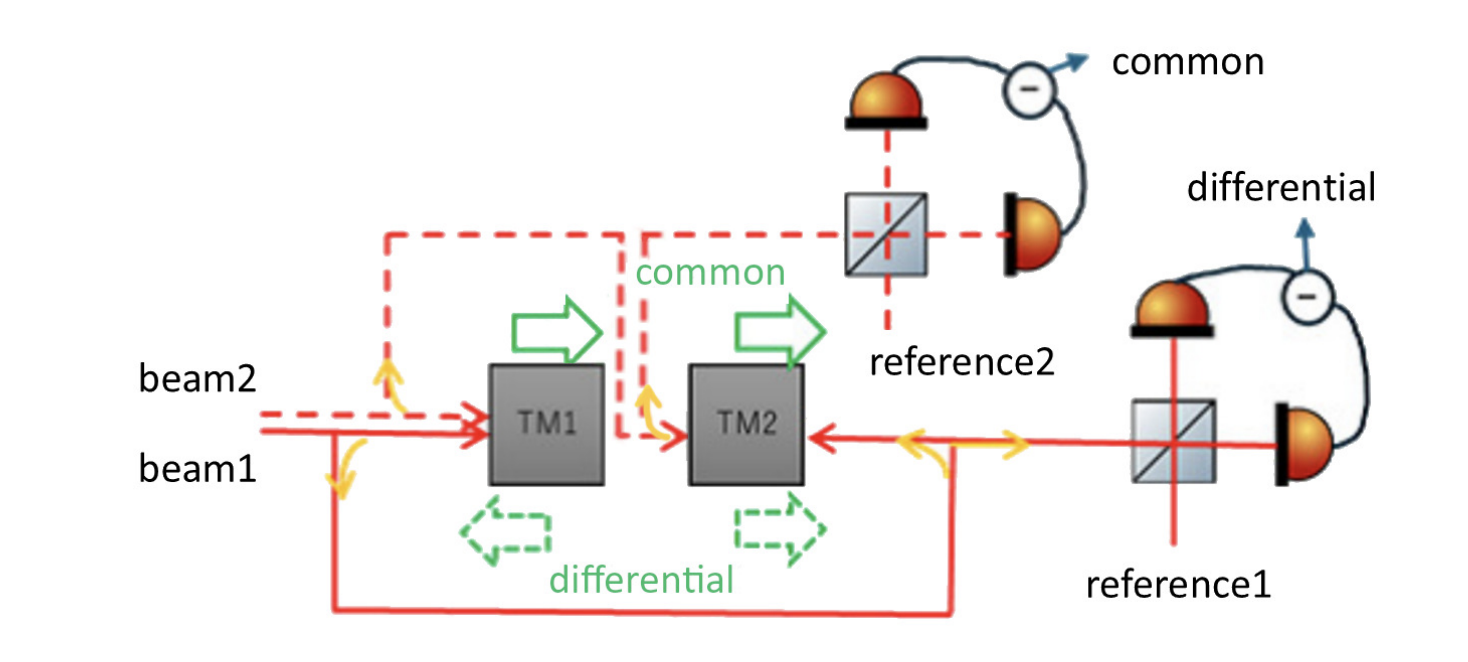
The search for experimental evidence supporting theories of quantum gravity represents a fundamental challenge in modern physics, and researchers are now exploring novel ways to detect subtle quantum effects in the gravitational field. Nobuyuki Matsumoto from Gakushuin University, Katsuta Sakai from RIKEN, and Kosei Hatakeyama from Kyushu University, along with their colleagues, propose a space-based instrument designed to detect gravitationally induced entanglement (GIE), a phenomenon predicted by some quantum gravity theories. Their design utilises a miniature interferometer, inspired by the LISA Pathfinder mission, but employs milligram-scale test masses and a millimetre separation, dramatically increasing its sensitivity to these delicate quantum effects. The team’s simulations demonstrate that GIE could be experimentally verified with a relatively short integration time, offering a promising pathway towards bridging the gap between quantum mechanics and general relativity.
Confirming the quantum nature of gravity remains a key goal in theoretical physics, and researchers are now exploring ways to test this using gravitationally induced entanglement. This intriguing phenomenon suggests that massive particles can become entangled simply through their gravitational attraction, without any need for direct electromagnetic interaction. Demonstrating this entanglement would not only provide evidence supporting a quantum theory of gravity, but also potentially unlock new possibilities for advanced quantum technologies, requiring precise measurements of entangled particles.
👉 More information
🗞 Space-based mm/mg-scale Laser Interferometer for Quantum Gravity
🧠 DOI: https://doi.org/10.48550/arXiv.2507.12899


