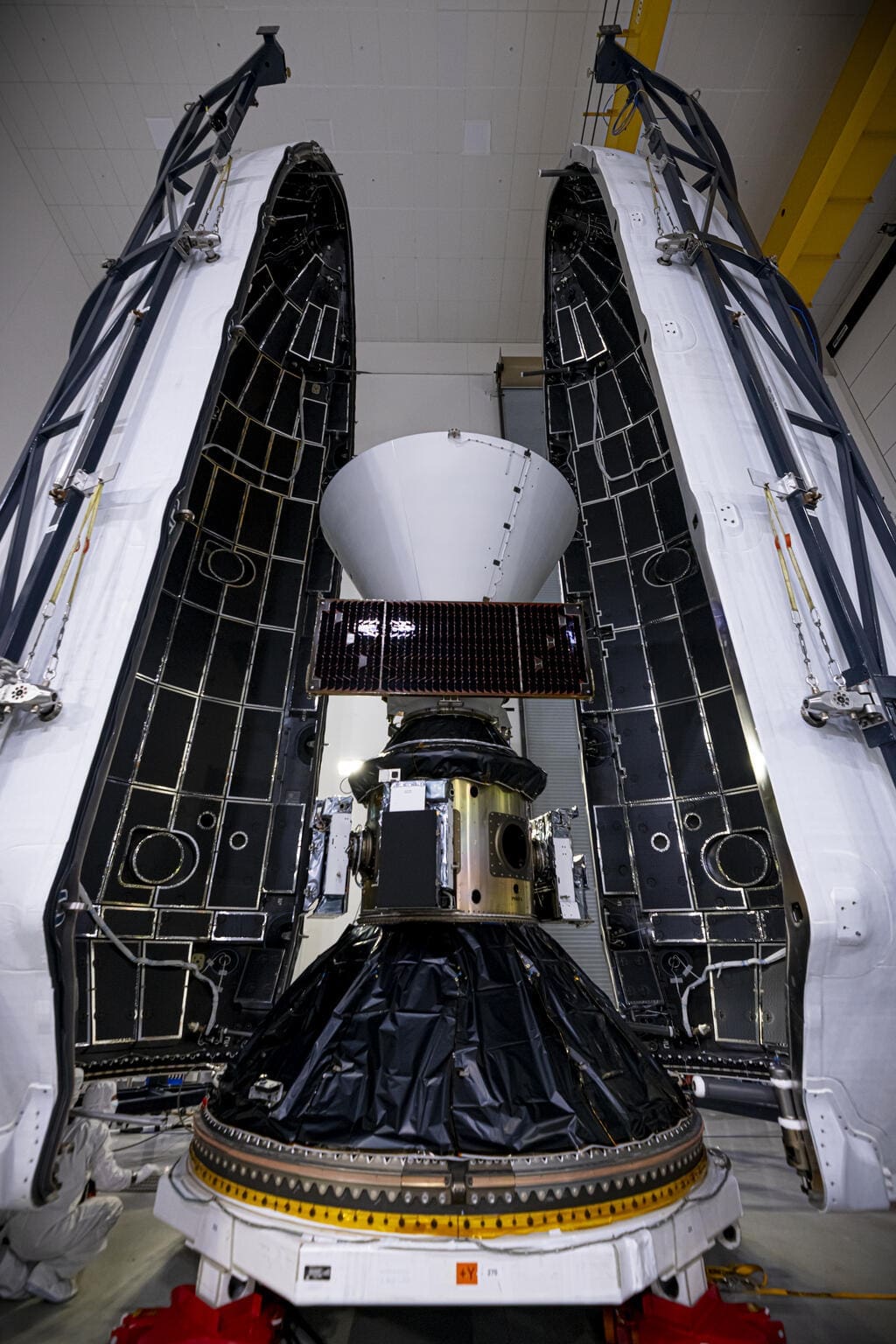
Southwest Research Institute (SwRI) led the launch of four small spacecraft as part of NASA’s PUNCH mission on March 11, 2025, from Vandenberg Space Force Base in California. The constellation aims to study the solar corona and its transition into the solar wind using a coronagraph developed by the U.S. Naval Research Laboratory and wide-field imagers designed by SwRI.
Principal Investigator Dr. Craig DeForest of SwRI’s Solar System Science and Exploration Division in Boulder, Colorado, oversees the mission. For the first time, the mission will track space weather events like coronal mass ejections in three dimensions, enhancing our ability to predict and mitigate their effects on Earth-based systems. The spacecraft are undergoing a 90-day commissioning period before beginning their science mission in June 2025, with data shared through NASA’s Solar Data Analysis Center.
PUNCH Constellation Launches from Vandenberg Space Force Base
The PUNCH constellation, comprising four small spacecraft, was successfully launched from Vandenberg Space Force Base on March 11, 2025. This mission, led by Southwest Research Institute (SwRI) under NASA‘s auspices, aims to study the solar corona and its transition into the solar wind.
PUNCH stands for “Polarimeter to Unify the Corona and Heliosphere.” Its primary objective is to investigate how the Sun’s outer atmosphere transforms into the solar wind. The four spacecraft work in tandem, forming a virtual instrument that provides comprehensive observations of this dynamic process.
Each spacecraft is equipped with advanced instruments: one carries a coronagraph to observe the corona, while the others are fitted with wide-field imagers to capture the behavior of the solar wind extending into space. These instruments use deep baffles to suppress stray light, ensuring high-contrast observations. The scientific instruments incorporate polarization filters to enhance data accuracy, enabling precise measurements of magnetic fields and plasma properties in the corona and heliosphere.
The mission’s findings will directly benefit efforts to protect Earth’s infrastructure from the adverse effects of solar storms. Improved predictions of space weather phenomena will allow for better preparedness and mitigation strategies, ensuring the resilience of critical systems in the face of solar activity. Through its innovative approach, PUNCH advances our ability to monitor and understand the dynamic processes shaping the Sun-Earth environment.
More information
External Link: Click Here For More