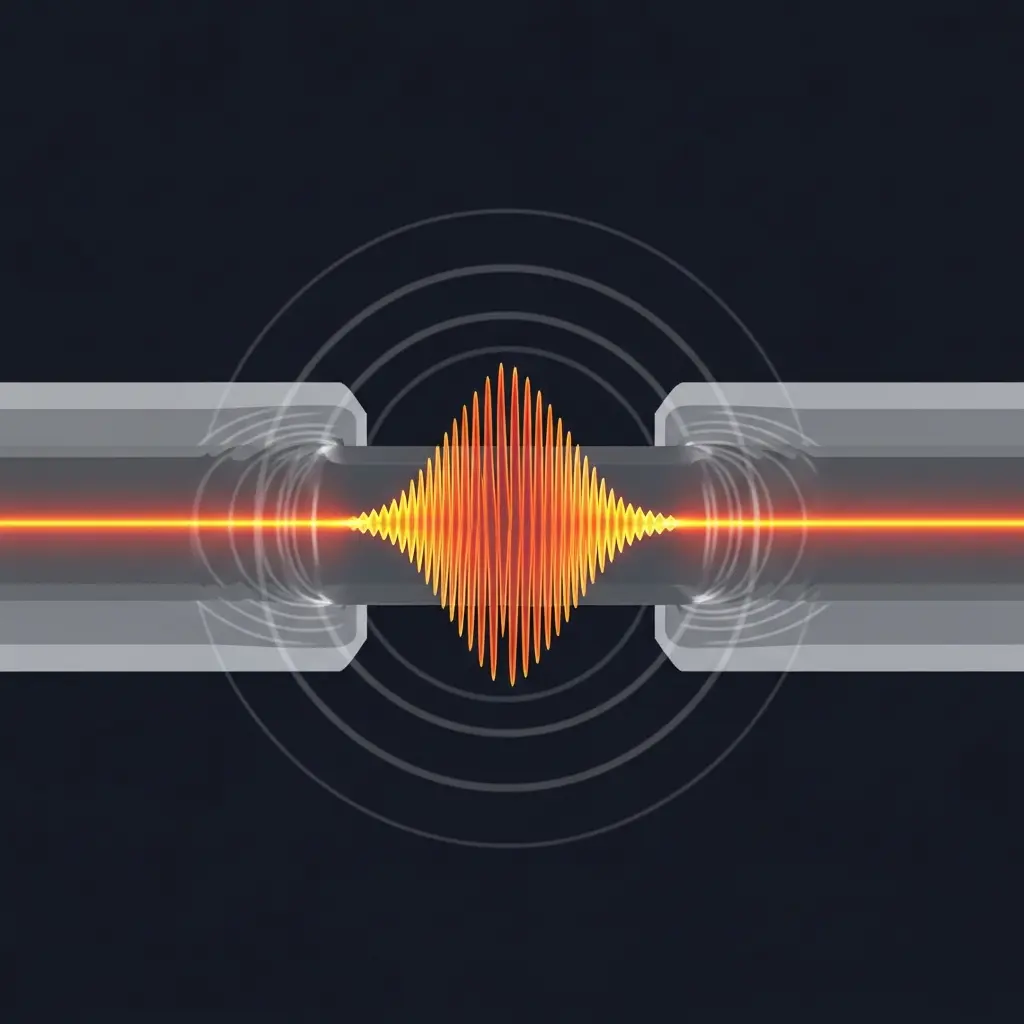
Researchers are increasingly focused on integrating acoustic modulation into photonic integrated circuits for advances in signal processing and microwave photonics. Zheng Zheng, Ahmet Tarık Işık, and Akshay Keloth, from the Nonlinear Nanophotonics Group at the University of Twente, alongside Ye et al., demonstrate thermoelastic surface acoustic waves (SAW) within silicon nitride integrated circuits, a platform typically limited by its lack of piezoelectric properties. This work circumvents the need for hybrid material integration by achieving acousto-modulation directly within the silicon nitride, realising a 13.6 dB phase modulation efficiency enhancement and a suppression ratio of 8 dB in single-sideband intermodal scattering. This initial development of thermoelastic SAW techniques promises significant progress towards fully integrated and programmable photonic systems with low propagation losses of 8 dB/m.
Thermoelastic acoustic wave modulation in low-loss silicon nitride photonics
Scientists have achieved a significant advance in integrated photonics by demonstrating thermoelastic surface acoustic waves within low-loss silicon nitride circuits without requiring additional materials. This breakthrough addresses a fundamental limitation of silicon nitride, a promising platform for scalable photonic devices, which naturally lacks piezoelectric properties necessary for acousto-optic modulation.
The research details the successful implementation of thermoelastic surface acoustic waves, generated via absorption of modulated pump light in a metallic grating, to actively control light within the silicon nitride structure. Maintaining a remarkably low optical propagation loss of 8 dB/m, the study showcases a versatile technique with potential for a range of applications.
Initially, researchers demonstrated efficient acousto-optic phase modulation, leveraging the low propagation loss to maximize interaction between light and acoustic waves through a multi-pass waveguide configuration. This configuration resulted in a 13.6-dB enhancement in modulation efficiency at a frequency of 0.81GHz, utilising a gold metallic grating with a 4-μm period.
Furthermore, single-sideband acousto-optic modulation was achieved through intermodal scattering at 0.76GHz, employing a 6-μm period metallic grating and attaining an 8-dB extinction ratio. The work extends beyond phase control, demonstrating a conversion of phase-to-intensity modulation using a ring resonator, with intensity modulation signals observed at 0.95 and 1.75GHz.
This innovative thermoelastic SAW technique, implemented in a low-loss silicon nitride platform, promises to expand the capabilities of integrated microwave photonics and programmable photonic systems. The chip design incorporates a 100-nm thick silicon nitride core waveguide covered by a 2-μm silica layer, with a 20-nm gold grating acting as the acoustic emitter.
This research establishes a pathway towards creating more dynamic and adaptable photonic circuits, offering a compelling alternative to traditional approaches that rely on material integration or thermo-optic effects. The demonstrated functionalities, phase modulation, intermodal scattering, and phase-to-intensity conversion, pave the way for advanced signal processing, quantum photonics, and data communication technologies within a compact, low-loss silicon nitride framework.
Fabrication of silicon nitride waveguides and gold gratings for integrated optoacoustic devices
A 100-nanometre thick silicon nitride layer was deposited via low-pressure chemical vapour deposition onto a silicon wafer with 8μm thermal oxide, followed by annealing at 1200°C to establish the foundational material for the photonic circuits. Waveguides were then patterned using electron beam lithography and transferred to the silicon nitride layer through reactive ion etching, precisely defining the optical pathways.
Subsequently, a 2μm thick silica layer was deposited using low-pressure chemical vapour deposition, providing structural support and optical confinement. Metallic gratings, crucial for acoustic wave generation, were defined by electron beam lithography and formed by magnetron sputtering of a 5nm chromium adhesion layer and a 20nm gold layer, ensuring efficient coupling between light and sound.
Lift-off in acetone under ultrasonication completed the fabrication process, yielding the final device structures. Experimental investigations employed a single-frequency pump laser at 1558nm and a tunable probe laser around 1557nm to excite and analyse the acoustic waves. The pump light underwent intensity modulation with a Thorlabs LN81S-FC modulator driven by a Wiltron 69147A signal generator before amplification by an Amonics AEDFA-C amplifier.
Heterodyne measurement, comparing the device output with a frequency-shifted signal from an Aerodiode RFAOM-AT-200, was captured by an Optilab PD-23-C-DC photodiode and displayed on a Keysight N9000B ESA. Intensity modulation was characterised using a Keysight P5005A-200, 2-port vector network analyser, revealing signals at 0.95GHz and 1.75GHz originating from fundamental modes and second-harmonic generation of the surface acoustic waves. This thermoelastic SAW technique demonstrates a 13.6 dB phase modulation efficiency enhancement with a multi-pass configuration and a single-sideband intermodal scattering suppression ratio of 8 dB.
High-efficiency acousto-optic modulation and intermodal scattering in silicon nitride waveguides
Thermoelastic surface acoustic waves (SAW) in silicon nitride integrated circuits achieve a propagation loss of 8 dB/m without requiring additional materials. Efficient acousto-optic phase modulation is demonstrated, benefiting from the low propagation loss which enables extended light and acoustic wave interaction lengths through multiple waveguide passes.
This multi-pass configuration yields a 13.6-dB enhancement in modulation efficiency at a modulation frequency of 0.81GHz, utilising a gold metallic grating with a 4-μm period. The observed enhancement approaches a saturation point attributable to SAW dissipation during propagation. Furthermore, single-sideband intermodal scattering is measured at 0.76GHz with a 6-μm period metallic grating, achieving an 8-dB extinction ratio.
This scattering process relies on a slight tilt angle of the gratings relative to a multimode waveguide, compensating for the wave vector differences between TE0 and TE1 optical modes. The forward propagation direction facilitates scattering from the fundamental TE0 mode to the higher-order TE1 mode, shifting the frequency by the SAW frequency.
Intensity modulation is also observed through the incorporation of phase modulation into a ring resonator, demonstrating intensity modulation signals at frequencies of 0.95 and 1.75GHz. This conversion leverages the positioning of modulated sidebands on the spectral slope of the ring resonator transmission function. The work demonstrates the potential of this thermoelastic SAW technique for integrated microwave photonics and programmable photonics applications within a silicon nitride platform.
Thermoelastic modulation achieves high-efficiency acousto-optic control in silicon nitride
Scientists have demonstrated thermoelastic surface acoustic wave modulation within silicon nitride integrated circuits without the need for additional materials. This achievement overcomes a key limitation of silicon nitride, which typically lacks piezoelectric properties necessary for acousto-modulation, and opens avenues for its use in advanced photonic applications.
A phase modulation efficiency enhancement of 13.6 dB was realised using a multi-pass configuration, alongside the observation of single-sideband intermodal scattering with an 8 dB suppression ratio and intensity modulation through integration with a ring resonator. The research establishes a pathway towards integrated microwave photonics and programmable photonics by utilising thermoelastic interactions to modulate light within a low-loss platform.
Measurements of radio frequency power differences between ports revealed fundamental SAW modes at 0.95GHz and second-harmonic generation at 1.75GHz, demonstrating control over modulation frequencies by adjusting ring resonator characteristics and probe wavelength. The refractive index perturbation induced by the acoustic waves was estimated to be 3x 10⁻⁸ refractive index units, highlighting the sensitivity of the system.
The authors acknowledge that further optimisation is required to improve modulation efficiency. Specifically, engineering the cladding thickness, metallic grating patterns, and integrating on-chip pump delivery via grating couplers are identified as key areas for future work. Despite these limitations, this initial validation of thermoelastic SAW modulation and the associated demonstrations represent a significant step towards realising programmable photonic circuits based on silicon nitride.
🗞 Thermoelastic surface acoustic waves in low-loss silicon nitride integrated circuits
🧠 ArXiv: https://arxiv.org/abs/2602.06732