The interplay between temperature and concentration gradients drives fundamental transport phenomena in many physical systems, and recent research explores these effects in the extreme conditions of hot, dense quantum chromodynamics (QCD) matter. Kamaljeet Singh, Kangkan Goswami, and Raghunath Sahoo, from the Indian Institute of Technology Indore and CERN, present the first comprehensive investigation of the Soret and Dufour effects within this exotic state of matter. Their work reveals how temperature gradients induce particle diffusion and concentration gradients drive heat flow, processes traditionally studied in simpler systems but now understood within the context of heavy-ion collisions. By applying kinetic theory and modelling both the deconfined and confined phases of QCD matter, the team derives key coefficients that quantify these coupled transport phenomena, offering novel insights into the thermo-diffusion and diffusion-thermo behaviour of this complex system and paving the way for more accurate hydrodynamic modelling.
Non-Equilibrium Transport in Quark-Gluon Plasma
This research investigates transport phenomena, specifically thermal and mass transfer, within the Quark-Gluon Plasma (QGP) created in heavy-ion collisions. Scientists move beyond standard hydrodynamic descriptions of the QGP, exploring how non-equilibrium effects and collective motion influence these transport properties. A central focus is the Soret effect, which describes how temperature gradients drive the separation of different particle species within the QGP. The study utilizes relativistic hydrodynamics as a foundation, modeling the QGP as a fluid and extending this framework to include dissipative effects like viscosity and thermal conductivity.
This approach is crucial for accurately representing the non-equilibrium nature of the QGP. Researchers also employ the Boltzmann equation, a theoretical tool used to derive transport coefficients and understand the microscopic origins of these dissipative effects. A key achievement is the detailed investigation of the Soret effect within the QGP, demonstrating its influence on particle separation and flow. This departs from traditional models that often neglect this effect and could explain discrepancies between experimental data and theoretical predictions. Scientists also derive expressions for relevant transport coefficients, connecting theoretical findings to experimental observables like particle ratios and flow patterns.
This research significantly improves our understanding of the QGP, a state of matter created in extreme conditions. The findings could lead to more accurate hydrodynamic models for describing heavy-ion collisions and help explain existing experimental observations. Furthermore, the investigation of the Soret effect opens new avenues for research in this field and establishes connections to other areas of physics, such as condensed matter physics and materials science.
QCD Coupled Transport and Baryon Charge Flow
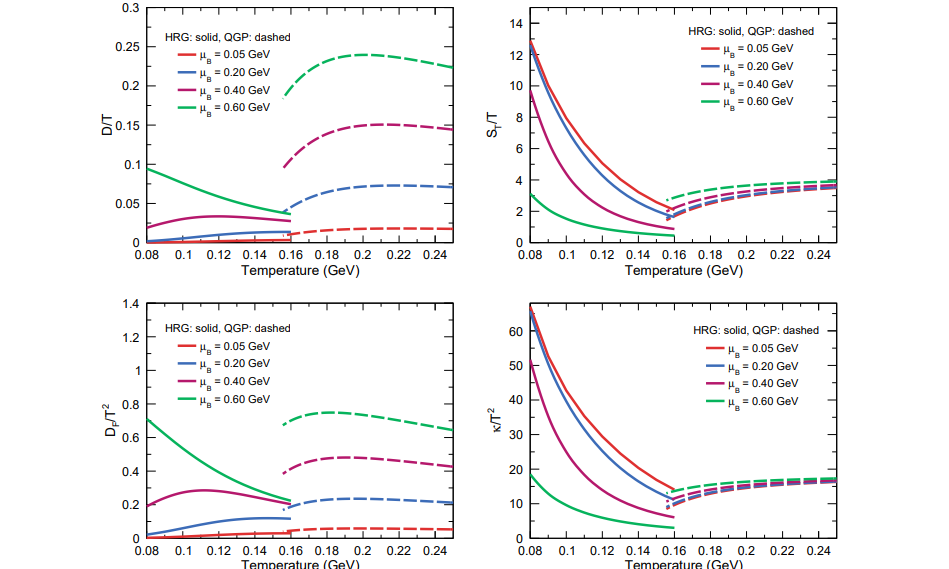
Scientists have achieved a first-principles investigation of the Soret and Dufour effects within hot and dense chromodynamics, or QCD, matter, revealing insights into coupled-transport phenomena traditionally studied in simpler systems. The research team calculated coupled-transport coefficients for QCD matter using quasiparticle models for the deconfined phase and the hadron resonance gas model for the confined phase, providing a comprehensive description of transport in strongly interacting matter. Results demonstrate how these coefficients collectively describe the coupled flow of heat and baryon charge, incorporating statistical weights, baryon numbers, effective energies, relaxation times, and equilibrium distributions. The study reveals the temperature dependence of scaled coupled-transport coefficients in both the hadron resonance gas and quark-gluon plasma phases for baryon chemical potentials of 0.
05, 0. 20, 0. 40, and 0. 60 GeV. The diffusion coefficient exhibits a strong dependence on baryon chemical potential, increasing significantly with μB, particularly at moderate temperatures, due to the Boltzmann factor governing baryon density.
The Dufour coefficient demonstrates the most substantial enhancement among all coefficients, rising sharply with increasing μB, and is predominantly driven by baryon number density in the hadronic medium. Measurements confirm that the relaxation time decreases as temperature increases and is further reduced by baryon chemical potential due to increased particle density. The team found that the Dufour effect, representing heat flow driven by chemical potential gradients, becomes increasingly significant in baryon-rich environments, while the diffusion coefficient vanishes for bosons like gluons and mesons. These findings provide a detailed understanding of how heat and baryon charge are transported in extreme conditions, offering new avenues for hydrodynamic modeling and the study of QCD matter.
Soret and Dufour Effects in Dense QCD Matter
Scientists pioneered a first-principles investigation into the Soret and Dufour effects within hot and dense chromodynamics (QCD) matter, revealing previously unexplored transport phenomena. The research harnessed the relativistic Boltzmann transport equation, employing the relaxation time approximation to model particle interactions and derive explicit expressions for both the Dufour coefficient and the Soret coefficient. These coefficients quantify heat flow induced by concentration gradients and particle diffusion driven by thermal gradients, providing a detailed understanding of coupled-transport phenomena. Researchers incorporated chemical potential and temperature gradients into a kinetic theory framework, enabling the calculation of these crucial coefficients for both the deconfined quark-gluon plasma phase and the confined hadronic phase.
They modeled the deconfined phase using quasiparticle models and the hadron resonance gas model for the confined phase, mirroring conditions microseconds after the Big Bang and replicating those found in ultra-relativistic heavy-ion collisions. This approach allows for the study of the quark-gluon plasma medium and its transition to hot, dense hadronic matter. Experiments at facilities like the Relativistic Heavy Ion Collider and the Large Hadron Collider provide the unique platform for studying strongly interacting matter created by colliding heavy nuclei at ultrarelativistic speeds. Scientists extended existing phenomenological studies of microscopic dynamics and transport phenomena, building upon previous work that investigated thermal and electrical conductivity, transient electromagnetic fields, and vorticity-induced rotation.
Furthermore, the study delved into the influence of the Dufour effect on heat current, demonstrating how gradients in baryon chemical potential can affect the cooling of the medium, and the Soret coefficient’s modification of particle diffusion. Researchers demonstrated that these coupled-transport phenomena, previously studied in classical systems, play a critical role in understanding the evolution of baryon-rich matter created in heavy-ion collisions. By incorporating these effects into hydrodynamic modeling, scientists aim to provide a more comprehensive understanding of the complex dynamics governing QCD matter and its behavior under extreme conditions.
Baryon Potential Drives Heat and Diffusion
This research presents a first-principles investigation into the Soret and Dufour effects within hot and dense chromodynamics, offering new understanding of how energy and particles move in this state of matter. Scientists calculated the Dufour coefficient, which describes heat flow due to concentration differences, and the Soret coefficient, which describes particle diffusion caused by temperature gradients, using a framework that combines kinetic theory with models of both confined and deconfined QCD phases. The analysis demonstrates that both diffusion and the Dufour effect are strongly influenced by the baryon chemical potential, meaning that baryon-rich environments experience significantly enhanced transport phenomena. These findings reveal a crucial link between heat and baryon transport in strongly interacting matter, with implications for understanding the evolution of the quark-gluon plasma created in heavy-ion collisions. The team observed that the calculated coefficients exhibit a particular dependence on temperature and baryon chemical potential, suggesting that the diffusion of baryons is most affected by temperature gradients in regions with low baryon density.
🗞 Soret and Dufour effects in hot and dense QCD matter
🧠 ArXiv: https://arxiv.org/abs/2509.18946