The challenge of efficiently translating quantum algorithms into instructions for real quantum hardware drives significant research, and a critical step in this process is the qubit mapping problem. Bjørnar Luteberget, Kjell Fredrik Pettersen, and Giorgio Sartor, alongside colleagues from SINTEF Digital and Fraunhofer ITWM including Franz G. Fuchs, Dominik Leib, and Tobias Seidel, present a new algorithm that tackles this complex task with unprecedented flexibility. Their work addresses a fundamental limitation in current compilation methods, which often impose artificial restrictions on how quantum gates are arranged and timed. By developing an exact branch and bound approach, the researchers demonstrate the potential to find provably optimal solutions for mapping qubits, and importantly, reveal how relaxing constraints on gate layering can substantially improve the performance of compiled quantum circuits. This advancement promises to unlock greater efficiency and capability from emerging quantum technologies.
Layered Mapping Impacts Sparse Quantum Hardware
This paper investigates how considering or ignoring layers impacts the optimization of qubit mapping for quantum circuits, aiming to minimize circuit depth or the number of SWAP gates while accounting for gate execution time. The authors developed a branch and bound algorithm with a novel approach to estimating the best possible solution, enabling it to tackle this complex problem. Key findings reveal that considering layers matters when quantum hardware is sparsely connected, like in linear or Y-shaped arrangements, but generally, ignoring layers outperforms considering them, except when minimizing SWAP gates on grid-shaped hardware. The algorithm also positively impacts a measure of circuit quality known as the HOP value, and offers flexibility for researchers to experiment with different optimization strategies.
The method involves a branch and bound algorithm that systematically explores potential qubit assignments, branching to investigate possibilities and bounding to eliminate suboptimal solutions. This approach allows for greater flexibility in arranging gates and potentially reducing circuit depth, unlike many existing methods that impose a fixed layering structure. The algorithm can minimize the number of SWAP gates needed to accommodate hardware connectivity, minimize overall circuit depth, or balance both objectives simultaneously.
Branch and Bound Algorithm Optimizes Qubit Mapping
Researchers developed a new approach to solving the qubit mapping problem, a critical challenge in quantum computing, by creating a flexible branch and bound algorithm. This method addresses the complexities of assigning virtual qubits to physical qubits while optimizing circuit performance. The team challenged common assumptions within the qubit mapping process, specifically the practice of grouping gates into layers and disregarding individual gate execution times, and sought to prove optimal solutions for various configurations. The core of their technique is a branch and bound algorithm capable of considering or ignoring gate layering and execution time, offering a versatile framework for optimization.
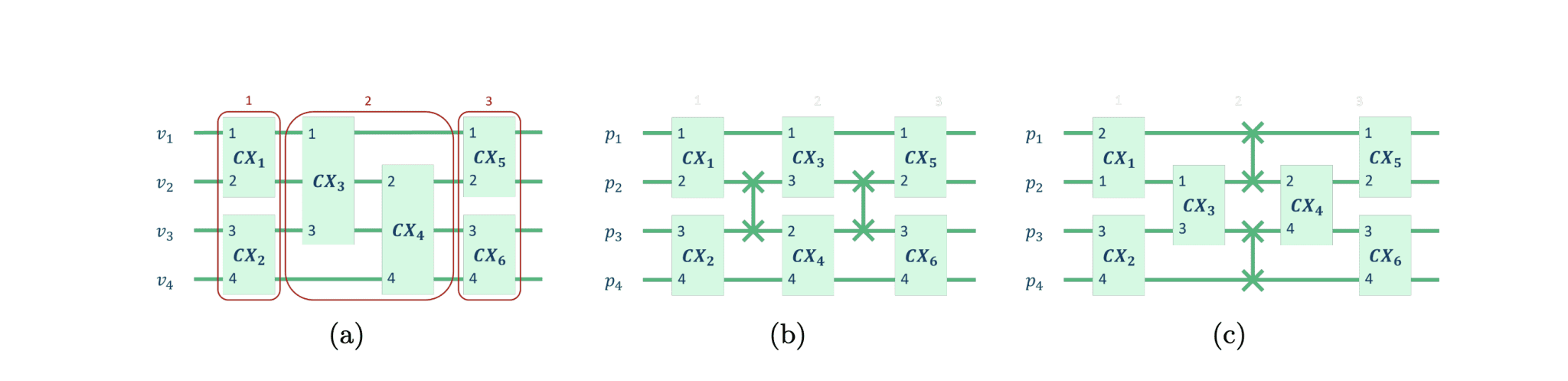
Unlike many existing methods, this approach doesn’t impose a fixed layering structure, allowing for greater flexibility in arranging gates and potentially reducing circuit depth. The algorithm can minimize the number of SWAP gates required to accommodate hardware connectivity, minimize overall circuit depth, or balance both objectives simultaneously. Experiments on benchmark circuits demonstrate that relaxing the layering constraint, allowing SWAP gates to be interleaved between two-qubit gates, significantly reduced circuit depth in several cases. For example, on a four-qubit linear hardware graph, an optimal solution ignoring layering achieved a depth of 7 CX gates, compared to 9 CX gates for an optimal solution enforcing layering, demonstrating the potential for substantial performance gains.
Optimal Qubit Mapping with Proven Solutions
Researchers have developed a new approach to solving the qubit mapping problem, a critical challenge in quantum computing that determines how virtual qubits within an algorithm are assigned to the physical qubits of a quantum computer. The team’s method addresses the complexities of both qubit assignment and qubit routing, the process of adding necessary swap gates to accommodate hardware connectivity limitations, and offers a flexible framework for optimization. This work acknowledges that the qubit mapping problem is computationally intensive and seeks to minimize the number of swap gates or the overall circuit depth to reduce errors and improve performance. The team’s algorithm can find proven optimal solutions for all variations of the qubit mapping problem, offering a significant advancement over existing methods.
By removing the constraint of grouping gates into layers and considering gate execution time, the algorithm achieves more efficient mappings. This flexibility allows for a more thorough exploration of the solution space, potentially leading to circuits with fewer swap gates and reduced execution time. Experiments on benchmark quantum circuits reveal the benefits of this approach, demonstrating that the team’s method can significantly outperform traditional techniques that rely on fixed layering. This improvement is crucial because minimizing swap gates directly translates to a reduction in the overall error rate of quantum computations, a critical factor for near-term quantum devices.
Layer Simplification Boosts Quantum Circuit Performance
This research investigates the impact of simplifying assumptions made during the compilation of quantum circuits, specifically concerning how gates are grouped into layers. Quantum circuits require mapping to the physical qubits of a quantum computer, a process complicated by hardware connectivity and the need to insert ‘swap’ gates to move information around. A common simplification involves dividing the circuit into layers, restricting when swap gates can be added and ignoring the actual time it takes to execute gates. The team developed a flexible algorithm to explore different approaches to this mapping problem, including options that both consider and ignore these layers.
Results demonstrate that ignoring layers can significantly improve performance, particularly when the quantum hardware has limited connectivity, such as linear or Y-shaped arrangements of qubits. The algorithm successfully finds optimal solutions and provides a platform for testing new ideas in quantum circuit compilation. The authors acknowledge that their algorithm currently treats all qubits as equally reliable, and future work could incorporate the varying levels of noise present in real quantum hardware. They also suggest exploring alternative objectives beyond minimizing swap gates or circuit depth, such as minimizing error rates. The research offers a valuable contribution to optimizing quantum computations, although the current implementation is best suited for relatively small circuits.
👉 More information
🗞 An Exact Branch and Bound Algorithm for the generalized Qubit Mapping Problem
🧠 ArXiv: https://arxiv.org/abs/2508.21718