

Spin ensembles underpin a wide range of technologies, from precision timekeeping to advanced sensing, yet their sensitivity has long been limited by unwanted noise. Rouven Maier, Cheng-I Ho, and Andrej Denisenko, along with colleagues at the University of Stuttgart, now demonstrate a significant advance in reading out these spin ensembles. The team achieves a readout that surpasses the conventional limitations of photon noise, approaching the fundamental limit set by the intrinsic fluctuations of the spins themselves. This breakthrough, achieved using nitrogen-vacancy centres in diamond and a carefully controlled nuclear spin environment, reduces noise to a level previously unattainable in solid-state systems, and promises to unlock new possibilities in precision measurement, the detection of subtle quantum correlations, and the development of advanced quantum technologies.
Repetitive Readout Enhances RF Sensing Sensitivity
Scientists are leveraging the unique quantum properties of nitrogen-vacancy (NV) centers in diamond to create highly sensitive radiofrequency (RF) field sensors. This research focuses on improving sensor performance beyond traditional limitations, employing repetitive readout to enhance signal detection and minimize noise. The team investigates methods like spin squeezing to further boost sensitivity and unlock the full potential of these quantum sensors. NV centers, defects within the diamond structure, exhibit quantum mechanical behavior, making them ideal for detecting weak external fields. Repetitive readout involves performing multiple measurements of the NV center’s spin state, allowing researchers to average out random noise and approach the fundamental spin projection noise limit. Detailed analysis determines the factors limiting sensor performance and guides optimization strategies.
Direct Spin Readout Reveals Correlated States
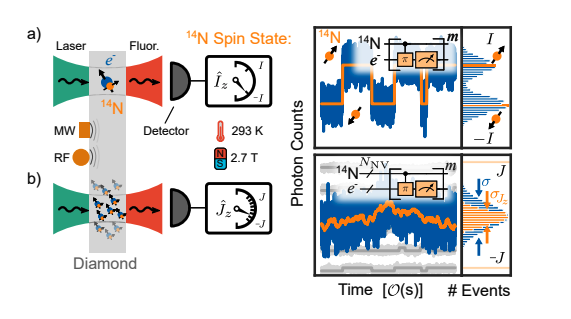
Scientists have developed a novel readout technique to directly measure the spin of a large ensemble of nitrogen-vacancy (NV) centers in diamond, surpassing the limitations imposed by conventional photon detection noise. This pioneering method, which does not disturb the quantum state being measured, allows access to the intrinsic spin projection noise that governs the ensemble’s behavior. By stabilizing the surrounding nuclear spins and employing repetitive measurements, researchers achieved a significant reduction in noise, enabling the direct observation of correlated spin states. The team engineered a system to map the population of different nuclear spin states onto the electron spin of the NV centers, facilitating precise measurement. To account for the limitations of the photon detector, scientists incorporated a correction factor into their model, accurately determining the number of active NV centers within the measurement area. Researchers initialized and controlled the spin ensemble using carefully timed pulses, observing long-lived oscillations and tracking the spin projection noise alongside the average spin state.
Projection Noise Limited Diamond Quantum Sensing
Scientists have achieved a breakthrough in solid-state quantum sensing by demonstrating readout in an ensemble of nitrogen-vacancy (NV) centers in diamond that is limited only by the fundamental projection noise of the spin. This achievement surpasses the long-standing challenge of photon shot noise and approaches the intrinsic sensitivity dictated by the quantum nature of the ensemble. Experiments, conducted at room temperature, utilized repetitive measurements to achieve a significant reduction in noise, allowing for the direct observation of correlated spin states. The team employed a confocal microscope and a specialized resonator to control the electron spin of the NV centers within a diamond chip. By carefully stabilizing the surrounding nuclear spins and implementing a repetitive readout scheme, researchers minimized technical noise and directly accessed the intrinsic fluctuations of the spin ensemble. This breakthrough establishes projection noise-limited readout as a practical tool for solid-state quantum sensors, opening pathways to quantum-enhanced metrology, direct detection of many-body correlations, and the implementation of spin squeezing in mesoscopic solid-state ensembles.
Projection Noise Limit Reached in Spin Readout
Scientists have achieved a significant advance in the readout of spin ensembles, demonstrating a technique that surpasses the limitations imposed by photon shot noise and approaches the fundamental limit set by intrinsic spin projection noise. Through careful stabilization of the surrounding nuclear spins and repetitive measurement methods, the team reduced noise, allowing for the direct observation of correlated spin states within a solid-state system. This achievement establishes projection noise-limited readout as a practical tool for solid-state quantum sensing. This breakthrough opens pathways to substantially enhanced metrology and enables the direct detection of many-body correlations, as well as the implementation of spin squeezing in mesoscopic solid-state ensembles.
The researchers anticipate that this improved sensitivity will benefit a range of applications, including rapid nuclear magnetic resonance and magnetic resonance imaging, as well as investigations into magnetic materials, phase transitions, and electronic chip failures. Furthermore, the ability to accurately read out spin states is directly relevant to the field of quantum simulations, allowing for the observation of complex, non-classical spin states. Future research will likely focus on optimizing these techniques and exploring the full potential of projection noise-limited readout in diverse quantum sensing and simulation applications.
🗞 Readout of a solid state spin ensemble at the projection noise limit
🧠 ArXiv: https://arxiv.org/abs/2509.11854


