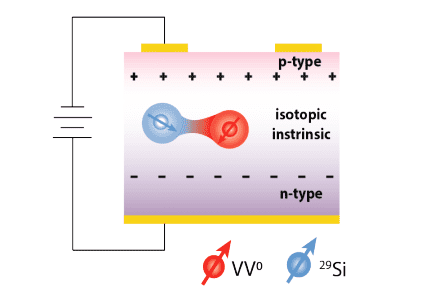
On April 17, 2025, Cyrus Zeledon and colleagues published Minute-long quantum coherence enabled by electrical depletion of magnetic noise, showcasing advancements in achieving long-lasting quantum coherence through silicon carbide devices with integrated spin defects.
Researchers demonstrate enhanced coherence in silicon carbide (SiC) electron spin qubits by controlling bias in isotopically purified SiC p-i-n diodes. This approach reduces both electrical and magnetic noise sources, achieving record coherences. Simultaneously, nuclear spin registers exhibit improved relaxation times, with Hahn-echo durations reaching minutes. These advancements highlight the potential of integrating solid-state spin defects into electronic devices to create highly coherent network nodes and processors for quantum information processing.
In the dynamic field of quantum materials research, scientists are dedicated to harnessing quantum phenomena for technological progress. A key focus is the development of isolated quantum systems essential for applications such as quantum computing and sensing. These systems require precise control over quantum states to ensure reliability and scalability.
A significant breakthrough involves vanadium-vacancy (VV0) defects in diamond, which serve as a novel platform for controlling nuclear spins. Researchers have discovered that these VV0 defects can act as sensors, enabling precise manipulation and readout of a single 29Si nuclear spin without external magnetic fields. This advancement simplifies the system by eliminating the need for bulky and expensive magnets.
The research utilized sophisticated techniques to achieve its results. Reverse bias voltage was applied to deplete the defect of free charges, effectively isolating the quantum system. This isolation is crucial for maintaining quantum state integrity. Additionally, Ramsey interference and Hahn echo methods were employed to measure spin states with high precision.
The experiments yielded remarkable results, with nuclear spin coherence time improving by a factor of 100 under optimal conditions. Longer coherence times are vital for practical applications like quantum computing, as they allow quantum states to be maintained for extended periods.
This research has profound implications for quantum technologies. By demonstrating control over nuclear spins without external magnetic fields, the study opens new avenues for integrating quantum systems into everyday technologies. This could lead to more practical and scalable quantum devices, making quantum computing and sensing more accessible and efficient in the future.
In summary, this advancement not only pushes the boundaries of quantum materials research but also brings us closer to realising the potential of quantum technologies in various real-world applications.
👉 More information
🗞 Minute-long quantum coherence enabled by electrical depletion of magnetic noise
🧠 DOI: https://doi.org/10.48550/arXiv.2504.13164