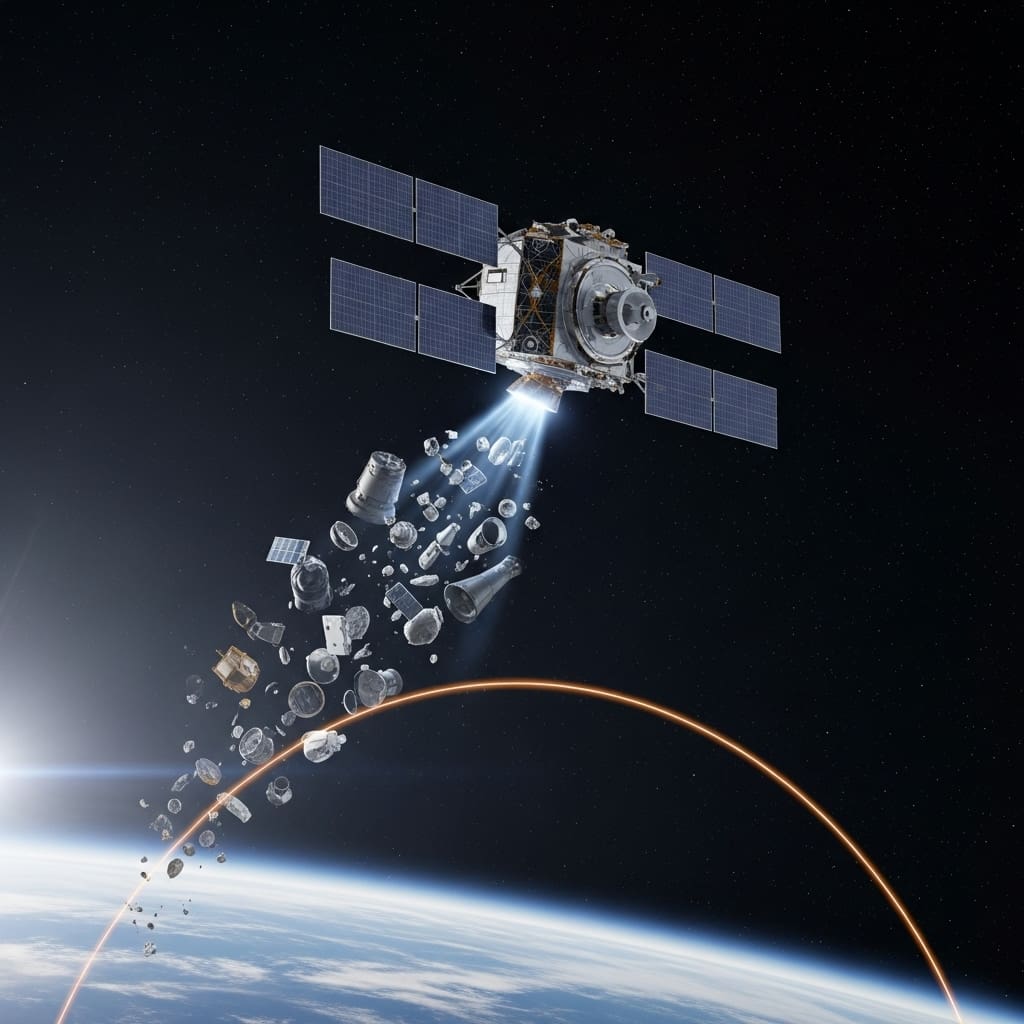
Scientists are tackling the growing problem of space debris with a groundbreaking new approach to orbital remediation. Om Mishra, Jayesh Patil (Indian Institute of Information Technology Dharwad), and Sathwik Narkedimilli (National University of Singapore) et al. present a fully autonomous, solar-electric module designed not just to capture debris, but to actively deorbit it, a crucial step towards sustainable space operations. Their research details a novel architecture combining a mechanical clamping system with a highly efficient NASA NEXT thruster and sophisticated autonomous navigation, validated through high-fidelity simulations showing successful deorbiting from 800km to 100km with remarkable positional accuracy. This work establishes a vital benchmark for renewable, fuel-independent propulsion, promising extended mission lifespans and a significant leap forward in multi-target debris removal capabilities.
High-fidelity simulations demonstrate the system’s capability to perform a successful retrograde deorbit from 800km to 100km, achieving position Root Mean Square Errors (RMSE) of less than 10m using radar-based Extended Kalman Filter (EKF) navigation. This breakthrough establishes a benchmark for renewable solar propulsion, minimising reliance on conventional fuels and extending mission longevity for multi-target removal efforts.
The team achieved a 93% data delivery efficiency within 1 second, utilising Delay/Disruption Tolerant Network (DTN) protocols to ensure reliable communication during the deorbit process. This innovative approach combines the robustness of mechanical capture with the efficiency of solar-electric propulsion, offering a significant advancement over existing fuel-dependent methods. The study’s architecture is designed for long-duration missions, enabling the sequential removal of multiple debris objects and enhancing overall orbital management capabilities. Simulations were conducted using established space-qualified hardware parameters, demonstrating the practical applicability and feasibility of the proposed system.
Experiments show the integrated system can reliably capture and deorbit debris, addressing a critical need for active remediation of the increasingly congested orbital environment. The mechanical clamping system ensures secure retention of debris throughout the deorbit manoeuvre, while the NEXT ion thruster provides precise, controlled low-thrust propulsion. This combination allows for fuel-efficient deorbiting of debris of varying sizes and trajectories, reducing the environmental impact of space operations. The research establishes a new paradigm for sustainable space debris removal, paving the way for future missions focused on maintaining the long-term safety and accessibility of space.
Furthermore, the autonomous guidance, navigation, and control framework enables sequential debris capture and deorbit missions without constant ground intervention. The system’s design prioritises mission longevity, fuel efficiency, and autonomous operation, addressing key challenges in the field of orbital debris remediation. This work opens possibilities for scalable, cost-effective solutions to mitigate the risks posed by space debris and ensure the continued viability of space exploration and utilisation. The. High-fidelity simulations demonstrate a successful retrograde deorbit from 800km to 100km, achieving position Root Mean Square Errors (RMSE) of less than 10m using radar-based Extended Kalman Filter (EKF) navigation.
Experiments revealed a 93% data delivery efficiency within one second, facilitated by Delay/Disruption Tolerant Network (DTN) protocols, ensuring reliable communication during critical phases of the mission. The propulsion system utilises a NEXT ion thruster delivering a continuous thrust of 0.237 N with a specific impulse (Isp) ranging from 4100 to 4200 seconds. This high-efficiency system, requiring a maximum power consumption of 6.9-7.3kW, allows for extended operation with a 20kg Xenon propellant tank onboard, significantly increasing mission longevity. The spacecraft bus, with a dry mass of 300kg, is designed to capture and deorbit a 100kg target payload, demonstrating practical applicability for real-world debris removal scenarios.
Measurements confirm the solar array generates up to 7.3kW, designed with a specific power of 30W/kg, resulting in a calculated mass of approximately 243kg. This primary generation system powers the thruster during sunlit phases and recharges a 33kg Li-ion battery pack, providing 4.1, 5.7 kWh of energy at a specific energy of 170 Wh/kg. The battery ensures continuous thruster operation during the approximately 35-minute Low Earth Orbit (LEO) eclipse periods, maintaining uninterrupted deorbit maneuvers. Operating at 80% depth of discharge, the battery is projected to sustain approximately 1000 cycles, estimating an effective mission duration of roughly three months.
The team measured the performance of an autonomous collision-avoidance system, employing a dual-layer navigation strategy. Global avoidance is pre-planned using ground-station data, while local avoidance utilises onboard sensors to detect uncataloged debris. Simulation results prove the maneuvering model effectively fuses these data sources, triggering optimal evasion maneuvers and autonomously resuming the deorbit mission upon threat detection. This breakthrough delivers a benchmark for renewable solar propulsion, minimizing reliance on conventional fuels and extending mission longevity for multi-target removal, paving the way for sustainable orbital management.
Solar-powered debris removal with precise navigation
Scientists have demonstrated a novel architecture for removing orbital debris utilising a mechanical clamping system coupled with a highly efficient, solar-powered NASA Evolutionary Xenon Thruster (NEXT) and autonomous navigation protocols. High-fidelity simulations confirmed successful retrograde deorbiting from 800km to 100km, achieving position Root Mean Square Errors (RMSE) below 10m through radar-based Extended Kalman Filter (EKF) navigation. Furthermore, the system exhibited 93% data delivery efficiency within one second, employing Delay/Disruption Tolerant Network (DTN) protocols, validating its communication capabilities. This research establishes a benchmark for renewable solar propulsion in orbital management, reducing reliance on conventional fuels and potentially extending the lifespan of multi-target removal missions.
The successful integration of mechanical capture with efficient propulsion and robust communication represents a significant advancement in addressing the growing problem of space debris. However, the authors acknowledge gradual divergence within the EKF during continuous low-thrust phases, attributed to limitations in Clohessy-Wiltshire linearization, indicating a need for more accurate nonlinear modelling. Future work will focus on enhancing navigational robustness by exploring Unscented Kalman or particle filters to better manage nonlinear dynamics and state divergence. Additionally, hardware-in-the-loop testing of the clamping system and edge-AI pipeline is planned, alongside investigations into multi-agent reinforcement learning for trajectory planning and hybrid propulsion systems for improved capture agility.
🗞 From Design to Deorbit: A Solar-Electric Autonomous Module for Multi-Debris Remediation
🧠 ArXiv: https://arxiv.org/abs/2601.12830