Quantum networks promise revolutionary advances in communication and sensing, yet their development currently faces significant hurdles regarding scalability, accessibility, and cost. Raj Kamleshkumar Madhu from NC State University, Visuttha Manthamkarn and Zheshen Zhang from the University of Michigan, and their colleagues, address these challenges by presenting a fully virtualized, open-access quantum network prototype. This innovative system moves beyond the limitations of physical infrastructure by creating a software platform that allows remote users to interact with core quantum hardware components, such as time taggers and optical switches, through a cloud application. By virtualizing these resources and employing a sophisticated allocation method, the team demonstrates a functional and efficient platform that promises to broaden access to quantum networking technology and accelerate its development, paving the way for wider research and potential real-world applications
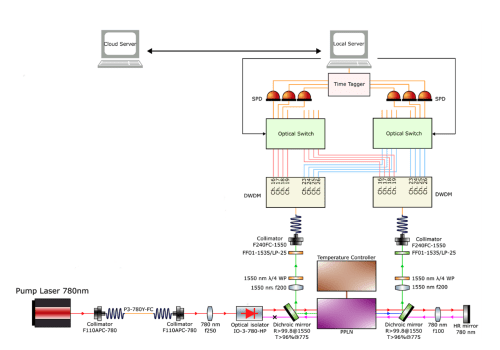
Current quantum network systems remain limited in scale and are highly application-specific, lacking a clear road map for global expansion. These limitations stem from a shortage of skilled professionals, limited access to quantum infrastructure, and the high cost of building and operating quantum hardware. To address these challenges, researchers propose an open-access, software-based quantum network virtualization platform designed to facilitate scalable and remote interaction with quantum hardware. The system utilizes a cloud application that virtualizes the core hardware components of a lab-scale quantum network.
Cloud Quantum Networking Testbed Implementation
This document details the design and implementation of a cloud-based quantum network testbed, aiming to democratize access to quantum networking resources by virtualizing hardware and providing a fair resource allocation system. The system allows multiple users to remotely access and experiment with quantum key distribution and other quantum communication protocols. The core innovation combines cloud infrastructure, hardware abstraction, and a sophisticated resource allocation algorithm to effectively manage limited quantum resources, demonstrating scalability through testing. The system uses the Hungarian Matching algorithm with a proportional fairness utility function to allocate limited entangled photon channels among users, maximizing overall system utility while ensuring fairness by prioritizing users receiving fewer resources.
Load testing, performed using Locust, evaluates performance under stress, while Kubernetes manages container orchestration and autoscaling, and Ngrok creates a secure tunnel for internet access. This platform democratizes access to quantum networking by removing barriers for researchers and developers lacking access to expensive quantum hardware. The system is designed to scale, and the resource allocation algorithm ensures fair access to quantum resources. Hardware abstraction simplifies development and deployment, and automated resource management reduces manual intervention.
Virtualizing Quantum Hardware for Remote Access
Researchers have developed a new software platform that virtualizes access to quantum networking hardware, potentially overcoming significant barriers to progress in this emerging field. Quantum networks promise revolutionary advances in communication, sensing, and cybersecurity, but current systems are limited by cost, complexity, and a shortage of skilled personnel. This new approach aims to democratize access by allowing multiple users to remotely interact with shared quantum hardware through a cloud-based system, recreating the functionality of key hardware components in software. A key innovation lies in the system’s ability to fairly allocate these shared resources among multiple users, ensuring no single user dominates access to the limited hardware.</p
The allocation process employs a sophisticated algorithm, inspired by optimization techniques, to distribute access to channel pairs, maximizing overall system efficiency and user satisfaction. The system provides a suite of measurement functions, including precise photon detection rate measurements and detailed analysis of photon arrival times, and can measure the generation of entangled photon pairs, a fundamental requirement for many quantum communication protocols. The platform quantifies the quality of entanglement by comparing the rate of genuine entangled pairs to accidental detections, providing a robust metric for evaluating system performance. To assess user experience, researchers developed a “Quality of Service” metric that considers both the amount of data a user receives and the time they spend waiting for access. The system then employs a “proportional fairness” principle, prioritizing users who have historically received less access to resources, while still maintaining overall efficiency. By virtualizing access and implementing intelligent resource allocation, this platform represents a significant step towards building scalable and accessible quantum networks for a wider range of researchers and applications.
Virtualizing Quantum Networks for Remote Access
This research presents a novel software-based platform designed to broaden access to quantum network testbeds. The system virtualizes essential hardware components, enabling multiple users to remotely perform quantum measurements concurrently via a cloud application. By abstracting the complexities of the underlying hardware, the platform aims to democratize access to quantum resources and facilitate wider experimentation. The system incorporates a resource allocation algorithm that employs the Hungarian Algorithm to ensure fair distribution of limited entangled photon channel links among users. Performance analysis demonstrates the system’s functionality and efficiency, with load testing showing stable operation under increasing user demand and a low failure rate. Future work will focus on refining the system to accommodate evolving hardware capabilities and user needs, including integrating variable detector efficiencies and more complex channel configurations, and enhancing backend logic to provide detailed user session management and deeper insights into system performance and user experience.
👉 More information
🗞 A Virtual Quantum Network Prototype for Open Access
🧠 DOI: https://doi.org/10.48550/arXiv.2507.17495