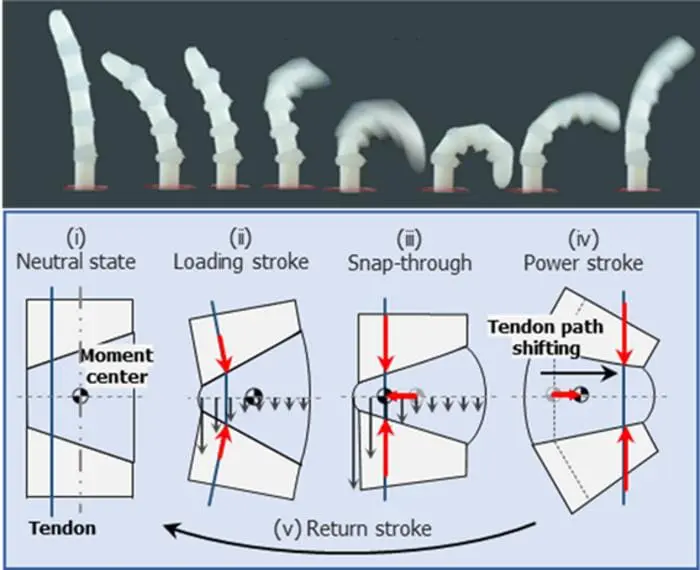
Researchers at Seoul National University’s College of Engineering have developed a novel mechanism known as the Hyperelastic Torque Reversal Mechanism (HeTRM), which enables soft robots made from rubber-like materials to achieve rapid and robust movements. Inspired by the remarkable abilities of mantis shrimp and fleas, which can deliver swift punches and jump to great heights despite their soft bodies, the research team led by Professor Kyu-Jin Cho has successfully harnessed the principles of torque reversal to create a new class of soft robots.
By leveraging the characteristics of hyperelastic materials, which rapidly stiffen as they compress, the HeTRM allows for instantaneous energy release and powerful bending motions, mimicking the cilia found in nature. This innovative technology has been demonstrated in various practical applications, including a soft gripper that can catch falling objects, a robot that crawls over rough terrain, and a robotic arm that wraps around objects with speed and agility, paving the way for expanded possibilities in soft robotics design and applications.
Introduction to Soft Robotics and Bioinspiration
Soft robotics is a field that has gained significant attention in recent years due to its potential to create robots that can interact with and adapt to their environment in a more flexible and gentle manner. One of the key approaches in soft robotics is bioinspiration, where researchers draw inspiration from nature to develop new technologies. The mantis shrimp and flea are two examples of organisms that have evolved unique mechanisms to generate powerful forces with their soft bodies. The mantis shrimp can deliver a punch at speeds of up to 90 km/h, while the flea can jump to heights exceeding 200 times its body length.
The secret behind these organisms’ ability to generate powerful forces lies in the “torque reversal mechanism,” which enables the instantaneous switching of rotational force direction applied by muscles to their limbs. This mechanism has inspired researchers to develop new technologies that can mimic this behavior. One such technology is the hyperelastic torque-reversal mechanism, which is a novel approach to creating soft joints with compression-responsive transient bistability. This mechanism has the potential to expand the horizons of soft robotics design and applications.
The research team at Seoul National University, led by Professor Kyu Jin Cho, has been working on developing this technology. They were inspired by the natural design of cilia, which use phase transitions to produce efficient and repetitive movements. By applying the principles of cilia to soft robotics, they aimed to create new types of motion without complex mechanisms. The team’s research has led to the development of a hyperelastic torque-reversal mechanism that can be used to create soft joints with compression-responsive transient bistability.
Hyperelastic Torque-Reversal Mechanism
The hyperelastic torque-reversal mechanism is a novel approach to creating soft joints with compression-responsive transient bistability. This mechanism works by storing energy in the material and releasing it all at once, allowing for rapid movement and high forces. The team’s research has shown that this mechanism can be used to create soft joints that can mimic the behavior of biological systems, such as the snapping of a tree branch or the jumping of a flea.
The hyperelastic torque-reversal mechanism is based on the principle of snap-through, which is a rapid transition between two stable states. This phenomenon is commonly observed in nature, where it is used to produce efficient and repetitive movements. The team’s research has shown that by leveraging material properties rather than structural designs, they can create soft joints with compression-responsive transient bistability.
The hyperelastic torque-reversal mechanism has the potential to be used in a wide range of applications, from soft manipulators to wearable devices. The team’s research has demonstrated the feasibility of this technology and has shown that it can be used to create soft joints that can mimic the behavior of biological systems.
Applications and Future Research
The hyperelastic torque-reversal mechanism has the potential to expand the horizons of soft robotics design and applications. The team’s research has demonstrated the feasibility of this technology, and they plan to focus on refining it and applying it to various environments and scales. Future research will focus on enhancing the accuracy of performance analysis through modeling, including shear stress, and verifying its applicability in various environments using finite element analysis (FEM).
The team also plans to enhance the practicality of the hyperelastic torque-reversal mechanism by applying it to larger systems or complex multi-joint soft robots. Additionally, they will improve the efficiency and durability of the mechanism through performance optimization of hyperelastic materials and utilizing multiple materials.
Other researchers are encouraged to actively incorporate nonlinear dynamic mechanisms, such as snap-through, into soft robotic designs. Such approaches will play a crucial role in developing energy-efficient and multifunctional soft robotic systems.
External Link: Click Here For More