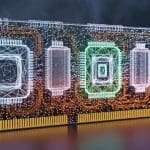
Physicists at the Department of Energy’s SLAC National Accelerator Laboratory, including Rebecca Leane, Anirban Das, and Noah Kurinsky, are proposing a new method to detect dark matter using quantum devices. They suggest these devices could be naturally tuned to detect thermalized dark matter, a type of dark matter that may have been present on Earth for years. The team theorizes that superconducting quantum devices could be redesigned as thermalized dark matter detectors. Their calculations suggest these devices could detect low-energy galactic dark matter as well as thermalized dark matter particles. The next step is to determine if quantum devices can be turned into dark matter detectors.
A New Approach to Detecting Dark Matter
Dark matter, a mysterious substance that makes up about 27% of the universe, has remained elusive to scientists despite numerous attempts to detect it. Physicists at the Department of Energy’s (DOE) SLAC National Accelerator Laboratory are now proposing a novel method to detect dark matter using quantum devices. This approach focuses on a type of dark matter that may have been present on Earth for years, known as thermalized dark matter.
Thermalized dark matter is believed to enter the Earth, bounce around, and eventually get trapped by the Earth’s gravitational field. Over time, this type of dark matter accumulates to a higher density than the few loose, galactic particles, making it potentially more likely to hit a detector. However, thermalized dark matter moves much slower than galactic dark matter, imparting far less energy, which makes it difficult for traditional detectors to identify.
Quantum Devices as Dark Matter Detectors
SLAC physicist Rebecca Leane and postdoctoral fellow Anirban Das, in collaboration with Noah Kurinsky, a staff scientist at SLAC, are exploring the possibility of using superconducting quantum devices as thermalized dark matter detectors. These devices, when cooled to absolute zero, create a stable quantum state. However, energy somehow reenters and disrupts this quantum state, a phenomenon that could potentially be attributed to bombardment by dark matter.
According to their calculations, the minimum energy needed to activate a quantum sensor is low enough that it could detect low-energy galactic dark matter as well as thermalized dark matter particles on Earth. However, this does not definitively prove that dark matter is responsible for disrupted quantum devices, but rather suggests it as a possibility.
Future Directions in Dark Matter Detection
The next step for the researchers is to determine if and how they can convert sensitive quantum devices into dark matter detectors. This involves considering various factors, such as the choice of material for the device. While aluminum has been the material of choice for detectors so far, there may be a better alternative for detecting the mass range of dark matter they are interested in.
Another consideration is that thermalized dark matter may not interact with a quantum device in the same way galactic dark matter is suspected to interact with direct detection devices. The researchers are exploring various scenarios of how dark matter might interact with the detector, including the possibility of other particles interacting with dark matter and changing the distribution of particles in the detector.
The Role of SLAC in Dark Matter Research
The research, funded by the DOE Office of Science, is a testament to the diverse range of scientific exploration at SLAC. The laboratory is a hub for research spanning particle physics, astrophysics and cosmology, materials, chemistry, bio- and energy sciences, and scientific computing. This project represents a synergy of the research at SLAC, bringing together different scientific disciplines to tackle the enigma of dark matter.
SLAC is operated by Stanford University for the U.S. Department of Energy’s Office of Science, the largest supporter of basic research in the physical sciences in the United States. The Office of Science is committed to addressing some of the most pressing challenges of our time, including the mystery of dark matter.
External Link: Click Here For More