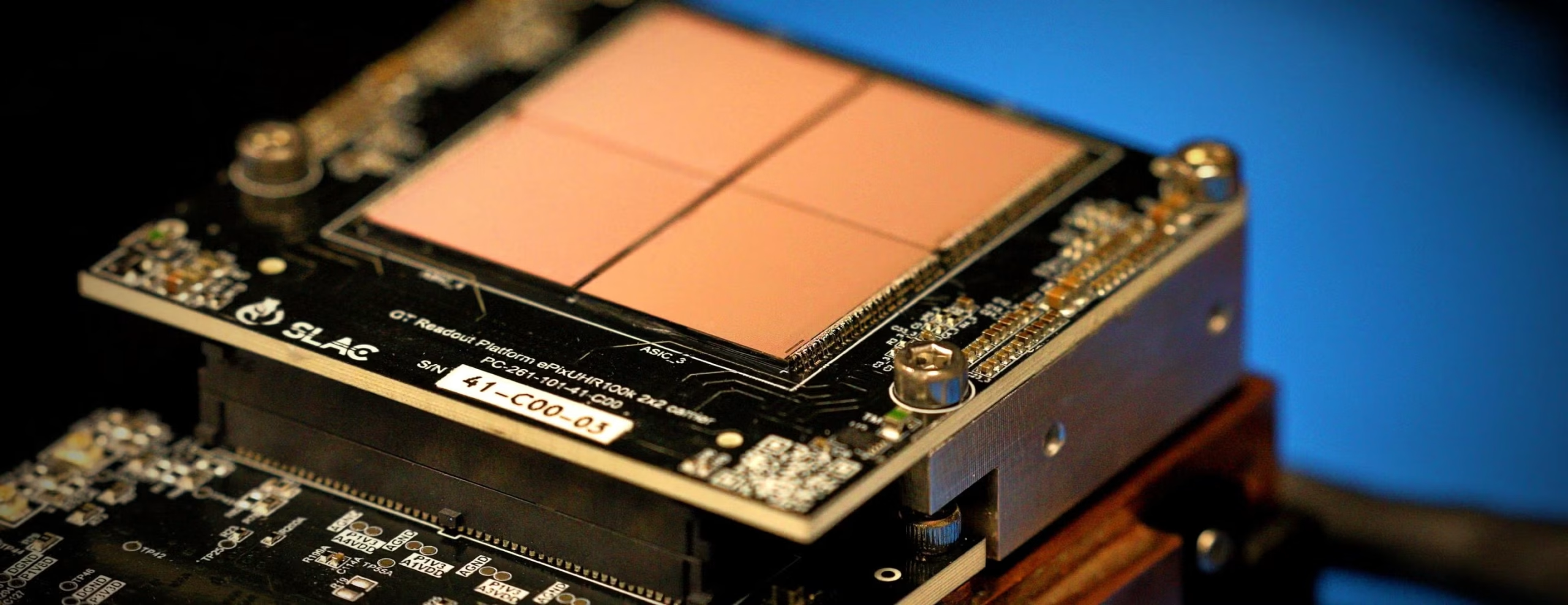
The Department of Energy has announced funding for three Microelectronics Science Research Centers to advance next-generation microelectronics, with SLAC National Accelerator Laboratory playing a key role. The centers will focus on making microelectronics more energy efficient and able to operate in extreme environments.
Harriet Kung, DOE Office of Science Deputy Director for Science Programs, emphasizes the importance of advancements in microelectronics for furthering scientific discovery. Paul McIntyre, SLAC associate lab director, will lead the Enabling Science for Transformative Energy-Efficient Microelectronics project, which includes partners from Stanford University, Georgia Institute of Technology, and Northwestern University. The team will explore new methods for manufacturing energy-efficient microelectronics, including the discovery of nanostructured materials and software-hardware integration.
Angelo Dragone, SLAC deputy associate lab director, will lead the Adaptive Ultra-Fast Energy-Efficient Intelligent Sensing Technologies project, which involves collaborators from six other national laboratories and universities, including Argonne National Laboratory, Brookhaven National Laboratory, and GE Vernova.
Introduction to Microelectronics Research Centers
The Department of Energy (DOE) has announced funding for three Microelectronics Science Research Centers, which aim to bring together national laboratories, universities, and industry partners to advance next-generation microelectronics technologies. These research centers will focus on developing innovative solutions for various challenges in the field of microelectronics, including energy efficiency, data processing, and operation in extreme environments. The DOE’s investment in these research centers is expected to drive significant advancements in microelectronics technology, enabling the development of faster, more efficient, and more reliable electronic devices.
The three research centers will be focused on different areas of microelectronics research, including energy-efficient computing, sensing systems, and microelectronics operation in extreme environments. The Energy-Efficient Computing Research Center will explore new approaches to computing, such as vertically stacking devices and integrating multiple functions into a single component or device. The Sensing Systems Research Center will develop adaptive, ultrafast, intelligent, and energy-efficient sensing technologies that can process and analyze data in real-time. The Extreme Environments Research Center will focus on developing microelectronics devices that can operate in extremely cold, high radiation, and high magnetic field environments.
Energy-Efficient Computing
One of the key areas of research in the Microelectronics Science Research Centers is energy-efficient computing. Conventional computer hardware configurations are becoming increasingly inefficient, with data being shuttled back and forth through relatively long wires connecting separate logic and memory chips. To address this challenge, researchers are exploring new approaches to computing, such as vertically stacking devices through new manufacturing methods and integrating multiple functions into a single component or device. This approach is inspired by the human brain, which is a highly energy-efficient system compared to traditional silicon-based computers.
The Adaptive Ultra-Fast Energy-Efficient Intelligent Sensing Technologies (AUREIS) project, led by Angelo Dragone, SLAC deputy associate lab director in the Technology Innovation Directorate, will focus on redesigning sensing systems to intelligently process and analyze raw data as close to the sensor as possible. This approach aims to reduce the amount of data that arrives at the computer, making it more energy-efficient. The AUREIS team will explore new materials, computing architectures, AI, and machine learning algorithms, and fabrication processes to develop adaptive, ultrafast, intelligent, and energy-efficient sensing technologies.
Sensing Systems
State-of-the-art instruments across the DOE national laboratories generate massive amounts of data at blazing speeds, making conventional methods of saving data and then analyzing it on a computer insufficient. To address this challenge, researchers are turning to extracting useful information in real-time by reimagining many aspects of the data collection and analysis process of sensing systems. The AUREIS project will develop new sensing technologies that can process and analyze data in real-time, reducing the amount of data that needs to be stored and transmitted.
The SLAC Shared Science Data Facility, an extension of the Stanford Research Computing Facility, will host several data centers to handle the unprecedented data streams produced by a new generation of scientific projects. The facility will provide world-class infrastructure for data-intensive research, enabling scientists to analyze and interpret large datasets quickly and efficiently.
Microelectronics in Extreme Environments
Making and operating microelectronics devices can involve extremely cold, high radiation, and high magnetic field environments. SLAC’s work on scientific instruments for high-energy physics experiments, quantum sensing, and ultrafast X-ray science brings unique expertise in designing semiconductors, microelectronics circuits, and systems to work in such extreme environments.
The Extreme Ultraviolet (EUV) Lithography and Plasma Science project, led by Lawrence Livermore National Laboratory, aims to develop a novel plasma source that can emit light in the EUV wavelength, enabling more energy-efficient chip manufacturing. The project will utilize SLAC’s advanced technology in target systems and expertise in laser-plasma interactions.
Conclusion
Overall, the Microelectronics Science Research Centers will drive innovation and advancement in microelectronics technology, enabling the development of faster, more efficient, and more reliable electronic devices that can operate in a wide range of environments. The collaboration between national laboratories, universities, and industry partners will facilitate the development of innovative solutions, leading to significant advancements in various fields and improving our daily lives.
External Link: Click Here For More