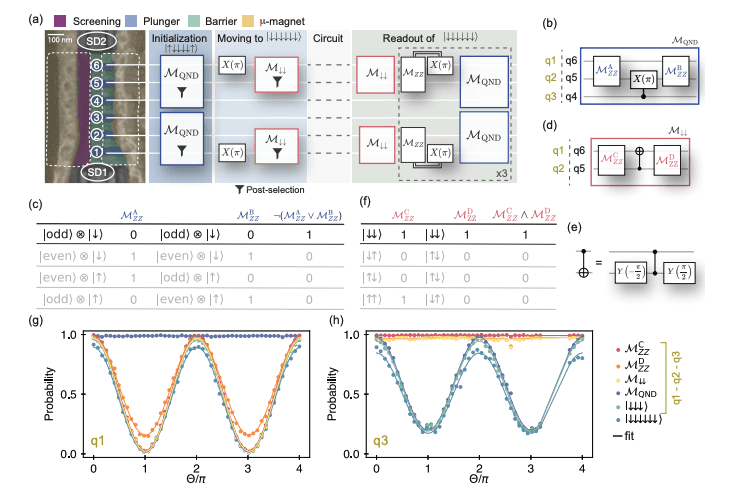
Researchers successfully implemented a six-qubit circuit using semiconductor technology, representing the largest such array to date. Experiments across multiple qubit permutations revealed accumulating errors limit circuit complexity, despite high individual qubit quality. Minimising idle times and improving fidelity are crucial for scaling.
The pursuit of scalable quantum computation increasingly focuses on solid-state systems, leveraging the compatibility of semiconductor fabrication with existing microelectronics. A significant challenge remains in demonstrating coherent control over a sufficient number of qubits to execute complex algorithms. Researchers from QuTech, Delft University of Technology, the Netherlands Organization for Applied Scientific Research (TNO), and Intel Corporation have now demonstrated the operation of a six-qubit circuit fabricated using silicon spin qubits. This work, detailed in a paper authored by I. Fernández de Fuentes, E. Raymenants, B. Undseth, O. Pietx-Casas, S. Philips, M. Mądzik, S. L. de Snoo, S. V. Amitonov, L. Tryputen, A. T. Schmitz, A. Y. Matsuura, G. Scappucci, and L. M. K. Vandersypen, represents the largest quantum circuit implemented to date on a semiconductor platform, and highlights the critical need for improvements in qubit coherence and control fidelity as systems scale.
Silicon Spin Qubits Demonstrate Six-Qubit Programmability, But Error Accumulation Remains a Key Hurdle
Recent research demonstrates the successful operation of a six-qubit circuit fabricated using silicon-based spin qubits, extending the capabilities of semiconductor quantum computing beyond previous three-qubit demonstrations. The work validates programmable multi-qubit operation across an array of interconnected qubits, representing a significant step towards building scalable quantum processors.
The study utilises the spin of electrons – an intrinsic form of angular momentum – as the basis for qubits. This approach offers potential advantages for integration with existing microchip manufacturing techniques, a crucial factor for scalability. However, experiments reveal that error accumulation increases substantially as circuit complexity grows, limiting the reliable execution of more demanding algorithms.
While individual qubit operations exhibit high fidelity – meaning they are performed with a low error rate – combining multiple qubits introduces errors that rapidly degrade overall performance. This highlights a critical challenge in quantum computing: maintaining quantum coherence – the ability of a qubit to exist in a superposition of states – across multiple interacting qubits.
Researchers pinpoint several areas for improvement. Minimising qubit idling times – the period when a qubit is not actively being manipulated – through simultaneous operations is crucial. Equally important is enhancing dephasing times, which define how long a qubit maintains its quantum state before decoherence occurs. Consistent improvements in both state preparation and measurement fidelities are also essential; even minor inaccuracies in these processes can propagate through the circuit and compromise results.
This work underscores the difficulties inherent in scaling quantum processors. Simply increasing the number of qubits is insufficient; advancements in qubit coherence, control, and measurement are vital for realising the full potential of silicon-based quantum computing.
Future research should focus on developing advanced error correction codes specifically tailored to the noise characteristics of silicon-based qubits. Investigating novel qubit designs and materials with inherently longer coherence times is also essential. Furthermore, expanding the scope of algorithmic demonstrations beyond the circuits presented here will provide a more rigorous assessment of the processor’s capabilities and identify further challenges in scaling quantum computation.
👉 More information
🗞 Running a six-qubit quantum circuit on a silicon spin qubit array
🧠 DOI: https://doi.org/10.48550/arXiv.2505.19200