Errors in preparing and measuring quantum states, known as SPAM errors, often overshadow the impact of gate errors in many quantum computing platforms, hindering progress towards reliable computation. Muhammad Qasim Khan, Leigh M. Norris, and Lorenza Viola, from Dartmouth College and Johns Hopkins Applied Physics Laboratory, now present a method to efficiently isolate and quantify both state-preparation and measurement errors using only high-fidelity single-qubit operations and repeated measurements. This achievement is significant because it allows researchers to pinpoint the sources of these errors without requiring qubit resets, a demanding operation in many systems, and to characterise them with a precision limited only by experimental repetitions. By applying this protocol to multiple qubits, the team identified substantial state-preparation infidelities and readout assignment errors, and importantly, demonstrated that ignoring state-preparation errors during measurement-error mitigation can lead to inaccurate results.
To improve hardware and develop more effective strategies for mitigating errors, it is necessary to separately characterise the contributions from state preparation and measurement. This research demonstrates a protocol that efficiently and separately characterises these error parameters, utilising only high-fidelity single-qubit gates and repeated single-qubit measurements without resetting the qubit’s state. The method assumes measurements do not disturb the qubit’s state and that measurement errors are independent and behave classically. Notably, the protocol’s complexity remains constant regardless of system size, allowing for effective characterisation of the target parameters.
Characterising and Correcting Single Photon State Errors
Single photon state preparation and measurement (SPAM) errors are critical challenges in quantum computing, often exceeding the impact of errors in quantum gates. Addressing these errors is therefore crucial for achieving meaningful quantum computation. Accurate characterisation of SPAM errors is essential, requiring an understanding of the probabilities of incorrect state preparation and measurement outcomes. Several error mitigation techniques are available, including post-processing methods, probabilistic error cancellation, detector tomography, Bayesian methods, and machine learning algorithms.
The effectiveness of these techniques scales with the number of qubits and the complexity of the quantum circuit, but limitations exist and more robust error correction methods will ultimately be required. Accurate modeling of the noise processes affecting quantum computations is paramount, including understanding correlations between different error sources. This research provides a comprehensive review of the field, detailing methods for characterising SPAM errors and providing an overview of various error mitigation techniques. The work also discusses the scaling of these techniques and explores advanced topics such as Bayesian statistics and machine learning for error mitigation.
Detailed SPAM Error Characterization Without Reset
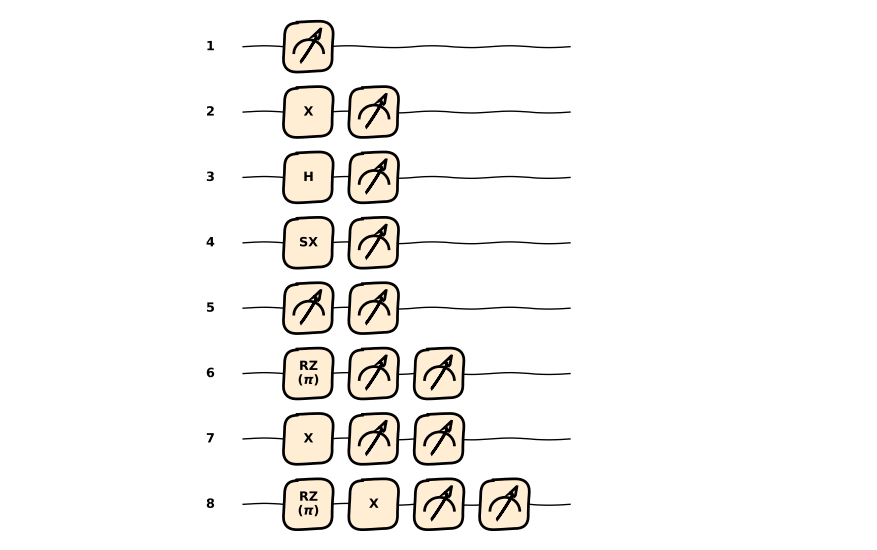
The research team developed a novel protocol to separately characterise errors arising from state preparation and measurement, which dominate single-qubit gate errors in many quantum computing platforms. This work addresses the need for detailed error characterisation to improve hardware and refine mitigation strategies, achieving this without resetting the qubit’s state between measurements. The method relies on high-fidelity single-qubit gates and repeated measurements, allowing for precise determination of error contributions independent of system size. Experiments conducted on quantum computing devices revealed state preparation infidelities reaching up to 0.
2 and readout assignment errors up to 0. 2. The protocol involves measuring a qubit twice without resetting its state, enabling the disentanglement of state preparation and measurement errors. This is achieved by characterising the measurement operators and relating them to the probabilities of obtaining specific measurement outcomes. The team demonstrated that accurately characterising these operators requires estimating eight independent parameters, but simplifying assumptions about the measurement process can reduce this number. Numerical simulations confirmed that neglecting state preparation errors when mitigating measurement errors can lead to biased estimates of observable expectation values. This breakthrough delivers a method for precise error analysis, paving the way for improved quantum hardware and more accurate experimental results.
State and Measurement Error Characterization Protocol
Scientists have developed a new protocol for separately characterising errors arising from state preparation and measurement, critical sources of inaccuracy in many quantum computing platforms. Recognising that these errors often dominate over those in the quantum gates themselves, the team devised a method that efficiently isolates and quantifies the contributions from each source using only high-fidelity single-qubit operations and repeated measurements without resetting the qubit’s state. This approach circumvents limitations of existing techniques by constructing circuits whose complexity does not increase with the number of qubits, allowing for precise characterisation limited only by the duration of the experiment. The researchers successfully applied this protocol to multiple qubits on a quantum computing device, identifying state preparation infidelities and readout assignment errors.
Importantly, numerical simulations demonstrated that failing to account for state preparation errors when mitigating measurement errors can lead to biased estimates of observable quantities. This highlights the necessity of accurately characterising both error sources for reliable quantum computation. Future research directions include exploring the impact of correlated errors and extending the protocol to encompass more complex error models. This work provides a valuable tool for improving the accuracy and reliability of quantum systems by enabling more precise error characterisation and mitigation strategies.
🗞 Separate and efficient characterization of state-preparation and measurement errors using single-qubit operations
🧠 ArXiv: https://arxiv.org/abs/2509.19448