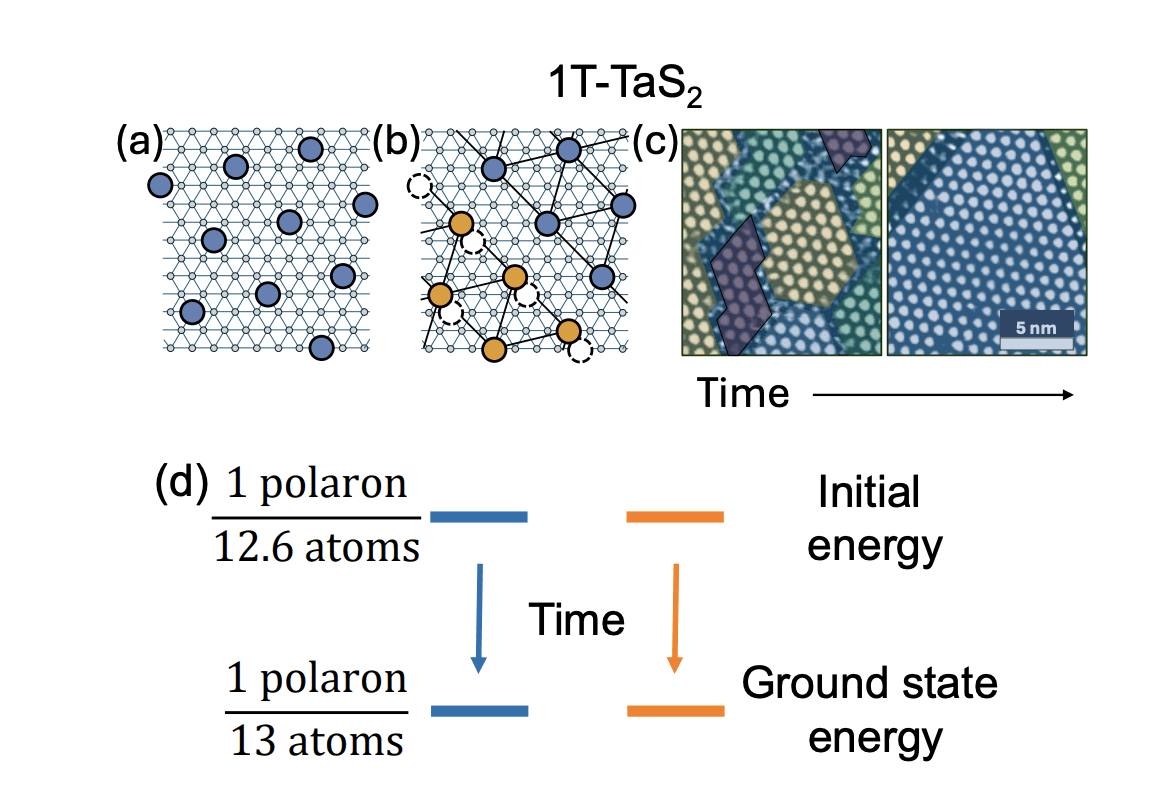
The behaviour of complex materials as they settle into their lowest energy state remains a central puzzle in physics, and researchers are now shedding light on this process in a fascinating quantum material. Jaka Vodeb, from the Jožef Stefan Institute and CENN Nanocenter, along with colleagues, investigates how domain walls, boundaries between different material states, rearrange themselves in a layered compound of tantalum and sulphur. This research demonstrates that individual particle movements, rather than large-scale collective shifts, drive these rearrangements, revealing a surprising simplicity in the material’s dynamics. By employing advanced computer simulations, the team uncovers a microscopic pathway involving cyclical particle leakage and cascades of quantum tunneling, establishing a powerful new method for understanding the behaviour of strongly correlated materials and bridging the gap between theoretical models and real-world observations.
Domain walls in magnetic materials relax toward their ground state through reconfiguration events that exhibit a crossover from thermally activated to temperature-independent behaviour, indicative of quantum tunnelling. This research employs quantum simulation of a two-dimensional transverse-field Ising model with longitudinal bias to uncover the microscopic processes underlying this relaxation. Using a mathematical transformation, the team maps the complex interactions to a simpler model, revealing that single-polaron tunnelling events, rather than collective multi-particle transitions, dominate domain wall motion. A detailed analysis of reconfiguration rates across varying conditions shows a consistent scaling relationship, confirming the importance of individual particle movement.
Domain Wall Dynamics in 1T-TaS2 Studied
Researchers have investigated the dynamics of domain walls within the layered material 1T-TaS₂, a material known for its complex electronic order and the formation of boundaries between differently ordered regions. The study combines theoretical modelling with quantum simulation to understand how these domain walls move and relax. This approach involved focusing on a simplified model by considering only a limited number of interactions within the domain wall, reducing computational complexity. The mathematical transformation allowed researchers to eliminate high-energy contributions, focusing on the low-energy dynamics crucial for understanding domain wall motion.
The key finding is that the dominant mechanism for domain wall movement involves hopping between different configurations, driven by individual particle interactions. The results demonstrate that single-spin flips within the domain wall are energetically unfavorable, meaning the dynamics are governed by higher-order processes. The dominant mechanism for domain wall motion is second-order hopping, with an amplitude proportional to the strength of the external field. This explains how the domain wall can move even without a direct driving force. Understanding and controlling domain wall motion could lead to new applications in areas such as memory devices, sensors, and energy storage.
Polaron Tunneling Drives Relaxation in 1T-TaS2
Researchers have achieved a significant breakthrough in understanding the complex relaxation processes within the layered material 1T-TaS₂, exhibiting unique electronic order and metastable states. The team employed quantum simulation, specifically a two-dimensional transverse-field Ising model, to investigate how these states transition toward a uniform ground state, revealing the microscopic mechanisms driving this behaviour. Experiments and simulations demonstrate that domain walls relax over time, decreasing polaron density and interaction energy as they approach the ground state. The research establishes that single-polaron tunnelling events, rather than collective movements of multiple particles, dominate the motion of these domain walls.
Through a mathematical transformation, the team mapped the complex interactions onto a simpler model, confirming that these domain wall movements arise from individual polaron hops. A crucial finding is the scaling collapse of reconfiguration rates when temperature is rescaled by a factor of approximately 1. 2 times the transverse field, providing strong evidence for the dominance of first- and second-order single-particle processes. This detailed analysis allows reconstruction of a microscopic relaxation pathway, consisting of cyclical polaron leakage followed by cascades of tunnelling events. The results demonstrate that quantum simulation is a powerful tool for inferring real-space mechanisms in strongly correlated systems, bridging the gap between effective models and the non-equilibrium dynamics of quantum materials.
Domain Wall Motion via Single-Particle Tunneling
This research addresses a longstanding question concerning how materials relax from metastable states, specifically investigating the layered dichalcogenide 1T-TaS₂. The team employed quantum simulations of a transverse-field Ising model, combined with a mathematical transformation, to reveal the microscopic processes driving reconfiguration events within the material. Results demonstrate that domain wall motion occurs via second-order tunnelling events, representing single-particle hopping rather than collective movements. A key finding is the confirmation that reconfiguration arises from cascades of these single-particle events, evidenced by a scaling analysis of reconfiguration rates across varying conditions.
This establishes a relaxation pathway involving local polaron leakage, followed by cascades of tunnelling events that redistribute energy and ultimately smooth out domain walls. The simulations successfully reproduce observations from scanning tunneling microscopy, providing a mechanistic understanding of complex configurational rearrangements. The authors acknowledge that their model focuses on a simplified representation of the material and does not include factors like phonon coupling or disorder, which could influence the observed tunnelling cascades. Future research will extend the quantum simulations to incorporate these additional complexities and apply the techniques to faster, time-resolved experimental data.
👉 More information
🗞 Microscopic Origin of Domain Wall Reconfiguration Dynamics in a Quantum Material via Quantum Simulation
🧠 ArXiv: https://arxiv.org/abs/2508.20028