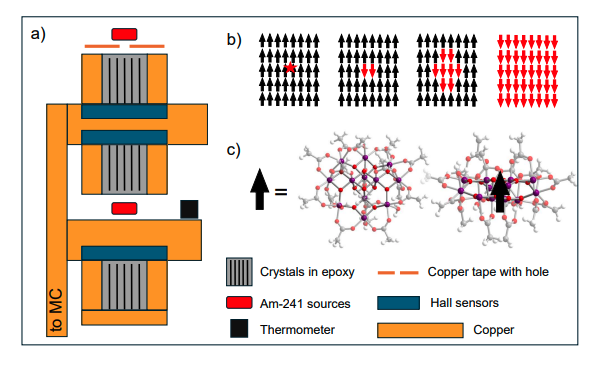
The quest to detect individual particles, from light to potential dark matter, demands increasingly sensitive technologies, and a team led by Bailey Kohn and Hao Chen, from Texas A and M University and Fudan University respectively, has pioneered a novel approach using single-molecule magnets. Their research confirms that these materials, specifically crystals made of manganese acetate, exhibit ‘magnetic avalanches’ triggered by even tiny energy deposits, effectively functioning as particle detectors for the first time. While the current setup detects energies in the mega-electronvolt range, the team, including Rupak Mahapatra and colleagues, demonstrates the potential for tailoring these materials to detect far smaller energy depositions, potentially reaching sub-electronvolt levels, and opening exciting new avenues in the search for elusive particles and fundamental interactions. This breakthrough establishes a new paradigm for particle detection, moving beyond traditional methods and offering a path towards more sensitive and versatile instruments.
Efficient Single Photon Detection for Quantum Technologies
Detecting individual particles of light, known as photons, with high efficiency and minimal errors is crucial for advancements in quantum technologies, sensitive measurements, and fundamental physics. Existing single-photon detectors often suffer from limitations in efficiency, timing precision, and unwanted false signals, hindering progress in these fields. This research addresses these challenges by investigating new materials and device designs to create detectors that reliably identify single photons with maximum sensitivity and minimal noise, paving the way for new scientific discoveries.
Sub-GeV Dark Matter Detection with Bubble Chambers
This body of work explores innovative approaches to detecting dark matter, particularly particles with very low masses, and developing highly sensitive sensor technologies. The overarching goal is to create detectors capable of identifying weakly interacting massive particles (WIMPs) and other dark matter candidates that are difficult to detect with conventional methods. The research focuses on refining bubble chambers, which detect dark matter interactions through the formation of bubbles in a superheated fluid, to improve their sensitivity. Understanding the direction from which a dark matter particle arrives could provide a strong signal, prompting investigations into directional detection techniques.
A particularly promising approach involves using single-molecule magnets (SMMs) as extremely sensitive detectors, leveraging their unique quantum properties. SMMs retain their magnetization even without an external field, making them ideal candidates for ultra-sensitive detection. Even a tiny energy deposit from a dark matter interaction could trigger a measurable change in the SMM’s magnetic state, potentially initiating a cascade of spin flips. Understanding how these magnetic avalanches initiate and propagate within the SMM is crucial for designing effective detectors. Detecting these subtle changes requires advanced sensor technologies, including silicon photomultipliers (SiPMs) to detect photons emitted during magnetic transitions and field-effect transistors (FETs) to detect changes in the SMM’s magnetic state.
The concept of incorporating SMMs within a magnetic bubble chamber is also being explored, potentially amplifying the signal for easier detection. This research could enable the detection of dark matter particles with masses and interaction strengths currently inaccessible to conventional detectors, potentially revealing the direction from which these particles arrive. The sensor technologies developed for dark matter detection also have potential applications in materials science, medical imaging, and quantum computing, advancing the field of quantum metrology and sensing.
Single-Molecule Magnets Detect Alpha Particle Impacts
Researchers have demonstrated that crystals of single-molecule magnets (SMMs) can function as particle detectors, establishing their potential as sensitive quantum sensors. These materials exhibit magnetic bistability, meaning they can trigger a cascading magnetic reversal, or “avalanche”, when struck by even small amounts of energy. The team successfully induced these avalanches by scattering alpha particles within the SMM crystals, confirming a long-held theoretical possibility and paving the way for a new generation of detectors. This breakthrough addresses a significant challenge in physics: the need for sensors capable of detecting extremely low energy depositions, down to the sub-eV level, with high efficiency and minimal false signals.
Current detection methods often struggle at these energy scales, limiting the search for elusive phenomena like low-mass dark matter and single quanta of infrared light. The SMM-based detector operates by converting the energy of an incoming particle into localized heat, which then triggers the magnetic avalanche throughout the crystal, resulting in a measurable change in magnetization. This amplification process allows for the detection of energies far below what would normally be detectable. Unlike other candidate sensor materials, SMMs possess unparalleled chemical tunability, meaning their properties can be precisely tailored to optimize performance and sensitivity. This opens the door to designing SMMs capable of detecting energies as low as a few millielectronvolts, potentially revolutionizing the search for dark matter and enabling the development of highly sensitive quantum sensors.
Single Molecule Magnet Detects Alpha Particles
This research demonstrates, for the first time, that crystals of single-molecule magnets, specifically Mn12-acetate, can function as particle detectors by exhibiting magnetic avalanches triggered by the absorption of elementary particles. The team successfully induced and detected these avalanches using alpha particles, establishing a detection threshold of less than 5. 486 MeV under the specified conditions of magnetic field and temperature. This confirms the potential of using single-molecule magnets for detecting energy depositions, opening possibilities for novel detector technologies. While the current setup exhibits a relatively high energy threshold, the findings highlight significant opportunities for improvement. Future research will focus on exploring a wider range of single-molecule magnets, optimising their energy barriers and thermal conductivity to lower the detection threshold. Further investigation into the specific heat capacities and thermal conductivities of candidate materials will be crucial to identify systems suitable for detecting particles across a broader energy spectrum, including those relevant to keV to MeV mass Dark Matter searches and CEνNS experiments, as well as meV scale “dark photon” detection.
🗞 Particle Detection Using Magnetic Avalanches in Single-Molecule Magnet Crystals
🧠 ArXiv: https://arxiv.org/abs/2508.02467