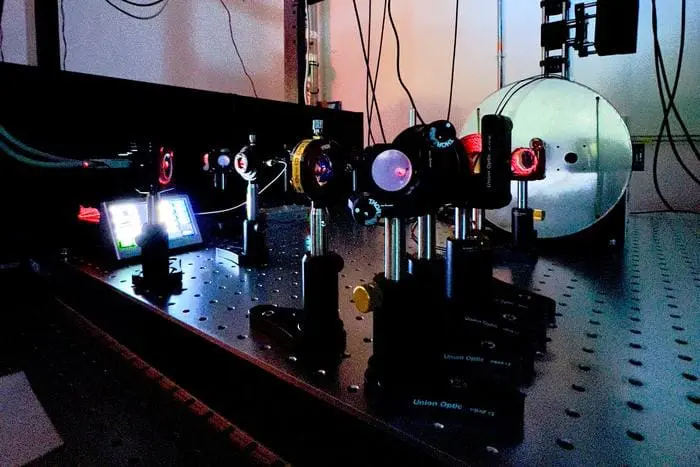
In a bid to unravel the mysteries of dark matter, an enigmatic entity thought to comprise 95% of the universe, Singapore has joined forces with the Global Network of Optical Magnetometers to search for Exotic physics (GNOME), a worldwide collaboration of 15 research institutions. By leveraging cutting-edge quantum magnetometers and atomic gravimeters, the Singapore node, hosted by the Agency for Science, Technology, and Research (A*STAR), aims to detect the faint signals of dark matter, which has long eluded direct observation due to its elusive nature.
Integrating advanced quantum sensors with machine learning algorithms and cloud computing capabilities is expected to bolster the network’s detection accuracy. At the same time, Singapore’s strategic location near the equator will enhance the geographic coverage of GNOME, allowing for more precise filtering of unwanted signals and amplifying the chances of uncovering the presence of dark matter and exotic particles.
This collaborative endeavor promises to advance our understanding of the universe. It has the potential to drive innovation and generate economic impact across various fields, including biomedical imaging, navigation systems, and environmental monitoring.
Introduction to the GNOME Network and Dark Matter Research
The Global Network of Optical Magnetometers to Search for Exotic Physics (GNOME) is an international collaboration aiming to detect dark matter signals and other exotic astrophysical fields. Dark matter, which is theorized to make up approximately 95% of the universe along with dark energy, has long been a subject of intrigue for scientists due to its elusive nature and challenges to our current understanding of physics. The existence of dark matter can be inferred through its gravitational effects on visible matter or potentially through its influence on atoms, which could mimic magnetic fields.
The GNOME network comprises 15 stations in prestigious research institutions worldwide, utilizing quantum sensors to collect magnetic field signals. By analyzing data from these stations, scientists hope to identify global “domain walls” moving through the Earth that could be generated by dark matter, thereby indirectly detecting its presence. This approach is crucial because dark matter remains undetectable through conventional direct observation methods.
Singapore’s inclusion in the GNOME network marks a significant step forward for the country’s scientific community. The Singapore station will be hosted at the Agency for Science, Technology and Research (A*STAR), with contributions from the Centre for Quantum Technologies (CQT), the National University of Singapore (NUS), and Nanyang Technological University, Singapore (NTU Singapore). This collaboration combines advanced quantum magnetometers, atomic gravimeters, and world-class atomic clocks, enhanced by cloud computing and machine learning functions provided by Amazon Web Services (AWS) Singapore.
The Role of Quantum Sensors in Dark Matter Detection
Quantum sensors play a pivotal role in detecting dark matter through their ability to measure extremely small changes in magnetic fields. For instance, the quantum magnetometer at A*STAR is designed to detect pseudomagnetic fields that could be caused by dark matter, indicating its presence. Combining different types of quantum sensors into a “hybrid-sensor network” broadens the range of dark matter and exotic particles that can be detected. This approach leverages the unique strengths of each sensor type to enhance overall sensitivity and accuracy.
Using atomic gravimeters and optical clocks in conjunction with magnetometers allows for a more comprehensive analysis of potential dark matter signals. These instruments can precisely measure gravitational fields and time standards, essential for distinguishing between true dark matter signals and background noise. Integrating these technologies within the GNOME network underscores modern scientific research’s collaborative and multidisciplinary nature.
Furthermore, applying machine learning algorithms to data analysis is expected to significantly enhance the detection capabilities of the GNOME network. By leveraging cloud computing resources provided by AWS Singapore, researchers can process vast amounts of data more efficiently, identifying patterns that may indicate the presence of dark matter. This synergy between quantum technologies and artificial intelligence represents a promising frontier in understanding some of the universe’s most elusive phenomena.
Scientific Implications and Potential Breakthroughs
The search for dark matter is about understanding this mysterious component of our universe and challenging and potentially revising our current understanding of physics. The laws of physics as we know them are insufficient to fully explain the behavior of dark matter, suggesting that new physics beyond the Standard Model may be at play. The detection of dark matter or the identification of its properties could therefore lead to significant breakthroughs in theoretical physics.
Moreover, the technological advancements driven by the pursuit of dark matter detection have far-reaching implications for other fields. Quantum sensors, for example, can be applied to precision measurements in fields ranging from geology to materials science. The development of more precise atomic clocks and gravimeters can improve our understanding of gravitational forces and time itself, with potential applications in navigation and telecommunications.
The involvement of Singapore in the GNOME network highlights the country’s commitment to advancing quantum technologies and contributing to fundamental scientific research. Singapore aims to establish itself as a major player in the global quantum community by fostering strong public-private partnerships and collaborations between local institutions. The anticipated delivery of first search data from the Singapore GNOME station in 2025 is eagerly awaited, as it could mark an important milestone in the international effort to unravel the mystery of dark matter.
Collaboration and Innovation in Quantum Research
The collaboration between A*STAR, CQT, NUS, NTU Singapore, and AWS Singapore in the context of the GNOME network exemplifies the power of partnership in advancing scientific research. By combining their expertise in quantum metrology, machine learning, and cloud computing, these organizations are poised to make significant contributions to our understanding of dark matter.
The comments from Dr. Wang Tao, Associate Professor Murray Barrett, Ms. Elsie Tan, and Professor Lam Ping Koy underscore the excitement and anticipation within the scientific community regarding Singapore’s entry into the GNOME network. Their statements also highlight the importance of public-private partnerships in driving innovation and the role of quantum technologies in tackling complex challenges across industries.
As the global scientific community continues to explore the mysteries of dark matter, collaborations like the GNOME network serve as a testament to the potential of international cooperation and interdisciplinary research in pushing the boundaries of human knowledge. The integration of quantum sensors, machine learning, and cloud computing represents a new frontier in the search for dark matter, with Singapore now playing a vital role in this endeavor.
External Link: Click Here For More