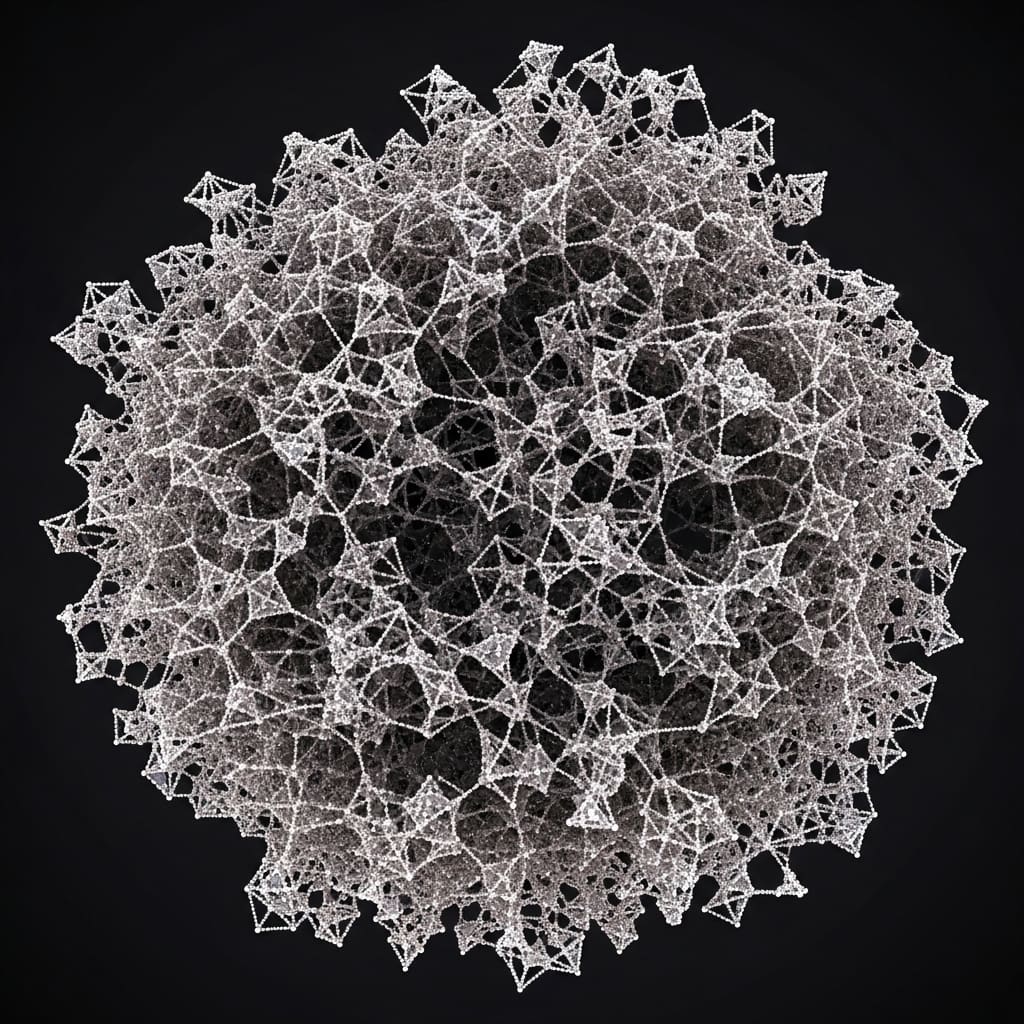
Scientists have long struggled to reliably connect the atomic structure of glasses to their macroscopic properties. Chenyan Wang, Mouyang Cheng, and Ji Chen, all from the School of Physics at Peking University, demonstrate a surprisingly simple solution to this complex problem in their new research. They reveal an approximate linear relationship between structural features and the resulting disorder in glass properties, underpinned by first-order perturbation theory. This work is significant because it challenges the recent trend towards increasingly complex machine learning models, proving that a linear approach can achieve high predictive accuracy while retaining crucial physical interpretability across diverse glassy materials. By combining this theoretical framework with a novel regularization analysis, the authors offer a powerful new avenue for understanding and predicting the behaviour of glasses.
Scientists establishing reliable and interpretable structure-property relationships in glasses is a longstanding challenge in condensed matter physics. Modern data-driven machine learning techniques have proven highly effective in establishing structure-property correlations, but many models are criticised for lacking physical interpretability and being task-specific.
In this work, researchers identify an approximate linear relation between structure profiles and disorder-induced responses of glass properties based on first order perturbation theory. They analytically demonstrate that this relation exists.
Predictive modelling of glassy material properties using linear machine learning and structural regularisation
Scientists have established a robust theoretical relationship applicable universally across glassy systems with varying dimensions and distinct interaction types. This robust theoretical relationship motivates the adoption of linear machine learning models, which researchers show numerically to achieve surprisingly high predictive accuracy for structure-property mapping in a wide variety of glassy materials.
They further devise regularization analysis to enhance the interpretability of their model, bridging the gap between predictive performance and physical insight. Overall, this linear relation establishes a simple yet powerful connection between structural disorder and spectral properties in glasses, opening a new avenue for advancing their studies.
In recent years, machine learning methodologies have witnessed a swift and widespread uptake across the breadth of scientific inquiry. Researchers have sought to leverage successful frameworks and methodologies from artificial intelligence to address complex problems across diverse disciplines. For example, in condensed matter physics and related fields, neural network quantum states and wavefunctions, machine learning force fields, and regression models for structure-property relationships have made influential contributions to many advances.
These successful implementations generally rely on two core factors, namely access to large-scale, high-fidelity datasets, or the exceptional representational capacity of modern neural networks. Yet alongside these advances, the community has growing concerns about the black-box nature of state-of-the-art models, which many argue hinders the discovery of new physical insights and principles.
A further unresolved question is whether optimal architectures for different scientific tasks have been identified without overusing advanced algorithms. In this study, researchers focus on the structure-property relationship for glasses. Unraveling the connection between atomic structure and physical properties in such systems has long remained a significant challenge, owing to the inherent complexity of their non-crystalline nature, which renders the development of universal empirical descriptors inherently intractable.
While correlations may be proposed between specific properties and empirical metrics, such as medium-range order parameters, coordination numbers, and packing fractions, these relationships are often weak and could prove unreliable in practice. In recent years, more accurate quantitative structure-property relationships have been established for glassy materials with the aid of machine learning architectures.
For example, unsupervised machine learning algorithms like topological data analysis and autoencoder have been utilized to uncover hidden structural signatures in glass; supervised machine learning like deep convolutional neural networks and graph neural networks are capable of predicting a wide range of electrical, mechanical and thermodynamic properties of glass. However, despite their improved predictive performance, most existing machine learning-based structure-property relationship approaches for glasses still offer limited physical interpretability, providing little direct insight into how specific structural features quantitatively contribute to macroscopic properties.
Building on recent progress, researchers re-examine the structure-property relationship problem in glasses and demonstrate that an approximate linear theoretical relationship can be established between the radial distribution function and the disorder-induced contributions to glassy physical properties. This linear theoretical framework facilitates the development of a simple linear regression machine learning model, which can be efficiently trained to predict structure-property relationships with high accuracy.
They validate the effectiveness of this parsimonious model using amorphous monolayer carbon, periodic Lennard-Jones systems, bulk amorphous SiC, and ternary amorphous CuAlZr alloys, highlighting its advantages over state-of-the-art neural network models. Furthermore, they conduct an interpretability analysis via regularization methods to verify its alignment with fundamental design principles.
Overall, compared to state-of-the-art machine learning models, their linear model not only boasts higher computational efficiency, requires less training data and is less prone to overfitting, but also exhibits superior interpretability. The fundamental distinction between glassy materials and crystalline solids lies in their structural disorder.
Crystalline materials possess long-range ordering, which typically corresponds to the global or stable local minima on the potential energy landscape. In contrast, glasses are disordered and their atomic structures deviate from the local energy minima occupied by the corresponding crystalline materials.
This observation motivates a first-order perturbative description of glassy structures and properties, in which deviations from the crystalline reference are treated explicitly at the leading order. As a direct consequence, structural descriptors and derived physical quantities become expressible as first-order expansions with respect to the atomic displacements, giving rise to explicit linear relations between structure descriptors and properties.
Researchers first consider the perturbation of atomic structures. For each atom i, its glassy coordinate ri is perturbed from the corresponding crystalline reference r(0) i by Δri, such that ri= r(0) i + Δri. To describe the structure of amorphous materials, the radial distribution function g(r) is often employed. g(r) is the radial part of the pair distribution function g(r): g(r) = 1/C ∑ i≠j δ(r −ri+ r j).
Within the first-order perturbation, it can be written as g(r) = g(0) (r) −1/C ∑ i≠j ∂/∂rj δ(r −r(0) i + r(0) j)(Δri−Δr j). This gives a set of linear equations between g(r) and {Δri}, hence a bi-directional linear mapping between g(r) and spatial deviations exists. For the property descriptor, they take the vibrational spectra as an example.
The aperiodicity of amorphous materials compresses the momentum space information to the origin of the Brillouin zone. Hence the dynamic matrix that describes the phonon features is directly proportional to the Hessian matrix, and the phonon density of states is calculated as: D(ω) = ∑ n δ(ω−ωn). ωn are phonon frequencies derived from the eigenvalues λn= ω2 nof the Hessian matrix, given by Hij= ∂2U/∂ri∂r j.
Perturbations of Δλn affect ωn, which further transfers to D(ω): D(ω) = D(0) (ω) − ∑ n d/dωδ(ω−ω(0) n) 1/2ω(0) n Δλn. Meanwhile, researchers show that a linear mapping exists between λn and structural perturbations Δrk. To derive this relation, they inspect the modulation of the structural disorder to the Hessian matrix is defined as: Hij= H(0) ij+ ∑ k ΦijkΔrk, where Φijk= ∂Hij/∂rk denotes the third-order force constant that introduces anharmonic effects.
This relation demonstrates that structural disorder Δrk perturbs the Hessian matrix elements, with the magnitude of perturbation directly linked to anharmonicity. To proceed with the derivation, they further assume that the displacement vectors Δrifor distinct atoms are independent Gaussian random variables, Δri∼N (0, σ2 r), with the purpose of enabling a quantitative estimate of the resulting eigenvalue variations.
Under this assumption, the induced Hessian perturbation ΔHij= Ín|ΔH|n⟩and |n⟩is the n-th eigenvector of the Hessian matrix H(0). Given ΔHij∝Δrk, they reach the conclusion that the change of each eigenvalue λnis approximately a linear transformation of the atomic coordinate perturbations Δrk. Finally, they establish linear approximations all the way from RDF g(r) to the PDOS D(ω).
Notably, this linear approximation is independent of the specific form of the interatomic potential and applies broadly to glassy systems across different spatial dimensions. Leveraging the insights gleaned from their linear approximation framework, researchers formulate a simple linear structure-property relationship framework for glass.
They consider a broad class of amorphous materials, ranging from unary amorphous monolayers to binary and ternary bulk glasses and high-entropy alloys, encompassing structural configurations that span from crystalline order to fully amorphous disorder. While atomic coordinates provide a complete representation of the structure, they reside in a 3N-dimensional space and are therefore unsuitable for direct learning or interpretation.
Motivated by the linear approximation framework developed in the previous section, they instead adopt a compact yet physically meaningful descriptor, the RDF g(r) as the structural descriptor of glass. g(r) captures two-body correlations that are robust across amorphous systems, while remaining scalable with system size and invariant under global translations, rotations, and permutations of identical atoms, making it an ideal input descriptor for machine learning-based property prediction. Within this framework, they formulate a simple linear structure-property relationship model of the form y = Wθg + bθ.
Here g denotes the vectorized RDF, constructed by discretizing RDF g(r) over radial bins and serving as the input structural feature; the output y represents the predicted property feature, which may correspond to a scalar quantity or a vectorized, symmetry-invariant representation of a physical observable. The parameters Wθ and bθ are learnable weight and bias parameters shared across all structures.
Linearity of structural disorder effects on glassy system properties
First-order perturbation theory reveals an approximate linear relation between structural profiles and disorder-induced responses of glass properties. This relationship was analytically demonstrated to hold universally across glassy systems irrespective of dimensionality or interaction type. The work motivates the adoption of linear machine learning models for structure-property mapping, achieving surprisingly high predictive accuracy across a variety of glassy materials.
The research establishes that eigenvalue shifts induced by structural disorder are uniformly controlled, rigorously justifying the application of first-order perturbation theory to the phonon spectrum. Within this framework, the eigenvalues of the Hessian matrix are expressed as λn = λ(0)n + Δλn, where Δλn is approximately a linear transformation of the atomic coordinate perturbations.
This linear approximation extends from the radial distribution function, g(r), to the phonon density of states, D(ω), and is independent of the specific interatomic potential. A linear structure-property relation was formulated, mapping the vectorized RDF g(r) to target property features, y, using the equation y = Wθg + bθ.
The model was tested on amorphous monolayer carbon, periodic Lennard-Jones systems, bulk amorphous silicon carbide, and a ternary amorphous CuAlZr alloy, representing a diverse range of compositions and potentials. These systems collectively demonstrate a universal linear SPR, where phonon properties are linearly mapped from the radial distribution function of amorphous materials. The study highlights that small structural variations induce linear responses in the Hessian eigenvalues, leading to smooth changes in associated eigenvectors.
Predictive links between glass structure and thermal properties via machine learning
Scientists have established a universal linear relationship between the structural profiles of glasses and their disorder-induced properties. This connection, derived using first-order perturbation theory, applies to glassy systems irrespective of dimensionality or the nature of atomic interactions. Numerical experiments across diverse glassy materials, including amorphous monolayer carbon, periodic Lennard-Jones systems, amorphous silicon carbide, and a copper-aluminium-zirconium alloy, validate this linear structure-property relationship.
The research demonstrates that a simple linear machine learning model can accurately predict properties like thermal conductivity and spectral characteristics from the radial distribution function, a low-dimensional structural descriptor. Furthermore, a regularization analysis was developed to improve the interpretability of the model, effectively linking predictive accuracy with physical understanding.
While the models perform well, the authors acknowledge that the accuracy relies on the smoothness of property changes related to the Hessian spectrum, potentially limiting its application to systems with abrupt transitions. Future work could explore extending this framework to more complex systems and incorporating additional structural descriptors to further refine predictive capabilities and physical insight.
🗞 Beyond overcomplication: a linear model suffices to decode hidden structure-property relationships in glasses
🧠 ArXiv: https://arxiv.org/abs/2602.05313