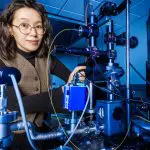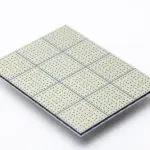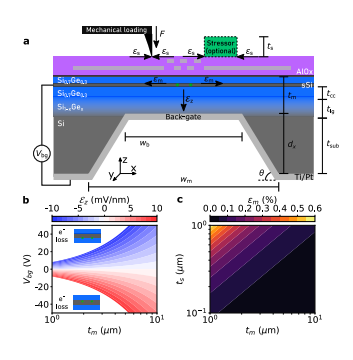
Silicon-germanium heterostructures hold considerable promise for building the high-performance quantum computers of the future, relying on the properties of electron spin qubits, but realising a scalable processor requires precise control over these qubits’ behaviour. Lucas Marcogliese, Ouviyan Sabapathy, and colleagues at the JARA-FIT Institute for Quantum Information and the Universities of Regensburg and Aachen, now demonstrate a new approach to manipulating these qubits by fabricating ultra-thin, suspended silicon-germanium membranes. This innovative platform allows researchers to finely tune the strain and electric fields experienced by the qubits, potentially enhancing their performance and enabling detailed investigation of the factors limiting their coherence. By creating these flexible membranes and carefully measuring their mechanical response, the team establishes a versatile system for future experiments aimed at mapping the complex landscape of valley splitting, a crucial property for controlling and interconnecting spin qubits in a quantum processor.
Building a scalable quantum processor, however, requires further improvements in critical material properties, particularly the landscape of valley splitting. Researchers believe that precise control of strain and electric fields is crucial for enhancing valley splitting, even in the presence of material imperfections. These silicon-germanium membranes offer a versatile platform for investigating how electrons scatter between different energy valleys, a phenomenon that has remained elusive in conventional structures and holds the key to optimizing qubit performance.
Silicon Quantum Dots and Valley Splitting Control
This research details a comprehensive exploration of silicon and silicon-germanium materials, focusing on their potential for quantum computing and advanced device fabrication. A central theme is manipulating valley splitting in silicon-germanium quantum dots to create qubits, aiming for high valley splitting to minimize decoherence. Achieving this requires extremely high-quality materials and precise fabrication control, including isotope purification to minimize disturbances. Understanding and controlling the g-factor, a property influencing electron spin, is also vital for qubit manipulation. Finite element analysis is used to model the mechanical behaviour of these structures, accounting for silicon’s anisotropic properties and the importance of managing stress and strain to prevent cracking.
Precise Silicon-Germanium Membranes for Advanced Qubits
Researchers have successfully fabricated suspended silicon-germanium membranes with precise control over their geometry, opening new avenues for advanced qubit research. These membranes, created on silicon substrates, are designed to host electron spin qubits and offer a platform for investigating their behaviour with unprecedented accuracy. The team developed a detailed model to predict and control the etching process, accounting for variations in etch rate due to the membrane’s geometry and composition. This model accurately predicts membrane thickness, achieving control within the micrometer range, and allows for precise tailoring of dimensions. Characterization using spectroscopic ellipsometry confirms the accuracy of the fabrication process, and optical microscopy reveals the successful creation of large-area membranes. These advancements are significant because they enable the creation of devices where strain can be precisely coupled to spin qubits, and allow for more complex device designs and investigation of subtle effects on qubit behaviour.
Etch Control Defines Silicon-Germanium Membrane Geometry
The research successfully demonstrates precise control over the etching process used to create suspended silicon-germanium membranes, crucial for fabricating advanced electron spin qubits. By carefully managing the etch rate, the team achieved micrometer-level accuracy in controlling membrane thickness and width. The study reveals that the etch rate is influenced by both the depth of the etching process and the germanium concentration within the silicon-germanium alloy, allowing for a refined model to predict and control the membrane geometry. This level of control enables the creation of membranes with specific geometries, paving the way for future experiments focused on mapping valley splitting in spin qubits.
🗞 Fabrication, characterization and mechanical loading of Si/SiGe membranes for spin qubit devices
🧠 ArXiv: https://arxiv.org/abs/2508.14589