Magnetometry stands to benefit enormously from increasingly sensitive force measurements, with potential applications spanning diverse fields from biomedical imaging to resource exploration. Fernando Gottardo, Banjamin J. Carey, and Nathaniel Bawden, working at The University of Queensland and associated research centres, have overcome a significant obstacle in this area by developing a new silicon-photonic optomechanical magnetometer. This innovative device integrates optomechanical principles with silicon photonics, achieving a magnetic field sensitivity of 800 pT Hz-1/2, a three-fold improvement over existing integrated designs. The team, which also includes Glen I. Harris from Griffith University and Queensland University of Technology, alongside Hamish Greenall and Erick Romero, achieves this breakthrough through a novel fabrication process that allows for high-quality metallisation of nanoscale mechanical structures, paving the way for high-performance, room temperature, and fully chip-integrated magnetometers.
Silicon Photonics and Optomechanical Resonators
This research explores highly sensitive sensors leveraging optomechanics and magnetostriction, developing innovative platforms using silicon photonics to integrate light-based components onto silicon chips. Key to this work are photonic crystal cavities and Fabry-Perot microcavities, structures designed to enhance light-matter interaction and create highly sensitive resonators. Researchers are also investigating double-disk resonators fabricated on silicon-on-insulator substrates, employing techniques like vacuum packaging and nanogetters to minimise noise and improve resonator performance. This research aims to create compact, integrated sensors for diverse applications, including biomedical sensing, environmental monitoring, and fundamental physics research.
Embedded Support for Nanoscale Optomechanical Magnetometers
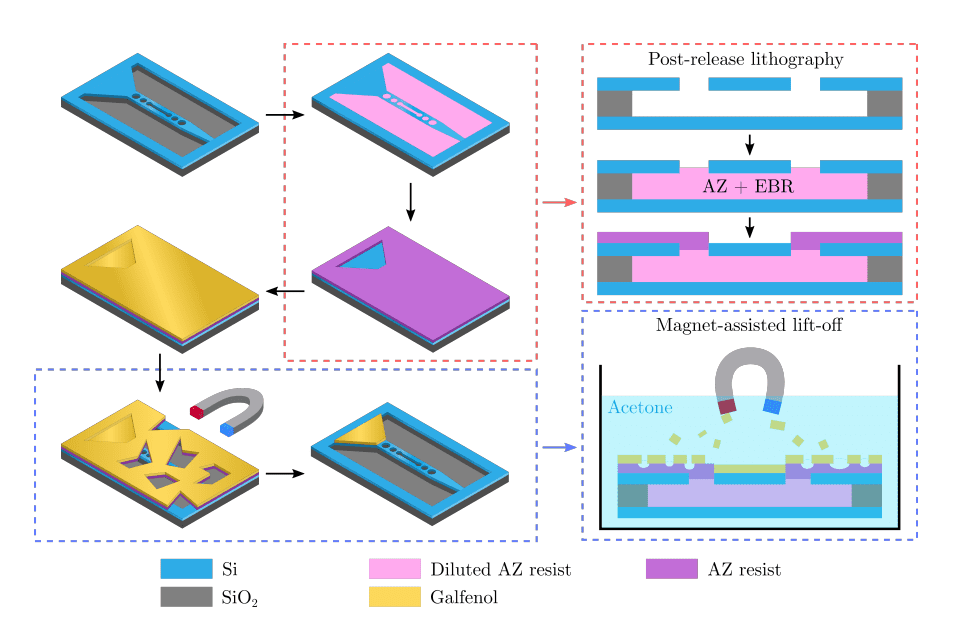
Scientists have engineered a novel fabrication process to create high-performance optomechanical magnetometers on silicon-on-insulator chips, overcoming a key barrier to integrating these sensors with photonic circuits. The fragility of nanoscale mechanical structures during post-fabrication processing was addressed by embedding and supporting released devices within partially solidified photoresist. Careful dilution of the photoresist allowed gentle spin coating without damaging the delicate structures, followed by curing and reinforcement to provide sufficient support for standard photolithography, enabling precise deposition of magnetostrictive material. The process begins with patterning an SOI chip using electron beam lithography and etching, followed by releasing the mechanical structures using HF vapour-phase etching. A magnetically assisted lift-off procedure, submerging the chip in acetone with a positioned magnet, avoids damaging the released structures. Characterisation revealed the material’s effectiveness in transducing magnetic fields into mechanical motion, achieving a magnetic field sensitivity three orders of magnitude beyond previous waveguide-integrated designs.
Integrated Optomechanics Boosts Magnetometry Sensitivity
Researchers have achieved a significant breakthrough in optomechanical magnetometry, developing silicon-on-insulator devices that demonstrate exceptionally sensitive force measurements. The study successfully addresses the incompatibility between chip-scale fabrication and the integration of functional magnetic films, with a novel post-release lithography process enabling high-quality metallisation of released mechanical structures. The resulting devices exhibit a magnetic field sensitivity of 800 picotesla per root Hertz, representing an improvement of three orders of magnitude over previously developed waveguide-integrated designs. This heightened sensitivity stems from the incorporation of photonic-crystal cavities, which enhance motion-to-optical signal transduction by more than tenfold. While currently less sensitive than non-waveguide-integrated counterparts, strategies are in place to overcome this deficit, including modifying the crystal design or increasing mechanical coupling to reduce thermomechanical noise. Employing materials with higher piezomagnetic coefficients could further improve sensitivity by a factor exceeding 45, potentially reaching 17 picotesla per root Hertz.
Chip Magnetometry Surpasses Noise Limits
This research demonstrates a significant advance in chip-scale magnetometry through the development of silicon-on-insulator optomechanical sensors. By successfully integrating magnetic films with silicon-on-insulator fabrication, the team achieved magnetic field sensitivity of 800 pT Hz -1/2, exceeding the performance of previously reported on-chip designs by three orders of magnitude. This improvement stems from enhanced optomechanical coupling, which effectively suppresses optical noise and allows the sensors to operate with greater sensitivity. The researchers highlight that the limiting factor in performance is now thermomechanical noise, a challenge that can be addressed through structural optimisation. The transition to a silicon-on-insulator platform opens possibilities for broader application, as the sensors are no longer limited by optical noise across the spectrum.
👉 More information
🗞 Silicon-photonic optomechanical magnetometer
🧠 ArXiv: https://arxiv.org/abs/2511.07852