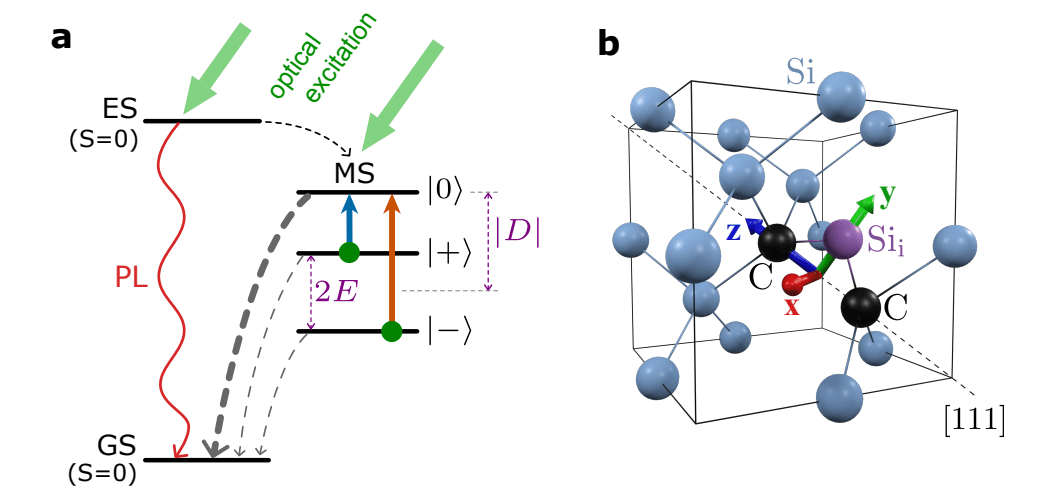
The microscopic world often obscures individual atomic motion within larger systems, but researchers are now able to observe the behaviour of a single tumbling electron spin within silicon. Félix Cache, Yoann Baron, and Baptiste Lefaucher, alongside Jean-Baptiste Jager, Frédéric Mazen, and Frédéric Milési, have achieved a breakthrough in spin spectroscopy, allowing them to track the reorientation of a fluorescent defect known as the G center. This achievement overcomes limitations of previous methods, which required vast ensembles of spins or focused only on static systems, and reveals a surprisingly complex magnetic structure arising from the defect’s random tumbling within the silicon crystal. By linking spin orientation to detectable changes in microwave fields, the team demonstrates a new level of control and understanding of the interplay between optical, spin, and rotational properties at the atomic scale, opening possibilities for advanced quantum technologies.
SiV Centers in Silicon for Quantum Qubits
Researchers are actively investigating silicon-vacancy (SiV) color centers in silicon as promising building blocks for future quantum technologies, spanning materials science, physics, and engineering. Scientists are exploring techniques to create these centers, including ion implantation and high-temperature processing, striving for high densities with precisely controlled characteristics. The quality of the silicon itself is paramount, with studies demonstrating the benefits of using isotopically purified silicon to minimize disruptions and improve performance. Strain engineering plays a crucial role in tuning the optical properties of SiV centers, allowing scientists to adjust their emission wavelength and maintain coherence.
This tuning can be achieved through methods like growing silicon on mismatched substrates or applying external pressure. Extending the coherence times of SiV qubits is a major goal, as this is essential for performing complex quantum computations; factors like nuclear spins and external noise are carefully considered and mitigated. Scientists are developing methods to reliably initialize SiV centers into well-defined quantum states, a necessary step for performing quantum operations. Controlling the spin state of these centers is crucial for implementing qubits, and researchers are utilizing microwave fields, optical pulses, and magnetic fields to manipulate these spins.
Integrating SiV centers with waveguides and photonic structures is vital for creating scalable quantum devices, allowing for efficient coupling of light to and from the qubits. A significant challenge lies in developing scalable architectures for SiV-based quantum computers, requiring methods to create and control large numbers of qubits. Researchers are also exploring combining SiV centers with other quantum systems, such as superconducting circuits, to leverage the strengths of different technologies. Theoretical studies, utilizing methods like density functional theory, are used to understand the electronic structure and optical properties of SiV centers, while simulations model the dynamics of these qubits and optimize control sequences. The telecom-band emission, relatively long coherence times, and ability to tune their properties through strain make SiV centers particularly attractive for quantum communication and computation. This research demonstrates significant progress in understanding and controlling SiV color centers, paving the way for the development of practical quantum technologies.
Single-Spin Detection via Silicon Photonic Cavities
Scientists have pioneered a new approach to electron spin resonance spectroscopy, achieving the detection of individual electron spins and revealing atomic motion previously hidden within an ensemble. This work overcomes the limitations of conventional methods by focusing on a fluorescent defect in silicon known as the G center, which behaves as a pseudo-molecule randomly reorienting within the crystal lattice. The team integrated individual G centers within silicon photonic micro-cavities, fabricated using Bragg grating techniques, to enhance signal collection and enable precise measurements. Researchers employed high-resolution pulse optical detection of magnetic resonance (ODMR) spectroscopy, linking electron spin states to optical emission, to investigate the magnetic structure of the G center.
Experiments revealed a fine structure in the magnetic resonance signal, demonstrating that the spin principal axes jump between discrete orientations within the crystal, a phenomenon termed “spin tumbling. ” To interpret these observations, the team developed a detailed model of the G center’s atomic reorientation, based on its unique structure resembling a water molecule trapped within the silicon crystal lattice. By quantitatively analyzing the transition-dependent Rabi frequencies observed in coherent spin control experiments, scientists determined that spin tumbling induces variations in the coupling to the microwave magnetic field, providing insights into the atomic arrangement of the G center. This innovative methodology allows for the investigation of the interplay between optical, spin, and rotational properties in a versatile material, opening new avenues for silicon-based quantum technologies.
G Center Reveals Dynamic Spin Reorientation
Scientists have achieved single-spin spectroscopy of a silicon defect, known as the G center, revealing its unique behavior as a pseudo-molecule randomly reorienting within the crystal lattice. This work demonstrates high-resolution spin spectroscopy, uncovering a fine magnetic structure resulting from the defect’s spin principal axes jumping between discrete orientations. Experiments reveal that the tumbling motion induces variations in coupling to microwave magnetic fields, allowing the team to detect position-dependent Rabi frequencies during coherent spin control. The team integrated single G centers within circular Bragg grating cavities to enhance emission rates and collection efficiency, boosting the zero-phonon line signal compared to isolated defects.
Measurements confirm exceptional crystal quality around the defect. Crucially, the researchers demonstrated nearly perfect single-photon emission, confirming the presence of a single emitter within the cavity. Further investigations into the G center’s spin coherence properties revealed distinct spin transitions and fine structure within the ODMR spectrum. Rabi oscillations were performed, and Ramsey fringes demonstrated coherence times. High-resolution ODMR spectra confirmed the presence of multiple spin transitions, providing detailed information about the atomic arrangement of the G center within the silicon lattice. These results demonstrate a new level of control and understanding of individual spin states in a solid-state system, opening possibilities for advanced quantum technologies.
👉 More information
🗞 A single optically detectable tumbling spin in silicon
🧠 ArXiv: https://arxiv.org/abs/2510.15590