

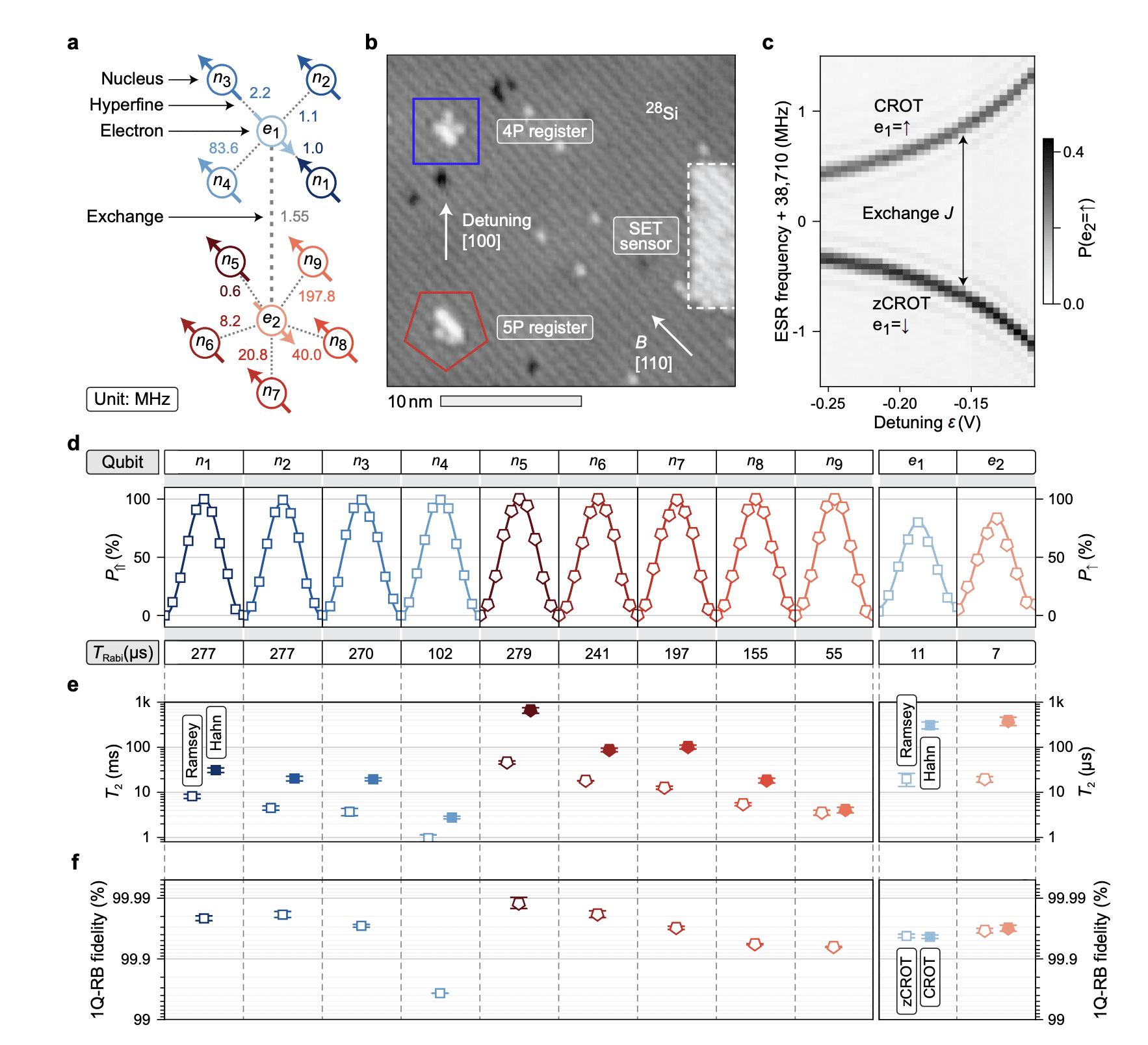
Researchers fabricated an 11-qubit processor using phosphorus atoms in silicon, linking two multi-qubit registers via electron exchange. They demonstrated coherent coupling with fidelities between 99.5% and 99.99%, verified all-to-all connectivity via Bell and Greenberger-Horne-Zeilinger states, and achieved a key step towards fault-tolerant quantum computation.
The pursuit of scalable quantum computation necessitates both robust qubits and the ability to interconnect them with high precision. Recent work demonstrates a significant advance in this field, utilising the nuclear spins of phosphorus atoms embedded within silicon as qubits. These spins exhibit exceptionally long coherence – the time for which quantum information is preserved – exceeding several seconds. Researchers from Silicon Quantum Computing Pty Ltd and UNSW Sydney, led by Michelle Y. Simmons, have fabricated and controlled an 11-qubit processor based on this technology. Their findings, detailed in the article ‘An 11-qubit atom processor in silicon’, showcase coherent coupling between these nuclear spins, achieving single- and multi-qubit gate fidelities ranging from 99.5% to 99.99%. The team verified all-to-all connectivity and generated complex entangled states, representing a key step towards building larger, fault-tolerant quantum computers.
Eleven-Qubit Processor Achieves High-Fidelity Control and Entanglement
Phosphorus atoms implanted in silicon represent a compelling platform for quantum computation, owing to the extended coherence times exhibited by the nuclear spins of the phosphorus atoms. Researchers have now constructed and demonstrated a fully controlled 11-qubit processor utilising two multi-nuclear spin registers interconnected via electron exchange interactions.
The processor exploits the hyperfine interaction – a subtle coupling between the nuclear spin of the phosphorus atom and the spin of a shared electron – to achieve multi-qubit control. This allows for coherent manipulation and entanglement across all 11 qubits, with single- and two-qubit gate fidelities ranging from 99.5% to 99.99%. Fidelity, in this context, represents the accuracy of a quantum operation.
The team successfully prepared both local and non-local Bell states – maximally entangled states of two qubits – achieving record state fidelities exceeding 99%. This confirms efficient ‘all-to-all’ connectivity, meaning any qubit can directly interact with any other. Further demonstrating the system’s capabilities, researchers generated Greenberger-Horne-Zeilinger (GHZ) states – entangled states involving all 11 data qubits. GHZ states are particularly sensitive to decoherence and their successful creation indicates a robust and well-controlled system.
Supplementary data details the optimisation of key parameters, including Rabi frequencies – the rate at which qubits oscillate under the influence of control pulses – for controlled-rotation (CROt) gates. The implementation of phase error compensation techniques during two-qubit randomised benchmarking further enhances performance.
This level of precision is crucial for implementing complex quantum algorithms and, importantly, for realising error correction schemes – essential for building fault-tolerant quantum computers. The demonstration of robust entanglement and high-fidelity gate operations represents a significant advance towards building larger, more complex quantum computers capable of addressing problems currently beyond the reach of classical computation. The validation of calibration and control protocols confirms their effectiveness in maintaining high performance across interconnected registers.
👉 More information
🗞 An 11-qubit atom processor in silicon
🧠 DOI: https://doi.org/10.48550/arXiv.2506.03567


