

Programmable photonics represents a powerful approach to building optical circuits directly onto chips, allowing for flexible control of light and the implementation of complex functions. Jacek Gosciniak from the Institute of Microelectronics and Optoelectronics, Warsaw University of Technology, and colleagues demonstrate a new architecture for these circuits based on shifted rectangular waveguide meshes. Current designs rely on hexagonal meshes, which limit both the precision and bandwidth of optical signals, but this innovative approach uses rectangular cells with fewer components, offering improved spectral and temporal resolution. By strategically shifting the arrangement of these cells, the researchers unlock greater control over light routing and create opportunities for advancements in areas such as topological photonics, quantum information processing, and high-speed optical communications.
Reconfigurable Photonic Meshes for Signal Processing
This research details advancements in programmable photonic meshes for signal processing, particularly focusing on filter design and integrated power monitoring. Photonic meshes, interconnected networks of optical components, create programmable optical circuits, allowing dynamic control over light signals for complex tasks. Scientists are developing universal building blocks to create these versatile meshes, enabling circuits that can perform various functions, like filtering, without physical hardware changes. The research highlights the use of these meshes for designing optical filters, dynamically tuned to select specific wavelengths or frequencies of light, with potential applications in artificial intelligence, neuromorphic computing, quantum computing, and various communication and sensing applications.
A key innovation is the development of integrated power monitoring systems within the photonic mesh itself, crucial for self-configuration, calibration, and closed-loop control, enabling real-time feedback and dynamic optimization. The research explores several approaches to integrated power monitoring, including transparent photoconductors, which become conductive when exposed to light, and photothermal plasmonic sensors, utilizing heat generated by light absorption to detect power levels. Wheatstone bridges, implemented within the waveguide, measure resistance changes due to light-induced effects, and transparent conductive oxides are highlighted as materials for these sensors, offering low loss and compatibility with silicon photonics. This architecture offers reconfigurability, allowing dynamic function changes without physical modifications, and integration of the power monitoring system for self-calibration and closed-loop control. The modular design enables building complex circuits with numerous components, and photonic circuits potentially consume less power than traditional electronic circuits. Future research focuses on improving power monitoring sensitivity and accuracy, developing sophisticated self-configuration algorithms, exploring new materials, and demonstrating complex AI and quantum computing systems based on these technologies.
Rectangular Photonic Meshes Unlock Broadband Signal Processing
Scientists pioneered a new architecture for programmable photonic circuits, shifting from traditional hexagonal waveguide meshes to rectangular designs to overcome limitations in spectral and temporal resolution. Existing hexagonal meshes, constrained by their six-component elementary cells, restrict the processing of broadband signals and high-precision delay lines, prompting this innovative approach. The new rectangular mesh utilizes tunable basic units, reducing the number of components per cell to four while enabling signal redirection to the input port, a feature absent in standard square meshes. This method involves fabricating waveguide meshes where adjacent columns or rows are intentionally offset, creating a unique configuration that unlocks enhanced tunability.
Researchers engineered these rectangular cells to manipulate light paths with greater precision, allowing for more complex optical circuits to be implemented on a single chip. The chip’s architecture supports the creation of circuits with optical feedback and linear multiport transformations, achieved through precise programming of resources and selection of input/output ports. Experiments employed a fabrication process to create these shifted rectangular meshes, carefully controlling the offset between columns or rows to optimize performance. The resulting circuits demonstrate the ability to process signals with greater bandwidth and achieve finer control over signal timing, crucial for advanced applications. This approach enables the development of circuits for topological photonics, quantum information processing, neuromorphic computing, and high-speed optical communications.
Rectangular Meshes Boost Photonic Processor Performance
Scientists have developed a new architecture for programmable photonic processors, utilizing shifted rectangular waveguide meshes that significantly enhance performance compared to existing designs. The core advancement lies in a redesigned mesh cell, reducing the number of tunable basic units from six, as found in conventional hexagonal meshes, to just four. This reduction directly translates to a shorter optical path length, minimizing optical insertion losses and enabling the creation of filters with larger free spectral ranges. The team’s innovative approach involves shifting adjacent columns or rows within the rectangular mesh by half the length of a basic unit.
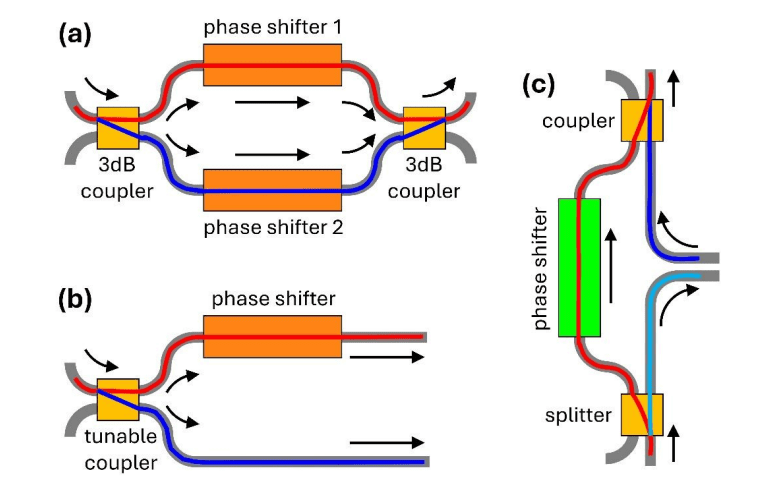
This adjustment unlocks crucial functionality previously limited to hexagonal meshes, the ability to utilize all ports as both inputs and outputs. The resulting architecture achieves a more efficient three-point interconnection scheme, improving signal routing compared to standard rectangular meshes which require four interconnection points. This new design allows for the creation of photonic processors with enhanced capabilities in areas requiring broadband operation and high-speed processing. Researchers demonstrate that by minimizing the number of tunable basic units, they can synthesize large free spectral range filters, critical for applications demanding precise spectral control. The core building block of this system is a programmable unit cell constructed from these tunable basic units, and the team has successfully implemented various configurations utilizing balanced Mach-Zehnder interferometers and tunable couplers as the core variable beam splitters within the mesh.
This work presents a novel shifted rectangular mesh architecture for programmable photonic processors, representing an advancement in the field of integrated optics. Researchers successfully demonstrated a design that reduces the size of the fundamental unit cell and achieves a higher free spectral range compared to currently available hexagonal mesh designs. This innovative geometry unlocks additional flexibility in circuit design, enabling enhanced control over both spectral and temporal characteristics of light. The team’s approach allows for the creation of compact, reconfigurable circuits with the potential for optical feedback and complex signal processing. This design offers a promising pathway towards more versatile photonic processors suitable for a range of applications, including topological photonics, quantum information processing, neuromorphic computing, and high-speed optical computation.
👉 More information
🗞 Shifted rectangular mesh architecture for programmable photonics
🧠 ArXiv: https://arxiv.org/abs/2510.17307


